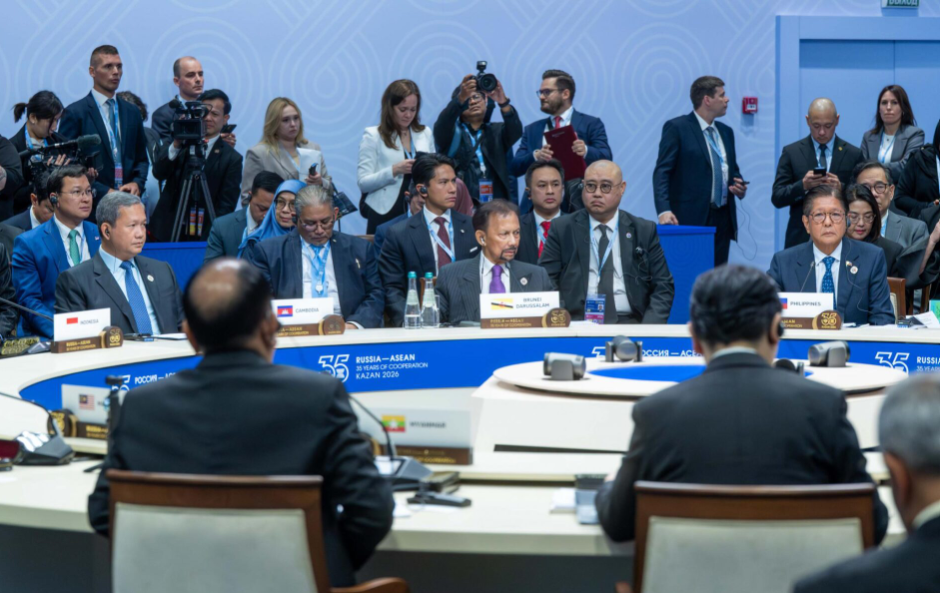
Brunei's Sultan Hassanal Bolkiah has underscored the strategic importance of bolstering ties between Southeast Asia and Russia, speaking at a landmark commemorate summit held in Kazan on Thursday. The gathering, convened at the Kazan Expo International Exhibition Centre, brought together Asean leaders and Russian President Vladimir Putin to reaffirm commitments made during three and a half decades of formal dialogue partnership. The Sultan, who travelled to the Russian city alongside his Minister of Foreign Affairs Prince 'Abdul Mateen, expressed gratitude for Putin's reception and praised the hospitality extended by the local Tatarstan authorities and Kazan residents.
The occasion marked a significant milestone in relations between the ten-nation bloc and Moscow. Since establishing its dialogue partnership framework in 1989, Asean and Russia have cultivated a relationship that has proven surprisingly resilient despite the dramatic shifts in the global political landscape. The Sultan's remarks acknowledged this durability, noting that cooperation has expanded substantially across the full spectrum of Asean Community pillars—encompassing political-security matters, economic integration, and socio-cultural initiatives. This breadth of engagement reflects a relationship that extends far beyond ceremonial diplomacy, touching directly on concerns that affect millions of people across both regions.
During his address, the Sultan also conveyed expressions of sympathy to Thailand's Prime Minister Anutin Charnvirakul regarding the death of Princess Bajrakitiyabha of Thailand, a gesture reflecting the personal bonds and mutual respect that characterize relations among regional leaders. Such moments underscore how Asean's cohesion and collective voice depend on these interpersonal connections alongside formal institutional frameworks.
Looking ahead to Asean Vision 2045, the Sultan articulated a compelling case for sustained Russian engagement in addressing transnational challenges. The geopolitical environment has grown markedly more complex and fragmented since the launch of Vision 2030, with escalating regional tensions, deepening economic divisions between major powers, the acceleration of climate-related crises, and the disruptive potential of emerging technologies. These interconnected pressures demand that regional organizations like Asean cultivate partnerships with major powers capable of contributing meaningfully to solutions. Russia's position as an energy superpower and a significant player in Eurasia makes it a natural partner for initiatives spanning energy security, food production, and technological innovation.
The Sultan identified specific domains where Asean-Russia collaboration could yield tangible dividends. Energy cooperation stands out as particularly relevant for Southeast Asia, where rapid economic growth and industrialization are driving surging demand for reliable power sources. Food security emerged as another priority, reflecting vulnerability across the region to supply disruptions and price volatility. Climate action and disaster management represent areas where shared scientific expertise and coordinated policy responses can multiply impact. Beyond these material concerns, addressing non-traditional security threats—from cybercrime and maritime piracy to trafficking and pandemic preparedness—requires the kind of sustained dialogue and intelligence-sharing that institutional partnerships facilitate.
Capital development and human resource investment featured prominently in the Sultan's vision for deepening ties. He emphasized that educational exchanges, training initiatives, and professional development programmes create lasting networks among young professionals and officials from both sides. These investments in human capital generate familiarity and mutual understanding that transcend official channels, building constituencies for continued cooperation across generations. Such initiatives prove particularly valuable given the technological disruptions reshaping labour markets globally; equipping Southeast Asia's youth with skills relevant to both regional and global economies requires learning from diverse partners including Russia.
The Kazan Declaration 2026 and accompanying strategic documents represent the culmination of working-level consultations conducted in the months preceding the summit. The Comprehensive Plan of Action covering 2026 to 2030 establishes concrete benchmarks and initiatives for the coming five-year period, moving beyond aspirational rhetoric toward actionable commitments. Separate joint statements addressing energy cooperation and cultural exchange indicate that the relationship encompasses both pragmatic economic and strategic interests alongside the softer dimensions of people-to-people connectivity.
The second plenary session, organised as a working lunch and centred on integration processes unfolding across Eurasia, highlighted the multilayered regional architecture in which both Asean and Russia operate. Contributions from the Asean Secretary-General, the Shanghai Cooperation Organisation's top official, and the Eurasian Economic Commission's leadership reflected the dense network of overlapping regional organisations that now characterise geopolitical engagement across Asia. For Malaysia and other Asean members, understanding these parallel integration efforts is crucial for navigating an increasingly multipolar world.
Parallel business engagement, demonstrated through the Asean-Russia Business Forum convened the preceding day, underscores that deepening state-to-state relations require corresponding momentum in the private sector. Companies and investors from both regions seek clarity and predictability for cross-border transactions, supply chain arrangements, and joint ventures. The forum's outputs signal to market participants that governments view mutual investment and commercial ties as strategic priorities rather than secondary concerns.
For Malaysia specifically, the enhanced Asean-Russia framework carries implications extending beyond ceremonial protocol. As Malaysia pursues its own strategic autonomy and seeks diversified partnerships beyond traditional Western alignments, the Asean-Russia relationship provides a model for balanced engagement with major powers. Thailand, Vietnam, and other regional nations face similar calculations. The Sultan's emphasis on peaceful resolution of disputes and respect for sovereignty reflects Asean's longstanding position that smaller states can enhance security through strategic partnerships rather than alignment with any single power bloc.
The outcome of this summit also signals to observers that despite US-led efforts to isolate Russia internationally, meaningful multilateral platforms continue functioning. Asean's consistent adherence to non-alignment and its maintenance of dialogue with all major powers—a principle enshrined in its charter—demonstrates why the bloc remains invaluable as a balancing force. Russia's sustained engagement with Asean reaffirms that attempting to exclude major powers from regional organisations ultimately proves counterproductive for regional stability.
Moving forward, the commitments made in Kazan require sustained attention from both bureaucratic machinery and political leadership. Implementation of the 2026-2030 action plan will test whether governments prioritise these stated objectives when competing demands arise. Malaysia and fellow Asean states should view this relationship not as a zero-sum proposition relative to ties with Western partners or China, but rather as part of a diversified diplomatic portfolio that enhances regional agency and prosperity.

%22%2F%3E%3C%2Fpattern%3E%3C%2Fdefs%3E%3Crect%20width%3D%22100%25%22%20height%3D%22100%25%22%20fill%3D%22url(%23ph523ndg)%22%2F%3E%3Crect%20width%3D%22100%25%22%20height%3D%22100%25%22%20fill%3D%22url(%23ph523ndp)%22%2F%3E%3Ctext%20x%3D%2250%25%22%20y%3D%2250%25%22%20text-anchor%3D%22middle%22%20dominant-baseline%3D%22central%22%20fill%3D%22rgba(255%2C255%2C255%2C0.95)%22%20font-family%3D%22Georgia%2C%20'Times%20New%20Roman'%2C%20serif%22%20font-weight%3D%22700%22%20font-size%3D%22272%22%20letter-spacing%3D%22-0.02em%22%3EAnwar%3C%2Ftext%3E%3C%2Fsvg%3E)