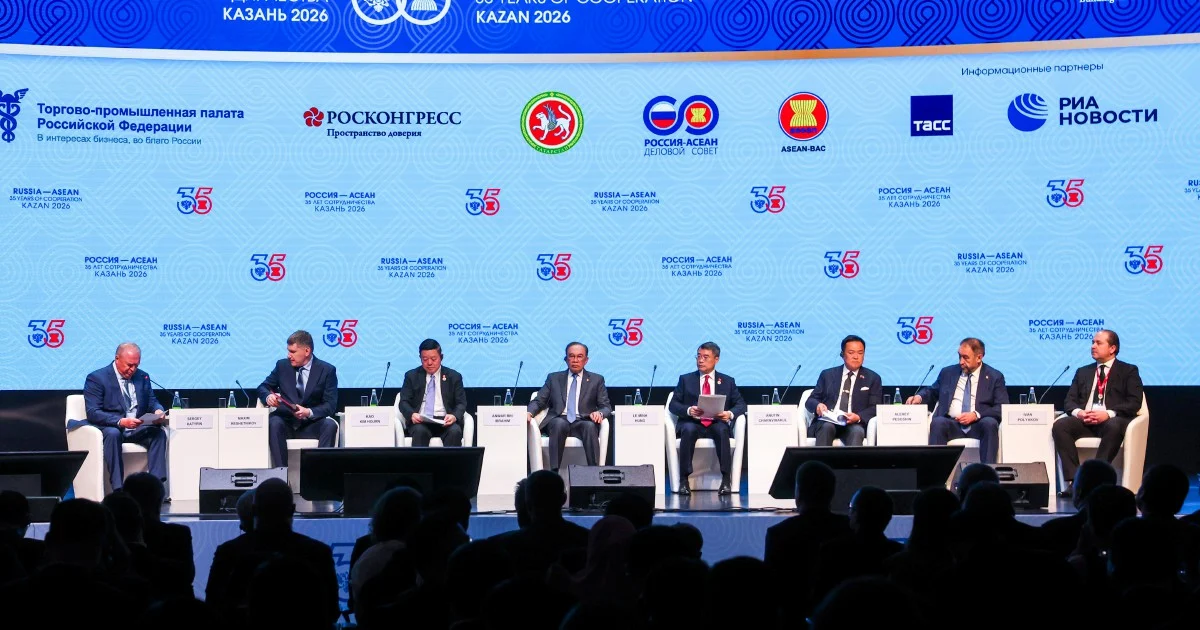
Prime Minister Datuk Seri Anwar Ibrahim has called for a significant expansion of multilateral engagement between the Association of Southeast Asian Nations and Russia, arguing that deeper partnerships across several critical sectors would benefit both regions. Speaking from Kazan, Malaysia's leader articulated a vision for cooperation that extends well beyond traditional diplomatic channels to encompass the practical economic challenges confronting policymakers across the Indo-Pacific and Eastern Europe.
Food security emerged as a primary concern in Anwar's remarks, reflecting growing anxieties among Asean member states about supply chain vulnerabilities and agricultural sustainability. Southeast Asia, despite its substantial agricultural output, faces mounting pressure from climate change, rapidly expanding urban populations, and competing land use demands. Russia, conversely, holds significant surplus production capacity and established logistics networks for grain and other staple commodities. Greater collaboration between Asean's agricultural sectors and Russian suppliers could potentially stabilize regional food prices and reduce dependence on distant trading partners, a particularly sensitive issue for smaller economies in the bloc.
The emphasis on energy cooperation carries particular weight given the region's heavy reliance on fossil fuel imports and the mounting transition pressures toward renewable resources. Southeast Asia consumes vast quantities of coal, natural gas, and petroleum products, with many nations dependent on external sources for meeting demand. Russia possesses substantial hydrocarbon reserves and sophisticated extraction infrastructure, while simultaneously the partnership could extend to exploring alternative energy technologies. This dual focus acknowledges both the immediate needs of developing economies and the longer-term imperative of pursuing climate-compatible energy pathways.
Advanced manufacturing represents a sector where collaboration could generate significant economic activity and technology transfer. Southeast Asian nations have increasingly positioned themselves as manufacturing hubs, yet they frequently lack domestic capacity in high-value production segments. Russian engineering expertise and industrial capabilities could complement Asean's cost advantages and strategic geographic positioning, potentially creating integrated supply chains that serve regional and global markets more efficiently. Such partnerships would particularly benefit smaller member states seeking to climb the value-added production ladder.
Digital technology cooperation addresses perhaps the most future-oriented dimension of Anwar's proposal. Southeast Asia's digital economy is expanding rapidly, yet infrastructure gaps, skills shortages, and cyber vulnerabilities persist across the region. Russia possesses considerable technological expertise in various digital domains, and expanded collaboration could facilitate knowledge transfer, capacity building, and joint innovation initiatives. This becomes increasingly relevant as the region grapples with digital transformation challenges and the need to develop indigenous technological capabilities.
Educational partnerships round out the proposed framework, offering grassroots mechanisms for building mutual understanding and developing human capital. Student exchanges, academic collaborations, and vocational training programmes would create enduring networks between the regions. These initiatives often prove more durable than government-to-government arrangements, establishing personal connections that facilitate future cooperation across multiple spheres.
Anwar's positioning of this agenda reflects Malaysia's broader strategic calculus within Southeast Asian diplomacy. As Asean chair aspirations and regional positioning considerations shape policy, Malaysia has pursued balanced engagement with major powers. The explicit articulation of cooperation possibilities acknowledges Russia's geographic and economic significance while maintaining Malaysia's participation in broader international frameworks. This approach differs markedly from zero-sum positioning that has characterized some international relations in recent years.
The timing of these remarks carries significance given the current geopolitical environment. Asean has maintained studied neutrality regarding major power competitions, yet selective engagement with Russia offers the bloc leverage and demonstrates its refusal to align completely with Western-centric international arrangements. Simultaneously, the emphasis on practical economic cooperation rather than security alliances reflects Asean's traditional preference for issue-specific partnerships over comprehensive blocs.
For Malaysian policymakers specifically, expanded Asean-Russia engagement presents both opportunities and complications. Malaysia's economy depends substantially on trade relationships with Western-aligned nations, yet diversification into Russian partnerships in select sectors could provide insurance against future disruptions. Food security vulnerabilities, particularly given Malaysia's dependence on agricultural imports, make Russian partnership proposals materially significant rather than merely rhetorical.
The proposed cooperation framework also addresses structural imbalances within the Asean bloc itself. Larger economies like Indonesia and Thailand might pursue bilateral arrangements independently, while smaller members risk exclusion from major partnership opportunities. Multilateral frameworks, as Anwar's proposal emphasizes, theoretically ensure more equitable benefits distribution across the ten-member organization, strengthening institutional cohesion.
Implementing such cooperation will require navigating complex diplomatic and practical challenges. Sanctions regimes imposed on Russia by Western nations create complications for Southeast Asian companies considering joint ventures, particularly those with existing Western ties. Logistical and regulatory harmonization between Asean's diverse economies and Russian systems demands sustained engagement and institutional development. Currency fluctuations and different development levels across Asean member states further complicate straightforward bilateral arrangements.