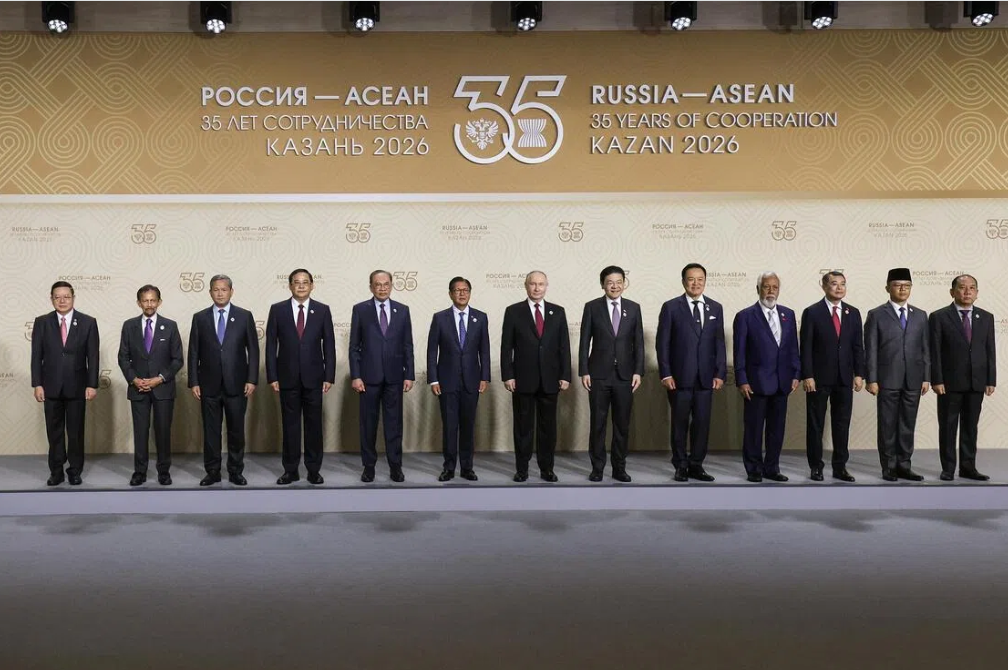
The Association of Southeast Asian Nations and Russia have jointly reaffirmed their determination to broaden and deepen their partnership across multiple sectors at a commemorative summit held in the Russian city of Kazan on June 17 and 18. The gathering marked a significant milestone, acknowledging three and a half decades of bilateral relations and three decades of structured dialogue mechanisms between the regional bloc and Moscow. The event demonstrated both sides' commitment to sustaining engagement despite the complex geopolitical environment in which they operate.
Several foundational documents emerged from the summit, laying the groundwork for coordinated action in the years ahead. The Kazan Declaration represents a comprehensive assessment of how Asean-Russia relations have evolved over the past 35 years while establishing strategic priorities for the future. Among the priority areas identified are maritime cooperation, trade and investment promotion, energy partnerships, infrastructure connectivity, security collaboration, educational exchange and cultural initiatives. These domains reflect the practical realities of what both Asean and Russia consider mutually beneficial, moving beyond rhetorical commitments to identify concrete areas where their interests genuinely overlap.
The adoption of a Joint Statement on Cultural Cooperation underscores the recognition that sustained diplomatic relationships require robust people-to-people connections. This initiative aims to deepen cultural exchanges and foster stronger societal links between Russia and Asean member states, acknowledging that economic and strategic partnerships function most effectively when supported by genuine understanding between ordinary citizens. Additionally, the Asean-Russia Comprehensive Plan of Action spanning 2026 to 2030 serves as an operational roadmap, providing specific guidance for implementation of cooperative initiatives across all priority sectors over the next five years.
Prime Minister Lawrence Wong, speaking at the summit on behalf of Singapore, articulated a carefully calibrated position that emphasizes cooperation in areas of genuine convergence whilst maintaining commitment to international law and established norms. He stressed that Asean seeks partnership with Russia on initiatives that build confidence and promote regional peace, stability and development. Wong's remarks highlighted Singapore's welcome for Russia's demonstrated support for what Asean terms "Asean Centrality"—the principle that the regional bloc should remain the driving force in regional architecture and decision-making. He specifically noted Russia's consistent participation in Asean-led mechanisms including the ASEAN Regional Forum and East Asia Summit.
Looking toward Singapore's assumption of the Asean rotational chairmanship in 2027, Wong signalled that Moscow's participation in both the ARF and EAS meetings would be valued, particularly during the Philippines' hosting of these forums later in 2024. This framing places Russia squarely within the regional institutional framework that Asean has painstakingly constructed over decades, ensuring Moscow remains engaged with Southeast Asian diplomacy through established channels rather than acting as an external force. The emphasis on Singapore's upcoming leadership of Asean, coupled with invitations for Russian participation, reflects how Asean manages relations with major powers through inclusive institutional mechanisms.
Wong identified several practical cooperation areas beyond the strategic realm where Asean and Russia can generate immediate value. Disaster management represents one such domain, particularly relevant given Southeast Asia's exposure to typhoons, earthquakes and flooding, where Russian technical expertise and resources could complement regional capacities. Countering drug trafficking emerged as another priority, reflecting shared concerns about transnational criminal networks that affect both Southeast Asia and Russia. Educational and cultural exchanges, including Russian participation in civil service training programmes across Asean member states, provide mechanisms for building understanding among government officials who will shape bilateral relations for years to come.
The Singapore Prime Minister's remarks carefully balanced cooperative aspirations with principled stances on international law and regional security. Wong emphasized that Asean's dual priorities of deepening integration whilst expanding external partnerships have become increasingly important given what he characterized as an unpredictable and volatile geopolitical environment. He underscored the necessity for countries to uphold international law and a rules-based global order, framing this not as anti-Russian positioning but as consistent application of principles that benefit all nations, particularly smaller ones dependent on stable international frameworks.
Wong articulated Singapore's position on Ukraine with deliberate precision, stating that the republic's stance derived from "consistent commitment to the principles of sovereignty and territorial integrity of all countries" rather than alignment with any particular side. Singapore has maintained sanctions on Russia since 2022 following Moscow's invasion of Ukraine, which Singapore's Ministry of Foreign Affairs characterized as a violation of international law. Yet Wong indicated Singapore's openness to supporting diplomatic efforts toward a ceasefire and eventual peace settlement, positioning the city-state as a supporter of dialogue whilst maintaining its principled stance on the conflict's illegality under international law.
Wong also addressed developments in the Middle East, welcoming a peace agreement between the United States and Iran and expressing hope that such arrangements could lead to a permanent end to conflict and reopening of the Strait of Hormuz. These references illustrate how Singapore frames international engagement—as a supporter of dialogue, de-escalation and the establishment of conditions for peaceful coexistence, regardless of which parties are involved. For Malaysian and broader Southeast Asian readers, this approach reflects how smaller regional states navigate relationships with major powers by emphasizing universal principles rather than ideological alignment.
On the bilateral level, Wong met with President Vladimir Putin at Moscow's request, a diplomatic courtesy that underscored the formal nature of the summit. The two leaders exchanged views on bilateral relations, regional developments and international issues, though specific details of their private discussions remained confidential. Wong's subsequent social media commentary emphasized the value of dialogue even between countries that disagree on certain matters, signalling that Singapore values its historical ties with Russia and its people whilst maintaining clear positions on specific issues. The framing suggests a pragmatic approach: disagreement on Ukraine need not prevent cooperation on disaster management, drugs, education or cultural exchange.
Wong also engaged with Rustam Minnikhanov, the Rais (head) of the Russian republic of Tatarstan, reflecting Singapore's recognition that Russia's internal structure involves significant regional authorities with their own international relationships. Singapore and Tatarstan maintain longstanding ties dating to a 2007 visit by former Minister Mentor Lee Kuan Yew, establishing precedent for sub-national level engagement. Discussions between Wong and Minnikhanov covered cultural, educational and people-to-people cooperation, suggesting that bilateral relations between Asean members and Russian regions represent another layer of engagement beyond central government interactions.
For Southeast Asian observers, the Kazan summit demonstrates how major powers and regional blocs can maintain active cooperation despite serious disagreements on particular geopolitical issues. The framework established through the Kazan Declaration and associated documents provides structure for engagement across multiple sectors—maritime, energy, trade, security and culture—allowing practical cooperation to proceed even when political differences exist. This approach aligns with Asean's traditional preference for dialogue, engagement and accommodation rather than isolation or confrontation. The summit also reinforces the principle that international relations need not be zero-sum, and that smaller states can craft independent foreign policies that simultaneously maintain principled positions on international law whilst pursuing cooperation with all major powers where mutual interests exist.
The emphasis on the 2026-2030 Comprehensive Plan of Action signals confidence that Asean-Russia relations will persist through this period, with both sides committing resources and attention to implementation. For Malaysia and other Asean members, this framework offers opportunities to participate in Russian-led initiatives on energy cooperation, maritime security and educational exchange. The summit's outcome reflects mature great power relations where disagreement on one issue does not preclude cooperation on others—a model particularly valuable for Southeast Asia, which must balance relationships with multiple external powers whilst maintaining strategic autonomy and pursuing regional integration.

%22%2F%3E%3C%2Fpattern%3E%3C%2Fdefs%3E%3Crect%20width%3D%22100%25%22%20height%3D%22100%25%22%20fill%3D%22url(%23ph523ndg)%22%2F%3E%3Crect%20width%3D%22100%25%22%20height%3D%22100%25%22%20fill%3D%22url(%23ph523ndp)%22%2F%3E%3Ctext%20x%3D%2250%25%22%20y%3D%2250%25%22%20text-anchor%3D%22middle%22%20dominant-baseline%3D%22central%22%20fill%3D%22rgba(255%2C255%2C255%2C0.95)%22%20font-family%3D%22Georgia%2C%20'Times%20New%20Roman'%2C%20serif%22%20font-weight%3D%22700%22%20font-size%3D%22272%22%20letter-spacing%3D%22-0.02em%22%3EAnwar%3C%2Ftext%3E%3C%2Fsvg%3E)