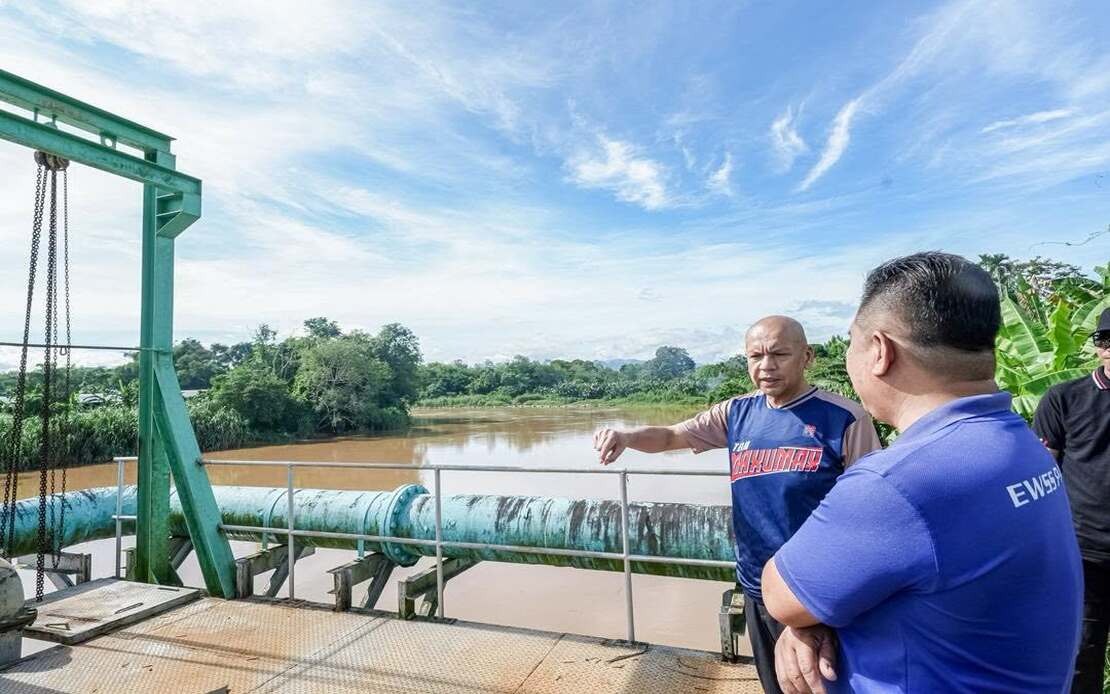
Domestic Trade and Cost of Living Minister Datuk Armizan Mohd Ali conducted an on-site inspection of water supply infrastructure projects in Papar on June 19, following a dedicated coordination meeting held four days earlier to assess implementation progress and the district's water service challenges. The ministerial visit underscores the growing urgency of addressing supply pressures in the region, where demand continues to outpace existing capacity—a problem increasingly common across Sabah's smaller towns as economic activity and residential populations expand.
Two major projects currently in progress will substantially reshape the district's water infrastructure. The Kogopon Water Treatment Plant upgrade represents the most significant undertaking, designed to nearly double its daily processing capacity from 40 million litres to 80 million litres. Running parallel to this effort is an enhancement initiative focused on the Kampung Kabang intake facility. Together, these complementary projects address both the quantity dimension—simply producing more clean water—and the supply chain resilience necessary to prevent bottlenecks further upstream. For Malaysian readers familiar with water crises in other districts, these twin approaches reflect a maturing understanding that infrastructure solutions require intervention at multiple points in the supply network.
Armizan, who represents Papar as its Member of Parliament in addition to his cabinet responsibilities, characterised the projects as essential responses to the district's escalating consumption patterns. The rising demand reflects broader demographic and economic trends: population growth, industrial development, and an improving standard of living all drive residential and commercial water usage upward. Without corresponding infrastructure investments, even adequately performing treatment plants eventually become constraining bottlenecks. The timing of these upgrades thus becomes critical, as delays risk extending shortages that already frustrate local communities.
During his inspection tour, the minister also examined operational conditions at two treatment facilities—the EWSS Plant and the JETAMA Limbahau Plant—which had experienced disruptions throughout the preceding week. Both installations encountered a common but vexing technical problem: elevated nephelometric turbidity unit (NTU) readings in raw water arriving at the plant intake. Raw water turbidity, measured in NTU values, reflects the concentration of suspended particles—silt, clay, algae, and organic matter—that cloud water and complicate treatment. When turbidity exceeds treatable thresholds, treatment plants typically must reduce throughput or temporarily halt operations entirely, since conventional filtration and chemical treatment processes have practical limits.
This operational vulnerability illuminates a broader reality of water supply in tropical regions like Malaysia and Southeast Asia. Monsoon patterns, upstream land clearing, and seasonal changes in river flow characteristics create predictable but challenging swings in raw water quality. Treatment plant operators must balance maintaining water output against the risk of allowing poor-quality water through to consumers. The temporary closures at both plants represent a protective decision—halting supply rather than risk delivering contaminated water—but such shutdowns themselves create supply crises for affected communities. Understanding these technical constraints is essential for assessing why water shortages persist despite substantial infrastructure investment.
Armizan emphasised the necessity of direct field monitoring to develop accurate assessments of operational challenges and to enable responsive problem-solving. This emphasis reflects good governance practice: ministerial oversight that remains grounded in on-site reality rather than relying solely on written reports. For Malaysian infrastructure projects, such visible accountability visits also carry symbolic weight, signalling to local communities that their service concerns reach the highest policy levels. When residents experience water cuts and quality problems, seeing their MP and a cabinet minister reviewing the situation in person—however briefly—can partially restore confidence in the system's responsiveness.
The water supply situation in Papar exemplifies challenges confronting many Malaysian districts as existing infrastructure approaches saturation. Unlike major metropolitan areas with multiple redundant systems, smaller towns typically depend on a primary treatment pathway with limited buffer capacity. A single plant malfunction, a quality event at the raw water source, or demand surge can cascade into visible service failures. The Papar projects, by expanding treatment capacity and improving intake resilience, move toward a more robust configuration. Yet they remain reactive rather than anticipatory—upgrades that were probably overdue when planning commenced.
For Southeast Asian perspective, Papar's infrastructure situation mirrors challenges across the region. Rapid urbanisation and rising living standards everywhere exceed original infrastructure design parameters. Water professionals across ASEAN face similar technical constraints: tropical climate volatility, competing demands for limited river resources, and the substantial costs of major capacity expansions. Successful districts typically combine infrastructure investment—as Papar is doing—with demand management measures including leakage reduction and conservation incentives.
The implementation timeline for both projects remains crucial. Infrastructure upgrades in Malaysia frequently experience delays stemming from procurement complexity, contractor challenges, or unforeseen site conditions. Every month of delay represents continued service shortfalls and resident frustration. Armizan's inspection visit implicitly established ministerial ownership of the timeline, creating accountability pressure for project completion. Whether this translates into accelerated delivery schedules will become apparent over coming quarters.
The raw water quality issue affecting the EWSS and JETAMA facilities points toward the secondary challenge beyond capacity: ensuring consistent input quality. Addressing turbidity problems sometimes requires upstream interventions—erosion control, riparian restoration, or source water protection—that extend beyond treatment plant boundaries. Papar residents experiencing supply disruptions ultimately need solutions across the entire supply chain, not merely larger treatment plants.

%22%2F%3E%3C%2Fpattern%3E%3C%2Fdefs%3E%3Crect%20width%3D%22100%25%22%20height%3D%22100%25%22%20fill%3D%22url(%23ph523ndg)%22%2F%3E%3Crect%20width%3D%22100%25%22%20height%3D%22100%25%22%20fill%3D%22url(%23ph523ndp)%22%2F%3E%3Ctext%20x%3D%2250%25%22%20y%3D%2250%25%22%20text-anchor%3D%22middle%22%20dominant-baseline%3D%22central%22%20fill%3D%22rgba(255%2C255%2C255%2C0.95)%22%20font-family%3D%22Georgia%2C%20'Times%20New%20Roman'%2C%20serif%22%20font-weight%3D%22700%22%20font-size%3D%22272%22%20letter-spacing%3D%22-0.02em%22%3EAnwar%3C%2Ftext%3E%3C%2Fsvg%3E)