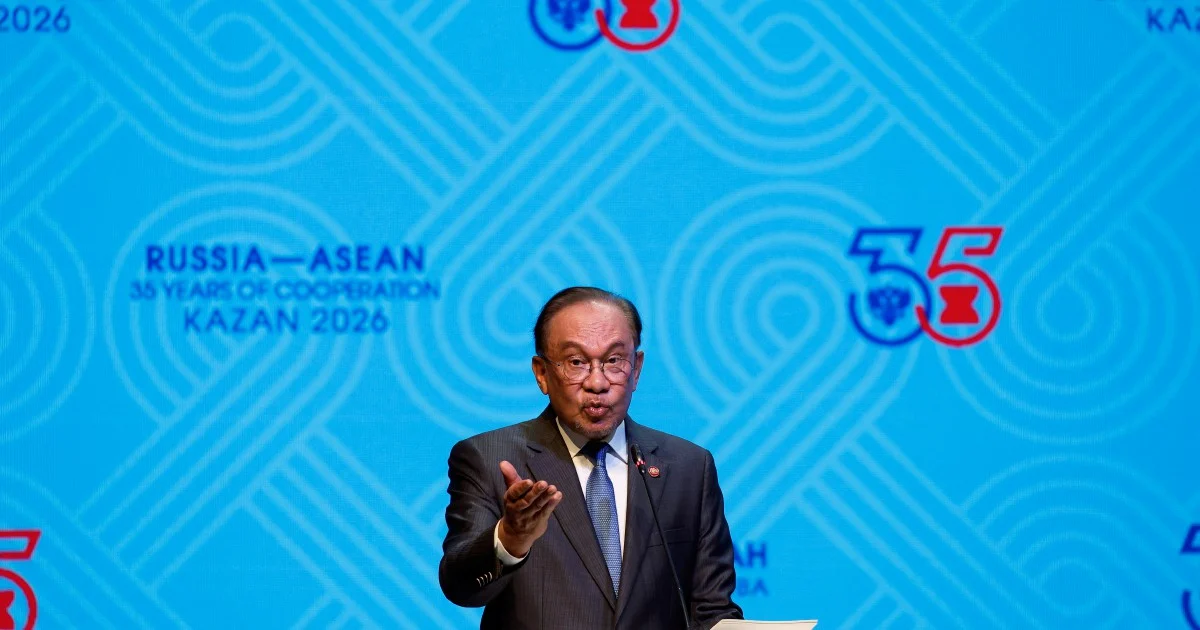
Prime Minister Datuk Seri Anwar Ibrahim has hailed the completion of the Asean-Russia Strategic Programme on Trade and Investment Cooperation 2026-2035 as a pivotal milestone in strengthening regional economic ties with Moscow, signalling Malaysia's commitment to broadening Southeast Asia's engagement with major powers beyond traditional Western partners.
The finalised decade-long cooperation framework represents a concrete outcome from high-level dialogue between the ten-nation bloc and Russia, marking a significant diplomatic and economic achievement at a time when global trade patterns are shifting amid geopolitical tensions. Anwar's remarks, delivered in Kazan, underscore how the agreement provides a structured platform for Asean members to deepen commercial relationships with a country that has increasingly turned its attention towards Asia-Pacific markets following Western sanctions.
However, Anwar's characterisation of the roadmap as merely "a shot in the arm" rather than a transformative breakthrough reveals careful optimism about realistic outcomes. The emphasis on the need for "an enabling environment" points to recognition that signing frameworks alone does not automatically generate trade flows or investment. This pragmatic approach reflects Malaysia's experience with previous multilateral agreements that have delivered uneven results across member states, depending on domestic policy coherence and implementation capacity.
The strategic timing of this finalisation carries weight for Southeast Asia's broader positioning during a period of great power competition. Russia, facing isolation from Western markets, has strategically pivoted towards deepening ties with Asian economies. For Asean, the programme offers an avenue to maintain diversified partnerships and reduce economic dependence on any single power bloc, a principle Malaysia has long advocated through its "look East" legacy and non-aligned foreign policy tradition.
The 2026-2035 timeframe extends beyond typical trade agreements, suggesting the two sides view this as a long-term strategic commitment rather than a temporary accommodation. This extended horizon allows for development of infrastructure, supply chain integration, and sectoral cooperation across energy, agriculture, technology, and manufacturing—areas where Asean and Russia have complementary strengths. Malaysia, as a significant regional economy and current voice within Asean forums, stands to benefit from enhanced bilateral opportunities within this expanded framework.
Yet the conditional language in Anwar's statement—emphasising that an enabling environment remains "key to turning them into reality"—highlights the complexity of translating diplomatic agreements into tangible economic outcomes. Practical challenges including logistics bottlenecks, currency fluctuations, sanctions compliance issues, and divergent regulatory standards have historically constrained Asean-Russia trade despite significant potential. The programme's success will ultimately depend on individual Asean member states' willingness to invest in implementation mechanisms and resolve outstanding trade barriers.
From Malaysia's perspective, deeper Asean-Russia cooperation creates both opportunities and considerations. Enhanced regional trade with Russia could diversify markets for Malaysian exports and create new investment channels, particularly in sectors like palm oil, petroleum products, and manufactured goods. Simultaneously, Malaysia must navigate complex international trade regulations and ensure that participation aligns with broader foreign policy objectives, particularly regarding relationships with Western trading partners on which it remains heavily dependent.
The roadmap's success also carries implications for Asean's collective bargaining power in regional economic architecture. A robust Asean-Russia partnership strengthens the bloc's ability to maintain strategic autonomy and negotiate more favourable terms with other major trading partners. This dimension reflects Malaysia's long-standing advocacy for Asean centrality in regional affairs and its resistance to division into competing spheres of influence.
Anwar's remarks suggest the Malaysian government views this agreement as foundational rather than immediately transformative—a starting point requiring substantial follow-up work at both Asean and bilateral levels. The prime minister's emphasis on enabling conditions implicitly calls on member governments to streamline regulations, improve customs procedures, and reduce barriers to facilitate increased trade volumes. This aligns with Malaysia's broader reform agenda under his administration, which has prioritised administrative efficiency and business-friendly policies.
Looking ahead, the programme's implementation will reveal whether Asean and Russia can move beyond symbolic gestures towards sustained commercial growth. Success requires coordinated action among ten diverse nations with varying strategic interests and economic capacities, alongside Russia's commitment to navigate international sanctions restrictions. Malaysia's role as a regional economic leader and bridge-builder positions it to champion pragmatic approaches that balance ambition with realistic assessment of implementation challenges.
The agreement ultimately represents a significant diplomatic achievement that opens doors for expanded engagement, yet realising its full potential demands sustained commitment and structural reforms across participating nations. For Malaysia and Asean broadly, this roadmap offers a valuable opportunity to strengthen ties with a major Eurasian power while maintaining the strategic flexibility that has long characterised the region's approach to great power relations.