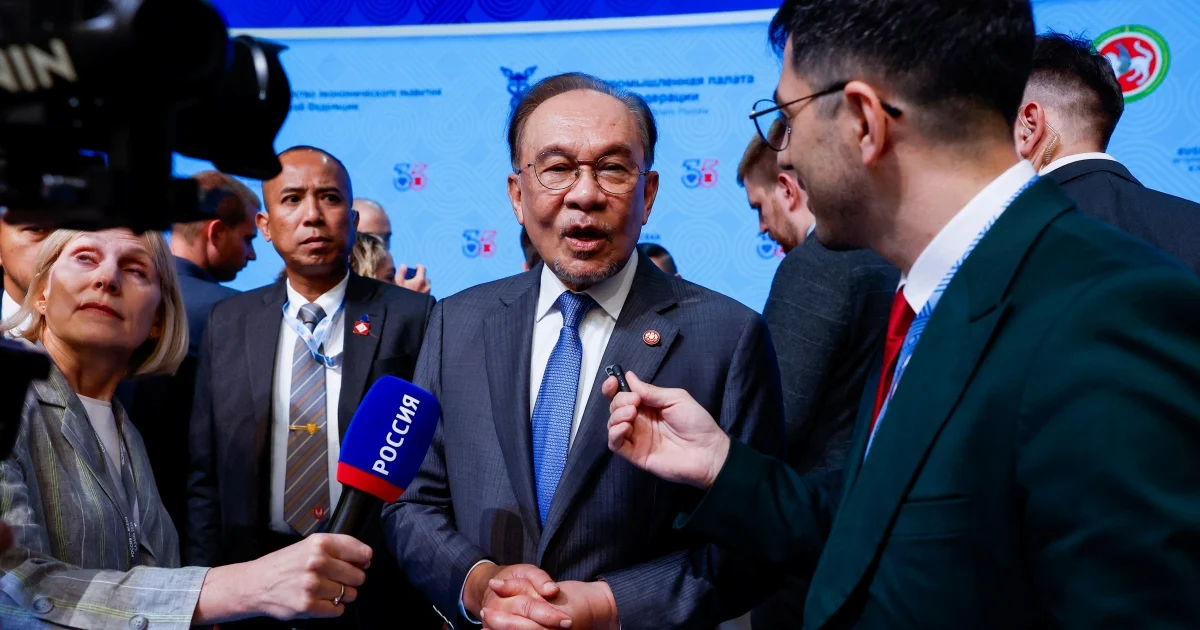
Prime Minister Datuk Seri Anwar Ibrahim has disclosed a personal appreciation for Russian music and literature during remarks in Kazan, presenting cultural affinity as a strategic dimension of international relations. The statement reflects a leadership perspective that views artistic and intellectual exchange not merely as supplementary to commerce and politics, but as a foundational element in constructing meaningful bonds between nations.
Anwar's comments mark a notable articulation of soft power strategy at a time when Malaysia seeks to deepen its engagement across multiple global regions. By publicly acknowledging his admiration for Russian cultural works, the Prime Minister signals openness to diverse civilisations and intellectual traditions, positioning Malaysia as a country that values exchange beyond transactional economic relationships. This approach aligns with Malaysia's longstanding commitment to maintaining balanced international friendships and avoiding geopolitical alignment that would compromise national interests.
The Russian Federation has historically maintained significant cultural and educational ties throughout Southeast Asia. Literature, music, and artistic movements from Russia have influenced intellectual circles across the region for generations. Anwar's explicit endorsement of Russian cultural contributions therefore carries diplomatic weight, suggesting Malaysia's continued receptiveness to Russian engagement at a moment when global alignments remain fluid and contested.
Cultural diplomacy has gained renewed prominence in foreign policy circles worldwide as nations recognise that soft power—influence derived from attraction rather than coercion—often proves more durable and cost-effective than military or economic leverage alone. Anwar's framing positions Malaysia within this emerging consensus, suggesting that the government views cultural institutions, educational partnerships, and artistic exchange as legitimate instruments for advancing national interests while fostering mutual understanding.
Malaysia's multicultural society and diverse intellectual heritage provide fertile ground for such exchanges. The country's own rich tapestry of Malay, Chinese, Indian, and indigenous cultures has long positioned it as a bridge between civilisations. When Malaysian leaders champion appreciation for foreign cultural traditions, they implicitly reinforce the principle that cultural pluralism strengthens rather than weakens national identity. This domestic dimension gives credibility to Malaysia's international advocacy for intercultural dialogue.
The timing of Anwar's remarks in Kazan, a city on the border between Europe and Asia with its own complex multicultural history, carries additional symbolic significance. Kazan has become an increasingly important platform for international engagement, particularly as nations navigate the consequences of geopolitical fragmentation. By articulating cultural appreciation while meeting with Russian interlocutors, Anwar demonstrates Malaysia's capacity to engage substantively across civilisational boundaries without sacrificing independence or principles.
For Malaysia's younger generation and broader intellectual class, such statements offer implicit permission to engage with global culture on terms beyond Western-centric frameworks. As digital connectivity expands access to international media, arts, and literature, Malaysian audiences increasingly encounter Russian cinema, music, and literature through streaming platforms and online communities. A Prime Minister's public embrace of these cultural forms legitimises such engagement and suggests that cultural consumption need not conflict with national identity.
The emphasis on cultural cooperation alongside economic ties reflects sophisticated understanding of how durable relationships are constructed. Economic partnerships, while important, can be disrupted by trade disputes, market fluctuations, or shifts in comparative advantage. Cultural bonds, by contrast, create networks of intellectuals, artists, and ordinary citizens whose mutual appreciation transcends immediate material interests. When economic cooperation encounters friction, pre-existing cultural understanding often provides buffer and context for resolution.
Russia's own emphasis on cultural promotion aligns with these objectives. Through mechanisms such as the Pushkin Institute and various cultural councils, Russia has long invested in spreading knowledge of its heritage globally. Malaysia's receptiveness to such initiatives potentially opens avenues for deeper institutional cooperation—fellowships for students, artist exchanges, museum collaborations, and academic partnerships. For Malaysian institutions and individuals, such arrangements offer access to world-class resources and traditions without requiring alignment on matters of strategic disagreement.
The articulation of personal cultural preferences by a sitting Prime Minister serves another important function: humanising leadership and suggesting approachability across difference. Political figures who publicly embrace foreign cultures appear more cosmopolitan and intellectually curious than those who confine themselves to nationalist rhetoric. This dimension of soft power—the personal magnetism and relatability of leaders—should not be underestimated in an era when international relations increasingly involve direct public communication and citizen-to-citizen engagement through social media.
Moving forward, Malaysia may leverage Anwar's stated appreciation for Russian culture into concrete institutional initiatives. Cultural centres, translation projects, academic exchanges, and joint artistic ventures would operationalise the sentiment expressed in Kazan. Such initiatives need not conflict with Malaysia's pursuit of cooperation with Western nations, other ASEAN members, or regional powers such as China and India. Instead, they demonstrate Malaysia's confidence in maintaining multiple relationships without forced exclusivity.
The broader message emerging from Anwar's remarks extends beyond bilateral Malaysia-Russia relations. It represents an implicit argument against the bifurcation of the world into rigid ideological blocs, a fragmentation that would constrain Malaysia's strategic autonomy and reduce opportunities for citizens and institutions. In championing cultural exchange and intellectual appreciation across perceived divides, the Prime Minister articulates a vision of global order characterised by pluralism, agency, and the enduring power of human connection through art and ideas.