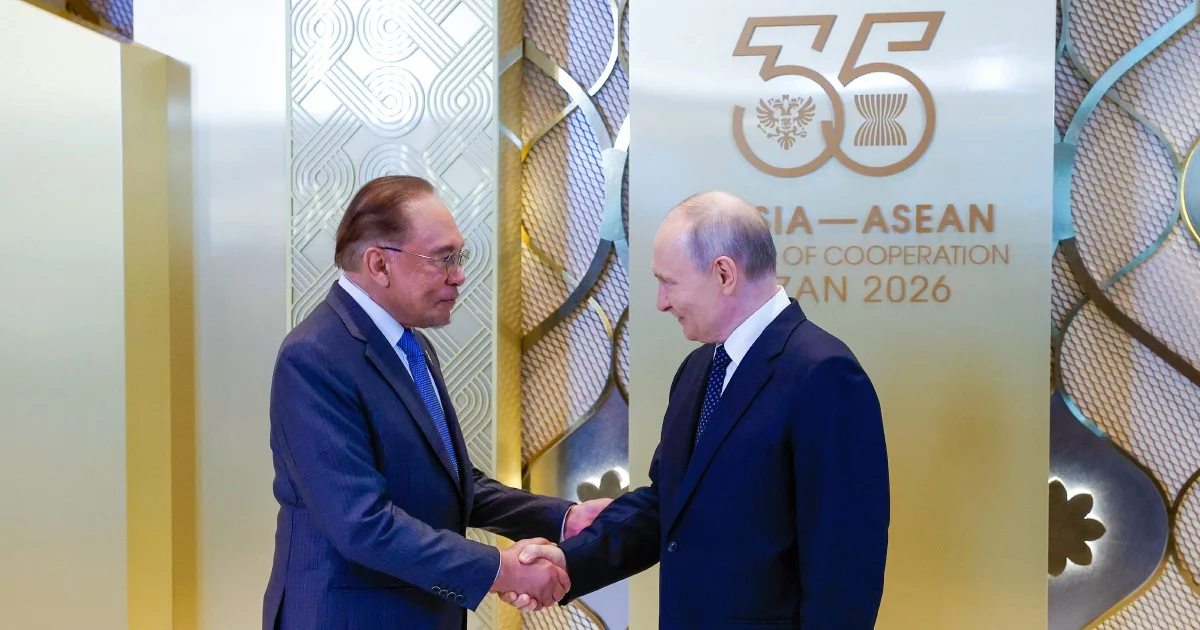
Prime Minister Datuk Seri Anwar Ibrahim and Russian President Vladimir Putin have held discussions in Kazan centred on broadening Malaysia-Russia cooperation across multiple sectors, with particular emphasis on fortifying energy ties and expanding commercial relations through novel payment mechanisms.
The meeting underscores Malaysia's strategic positioning as a nation seeking to diversify its international partnerships amid shifting geopolitical dynamics in the Indo-Pacific region. For Anwar's administration, engaging Moscow on substantive economic cooperation demonstrates an approach of principled non-alignment, maintaining pragmatic ties with major powers whilst pursuing national interests. The focus on energy collaboration reflects Malaysia's ongoing need to secure reliable energy supplies whilst navigating global market volatility that has characterised recent years.
Discussions between the two leaders highlighted the potential for expanding energy partnerships, an area of considerable mutual interest. Russia, as a global energy producer, maintains substantial hydrocarbon reserves and export infrastructure, whilst Malaysia, as a Southeast Asian energy consumer with significant domestic oil and gas resources, faces the dual challenge of meeting growing domestic demand whilst maintaining export revenues. The conversation likely explored opportunities for enhanced cooperation in crude oil supply chains, liquefied natural gas procurement, and potentially joint exploration ventures that could benefit both economies.
The emphasis on conducting trade in local currencies represents a particularly significant development, signalling both nations' interest in reducing reliance on Western-dominated payment systems. This approach allows Malaysia and Russia to circumvent potential financial sanctions or restrictions whilst facilitating more efficient bilateral commerce. For Malaysia specifically, conducting transactions in Malaysian ringgit or Russian roubles rather than US dollars could reduce foreign exchange exposure and strengthens the ringgit's international utility, aligning with longer-term financial sovereignty objectives that have gained prominence in Southeast Asian policy discussions.
This bilateral engagement occurs within a broader context of Malaysia's multifaceted foreign policy strategy under Anwar's leadership. The Prime Minister has consistently articulated a vision of balanced diplomacy, maintaining productive relationships with Western allies including the United States whilst simultaneously deepening ties with China, Russia, and other regional powers. Such positioning allows Malaysia to leverage relationships across the ideological spectrum, extracting maximum benefit from competing powers without sacrificing strategic autonomy.
Russia's engagement with Southeast Asia has intensified in recent years as Moscow seeks to counterbalance Western influence in the region. For Malaysia, whose geography and economic interests extend across the Strait of Malacca—one of the world's most critical maritime chokepoints—maintaining working relationships with major powers serves both economic and security interests. Energy security discussions with Russia complement Malaysia's existing partnerships with suppliers including Saudi Arabia, Qatar, and Brunei, creating a diversified import portfolio that buffers against supply disruptions.
The local currency trade mechanism reflects a broader emerging-market movement toward de-dollarisation, driven partly by concerns about Western monetary policy transmission and partly by the desire of non-Western powers to reduce vulnerability to financial coercion. Malaysia's participation in such arrangements positions the nation alongside other Asian economies experimenting with bilateral and multilateral payment systems that bypass traditional dollar-based channels. This aligns Malaysia with initiatives such as China's Cross-Border Interbank Payment System and reflects growing confidence among developing economies in alternative financial infrastructure.
Bilateral trade between Malaysia and Russia has historically remained modest compared to Malaysia's commerce with China, Japan, or the United States, suggesting considerable untapped potential. Enhanced energy cooperation could substantially expand the quantum of bilateral commerce. Similarly, manufacturing sectors in both nations—Russian machinery and technology alongside Malaysian electronics and processed goods—offer opportunities for deeper supply-chain integration. The emphasis on local-currency trading would reduce transaction costs and administrative friction, potentially spurring greater commercial activity.
For Malaysian investors and businesses, the Anwar-Putin discussion signals potential opening of opportunities in Russian energy and infrastructure sectors, provided Western sanctions frameworks do not preclude Malaysian participation. Conversely, Russian companies operating in Southeast Asia may find Malaysia an attractive hub for regional operations, particularly given the nation's role as a financial and commercial centre within ASEAN. The signals from this high-level engagement will likely filter through to commercial chambers and business associations in both countries, potentially catalysing increased corporate-level engagement.
The timing of these discussions, held in Kazan, reflects Russia's efforts to position itself as a centre of non-Western geopolitical initiative. The city has hosted various regional forums, and Putin's engagement with Southeast Asian leaders there emphasises Moscow's commitment to cultivating relationships beyond its traditional European and post-Soviet spheres. For Malaysia, such engagement demonstrates Anwar's active prosecution of a sophisticated foreign policy that recognises Russia's residual economic and geopolitical significance despite international sanctions.
Moving forward, the outcomes of this discussion will likely materialise through technical working groups focused on energy cooperation, trade facilitation mechanisms, and currency settlement arrangements. Malaysian policymakers will need to calibrate these developments carefully, ensuring that deepened Russia engagement does not create complications with Western partners—a balance Malaysia has largely maintained through its non-aligned positioning. The success of these initiatives will depend partly on global developments affecting Russia's economic capacity and international standing, factors beyond either nation's immediate control yet central to determining the tangible benefits of renewed bilateral cooperation.