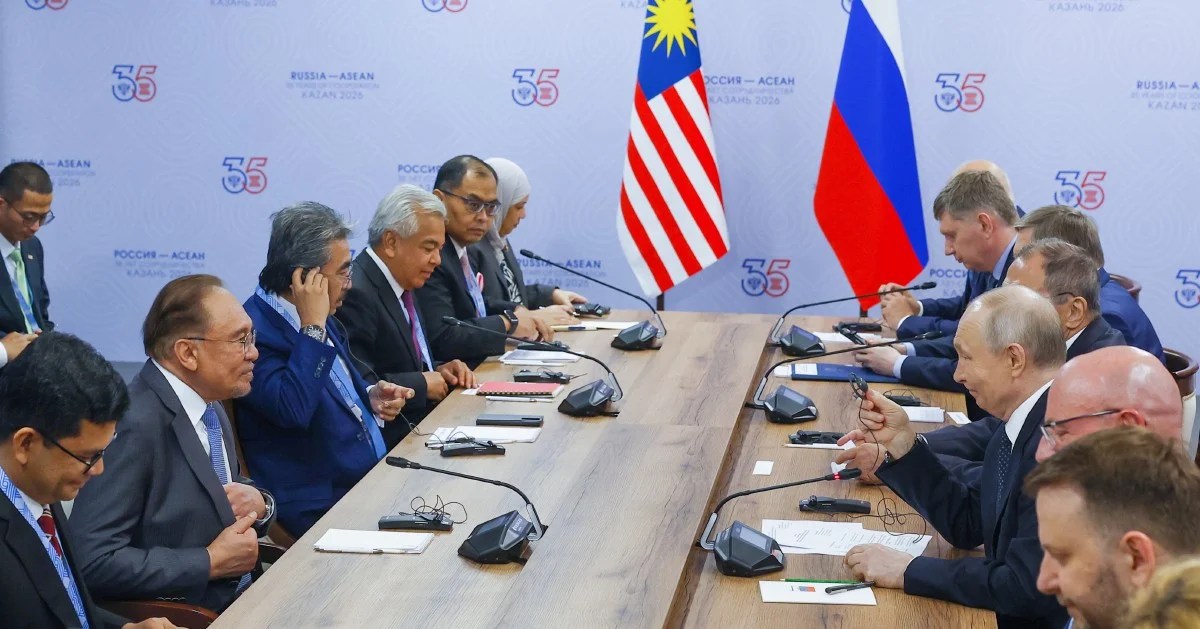
Prime Minister Datuk Seri Anwar Ibrahim has publicly acknowledged Russian President Vladimir Putin's support for bolstering energy cooperation between Malaysia and Petroliam Nasional Bhd (Petronas), marking a notable gesture of bilateral goodwill during a period of recalibrated international alignments in Southeast Asia.
The expression of gratitude, made during discussions in Kazan, underscores Malaysia's strategic interest in diversifying energy partnerships beyond traditional Western suppliers. This move reflects a broader pattern across the region where nations are evaluating their energy security options amid shifting global trade dynamics and supply chain considerations. For Malaysia, a country with significant hydrocarbon reserves but competing economic priorities, expanding cooperation with Russia represents one avenue among several for ensuring stable energy flows and investment into the sector.
Petronas, as Malaysia's national oil and gas company, serves as the primary vehicle for the country's upstream and downstream energy operations. Any endorsement from Moscow for strengthening collaboration with the state-owned enterprise carries implications beyond commercial transactions, touching on questions of technology transfer, operational expertise, and long-term investment commitments. The Russian government's backing suggests willingness to engage with Malaysian energy interests despite international sanctions and restrictions that have shaped Russia's economic relationships since 2022.
Energy cooperation between Malaysia and Russia has historically been limited compared to the nation's partnerships with Australia, Qatar, and other traditional suppliers. However, escalating global geopolitical tensions and the reconfiguration of energy markets have prompted policymakers in Kuala Lumpur to explore alternative arrangements. Russia, possessing substantial oil and liquefied natural gas reserves, remains a potentially valuable counterparty for long-term supply agreements and joint ventures, particularly in exploration and production sectors where Malaysian expertise and Russian resources could prove complementary.
Anwar's diplomatic engagement in Kazan signals that Malaysia is maintaining pragmatic relations across multiple centres of power. The Prime Minister's approach reflects continuity with Malaysia's traditional foreign policy doctrine of non-alignment, though adapted to contemporary circumstances where energy security intersects with strategic autonomy. By acknowledging Putin's support for energy cooperation through Petronas, Anwar is simultaneously communicating to domestic audiences that the government actively pursues national economic interests and to international partners that Malaysia remains open to engagement.
The timing of such overtures carries significance within ASEAN's broader positioning. Several Southeast Asian nations face pressure from competing powers to align with particular blocs, yet most prefer maintaining equidistance. Malaysia's emphasis on energy partnership rather than broader geopolitical alignment demonstrates a calculated approach—emphasising commercial and sectoral cooperation while avoiding positions that might alienate other strategic partners, particularly Western nations with whom Malaysia maintains substantial trade relationships and defence ties.
For Petronas specifically, expanding Russian engagement could unlock opportunities in deep-water exploration, Arctic operations through Russian technical expertise, and potentially facilitate investment flows into Malaysian energy infrastructure. Conversely, Russian companies gain exposure to Southeast Asian market dynamics and access to Petronas's established distribution networks across the region. Such mutual benefit provisions typically underpin agreements that transcend pure commodity exchange, potentially involving joint ventures or technology partnerships.
Malaysia's energy sector faces persistent challenges including declining onshore reserves, capital requirements for offshore development, and the need to balance hydrocarbon production with climate commitments and renewable energy transitions. Against this backdrop, international cooperation with experienced operators from resource-rich nations becomes strategically valuable. Russia's historical expertise in challenging extraction environments and its position as a major energy exporter provides technical and operational knowledge that Malaysian operators could leverage.
The geopolitical dimension extends beyond business considerations. Malaysia's willingness to publicly acknowledge Russian support signals to both Moscow and other regional actors that Kuala Lumpur calibrates relationships based on mutual interest rather than ideological conformity. This positioning allows Malaysia to maintain dialogue channels across different international groupings—ASEAN, the Shanghai Cooperation Organisation, Western-aligned organisations, and BRICS-adjacent networks—thereby maximising policy flexibility and diplomatic leverage.
Looking forward, the trajectory of Malaysia-Russia energy cooperation will depend on several factors: the evolution of international sanctions regimes affecting Russian energy companies, global energy price fluctuations that influence investment appetites, technological developments in renewable energy that might reduce reliance on fossil fuels, and broader regional security dynamics. Nevertheless, Anwar's acknowledgment of Putin's support indicates that regardless of external pressures, Malaysia intends to preserve space for practical collaboration in sectors critical to national development.
The interaction between national oil companies like Petronas and foreign governments increasingly reflects countries' strategic energy independence calculations. Malaysia's emphasis on partnering with Russia through its national champion energy firm represents not a rejection of existing relationships but rather an expansion of the nation's portfolio. In an era where energy security underpins economic resilience and geopolitical stability, Malaysia's demonstrated openness to diverse partnerships—from traditional suppliers to emerging alternatives—reinforces its position as a pragmatic player balancing multiple interests in an increasingly complex international system.