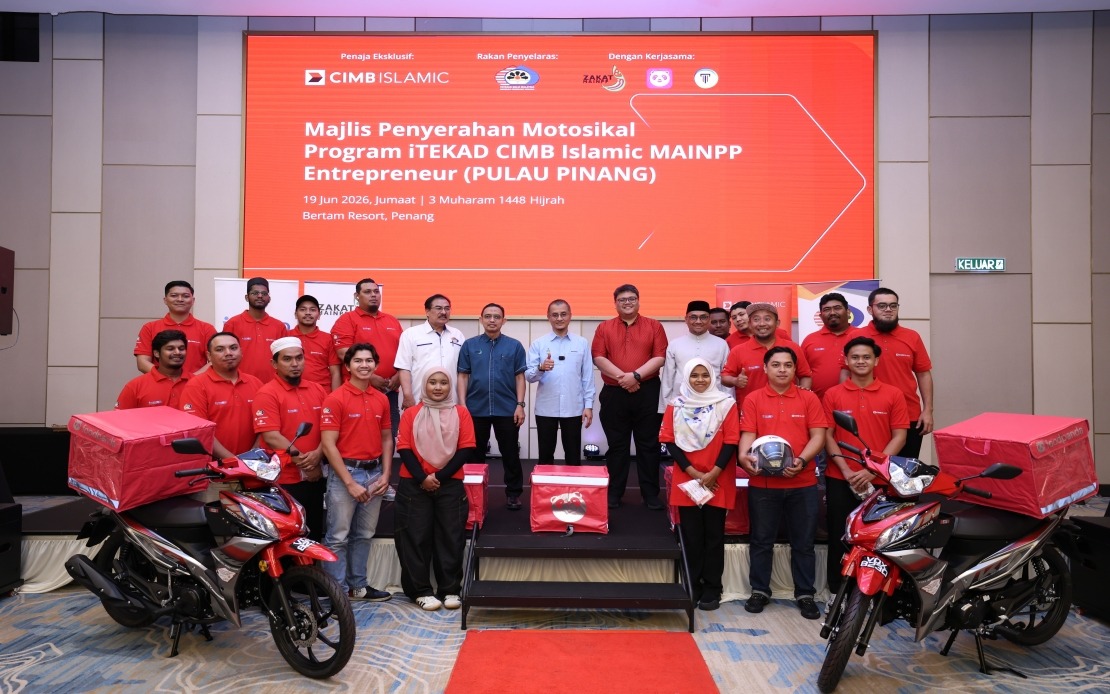
A collaborative initiative between CIMB Islamic Bank Berhad and the Penang Islamic Religious Council has marked a significant milestone in supporting disadvantaged entrepreneurs, with twenty selected participants receiving motorcycles at a handover ceremony in Kepala Batas. The iTEKAD CIMB Islamic-MAINPP Entrepreneur programme represents a coordinated effort to provide tangible assets and comprehensive business support to individuals from the asnaf community, creating pathways toward financial independence and breaking cycles of poverty.
The initiative draws strength from a diverse partnership ecosystem that pools resources and expertise across multiple sectors. Beyond the two primary institutions, the Malaysian Youth Foundation, Taylor's Community, and foodpanda Malaysia serve as implementation partners, each bringing specialized knowledge and operational capability to the table. This collaborative architecture underscores a broader recognition that sustainable poverty alleviation requires coordination across banking institutions, religious authorities, youth development organizations, and private sector stakeholders. Such synergy proves particularly valuable in Southeast Asia's entrepreneurial landscape, where informal work arrangements often lack formal training and financial infrastructure.
According to Datuk Dr Mohamad Abdul Hamid, Penang Deputy Chief Minister I and president of MAINPP, the programme extends far beyond simply distributing vehicles. Recipients gain access to structured training in financial management fundamentals, workplace discipline, and entrepreneurial principles designed to enable them to operate as organized micro-businesses rather than casual workers. The motorcycles and associated delivery equipment function as productive assets that facilitate income generation, particularly through partnerships like foodpanda that provide immediate earning opportunities within the gig economy.
The financial architecture supporting the initiative totals RM400,000, structured as a matching grant with equal contributions from two sources. CIMB Islamic Bank Berhad contributes RM200,000 from its Wakalah Zakat fund, while Bank Negara Malaysia provides an equivalent amount, demonstrating institutional commitment to asnaf economic empowerment at both commercial and regulatory levels. This funding model reflects Malaysia's evolving approach to utilizing zakat mechanisms not merely for charitable distribution but as capital for productive enterprise development.
The selection process demonstrates rigorous vetting standards typical of capacity-building programmes. From an initial pool of 151 applications, candidates underwent comprehensive evaluation including formal interviews and an intensive Entrepreneurship Camp conducted from May 31 to June 3, 2026. This bootcamp approach, combining residential immersion with practical training, allows programme managers to assess genuine commitment, learning capacity, and interpersonal skills before capital allocation. Only the top twenty candidates advanced to motorcycle distribution, suggesting a competitive and merit-based selection framework.
For Malaysian observers, the programme carries particular significance given the country's longstanding emphasis on bumiputera economic participation and Islamic social finance mechanisms. The deployment of zakat funds toward productive assets rather than subsistence support reflects contemporary thinking about breaking welfare dependency cycles. Within Penang's specific context, the initiative aligns with the state government's broader Islamic Religious Development Agenda 2030, which targets holistic community advancement across education, economic participation, family stability, and youth engagement.
The motorcycles themselves represent more than symbolic grants; they constitute entry points into the gig economy, enabling participants to offer delivery services through platforms like foodpanda while retaining flexibility to pursue other income streams. This positioning proves particularly relevant in urban and semi-urban Penang where rapid e-commerce expansion creates genuine demand for last-mile delivery services. By pairing vehicles with formal training, the programme addresses not just asset scarcity but capability gaps that often prevent disadvantaged groups from capitalizing on emerging economic opportunities.
The emphasis on continuous support mechanisms distinguishes this initiative from purely one-off assistance schemes. By combining initial asset provision with ongoing entrepreneurial guidance, the programme acknowledges that successful business launching requires sustained mentoring beyond the handover moment. This approach recognizes that many asnaf individuals lack established professional networks and business mentors who might otherwise provide informal guidance during critical early trading periods.
For Southeast Asian policymakers observing zakat modernization trends, the iTEKAD programme offers a replicable model demonstrating how Islamic charitable instruments can fund human capital and productive asset development. The involvement of commercial banking partners alongside religious institutions suggests pathways for financial sector integration in poverty alleviation. As digital payment platforms and gig work continue expanding across the region, programmes linking disadvantaged populations to these economic channels through appropriate asset provision and training become increasingly relevant.
The handover ceremony itself carried symbolic weight, with the distribution of motorcycles framed as institutional affirmation of participant potential and societal confidence in their capacity to succeed. By publicly recognizing these twenty individuals as entrepreneurs worthy of investment, the programme addresses psychological dimensions of poverty alongside material constraints. This dignity-affirming approach potentially generates stronger commitment than anonymous welfare transfers might achieve.
Looking forward, the success metrics for iTEKAD extend beyond motorcycle distribution to encompass income stability, business sustainability, and participants' progression toward conventional employment or established self-employment. The programme's integration with foodpanda creates built-in performance measurement through transaction data, allowing programme administrators to monitor earning levels and identify participants requiring additional support. Such evidence-based tracking enables continuous programme refinement and informs future similar initiatives across Malaysian states and potentially across Southeast Asia where similar asnaf populations face comparable challenges.

%22%2F%3E%3C%2Fpattern%3E%3C%2Fdefs%3E%3Crect%20width%3D%22100%25%22%20height%3D%22100%25%22%20fill%3D%22url(%23ph523ndg)%22%2F%3E%3Crect%20width%3D%22100%25%22%20height%3D%22100%25%22%20fill%3D%22url(%23ph523ndp)%22%2F%3E%3Ctext%20x%3D%2250%25%22%20y%3D%2250%25%22%20text-anchor%3D%22middle%22%20dominant-baseline%3D%22central%22%20fill%3D%22rgba(255%2C255%2C255%2C0.95)%22%20font-family%3D%22Georgia%2C%20'Times%20New%20Roman'%2C%20serif%22%20font-weight%3D%22700%22%20font-size%3D%22272%22%20letter-spacing%3D%22-0.02em%22%3EAnwar%3C%2Ftext%3E%3C%2Fsvg%3E)