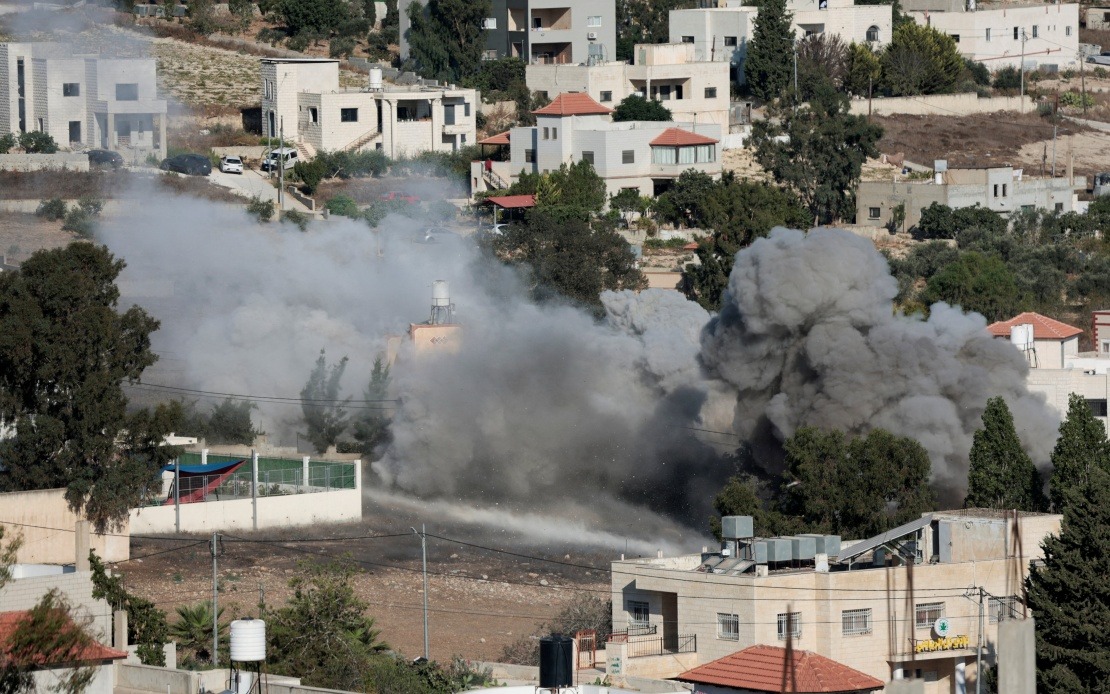
The United Nations Human Rights Office operating in the Occupied Palestinian Territory has formally documented what it describes as intolerable levels of violence perpetrated by Israeli settlers against Palestinian civilians, according to a statement released on Thursday. The office has called upon Israeli authorities to take decisive action by removing settlers engaged in systematic attacks, preventing the unlawful seizure of Palestinian land, and halting the expansion of Israeli colonies across the territory.
The escalation has followed the establishment of an Israeli colonial outpost near Qusra, situated south of Nablus, in November 2025. Since that time, settlers have consolidated control over territory adjacent to the village, triggering a marked intensification in hostile acts against the Palestinian population. The documented incidents encompass a troubling spectrum of violations, ranging from forced entry into homes and physical violence to destruction of property, theft, and arson attacks. Particularly alarming has been an assault on a mosque serving the local community, which represents an attack on a significant cultural and religious institution.
Among the most severe documented cases is an incident occurring in July in which settlers from an outpost in the Ras al-Ain area of Qusra deliberately disconnected water and electricity supplies to three Palestinian family residences. This action effectively rendered the homes uninhabitable, depriving residents of essential utilities necessary for basic survival and sanitation. The situation deteriorated further on August 9, when settlers sealed all access routes to the affected homes, erected physical barriers between them, and prevented occupants from moving in or out of the confined area.
The consequences for the trapped residents have been severe. Three Palestinian families, comprising approximately 15 individuals including at least two children, found themselves imprisoned in their own homes without access to water, electricity, or the ability to secure food and medical assistance. The families made repeated appeals to Israeli security forces stationed at the site to intervene and restore their freedom of movement, yet the forces failed to respond to these urgent pleas. Adding further isolation to their predicament, Israeli forces simultaneously restricted access by paramedics, human rights activists, and journalists who sought to provide support or document the unfolding crisis.
While Israeli soldiers removed the settlers' tent barrier on August 12, they notably did not remove the settlers themselves from the vicinity. The affected families continued to be surrounded and effectively held under siege as of the date of the UN statement, maintaining the coercive environment designed to force their departure. The UN Human Rights Office characterises these acts as criminal in nature, pointing out that they occur either with Israeli government support or with its deliberate indifference. The cumulative effect of such violence has created conditions that render daily life unbearable for Palestinian families and demonstrate an explicit strategy aimed at displacing people from their homes and ancestral lands.
The situation carries urgent implications given the immediate risk of forced removal. Palestinian rights organisations have warned that time is critically limited for these three families, as the ongoing confinement and environmental pressure could result in their expulsion from the territory they have inhabited. The UN office noted that the International Court of Justice has previously established that all Israeli settlements are illegal under international law, creating an authoritative legal foundation for demanding cessation of colonial activities and the evacuation of all settlers unlawfully present in the West Bank.
The UN has reiterated its position that Israel, as the occupying power, bears specific obligations under international humanitarian law to protect the Palestinian civilian population from harm. These obligations extend beyond passive observation and require active prevention of attacks by settlers, thorough investigation of violent incidents, and the imposition of meaningful accountability measures against perpetrators, supporters, and those who tolerate such violations. The failure to enforce these protections represents a breach of internationally recognised standards that govern conduct in occupied territories.
For Southeast Asian observers, this situation illustrates the broader challenge of civilian protection in protracted conflicts and the difficulties faced by international institutions in enforcing humanitarian norms. Malaysia, as a nation with significant Islamic constituencies and a longstanding advocacy position on Palestinian rights within regional forums like the Organisation of Islamic Cooperation, has maintained close attention to developments affecting Palestinian security and territorial integrity. The documented escalation provides concrete evidence supporting the arguments advanced by various governments and civil society organisations regarding the need for stronger international mechanisms to enforce compliance with established legal standards.
The incident also underscores the limitations of international monitoring when enforcement mechanisms lack teeth. Despite clear documentation and repeated public statements from UN bodies, the violence has continued and, according to the evidence presented, intensified. This dynamic raises difficult questions about the effectiveness of purely diplomatic pressure in situations where political will to comply with international norms appears absent. For countries concerned with the stability of international law and the protection of civilian populations in disputes, the case demonstrates that documentation alone, without corresponding enforcement capacity, may prove insufficient to prevent ongoing violations.
The settlers' actions, as described by the UN, represent a form of coercive confinement that approaches siege warfare tactics typically associated with armed conflict. The deliberate severing of essential utilities, the physical encirclement of homes, and the prevention of humanitarian access constitute measures designed to inflict maximum civilian suffering with the objective of achieving population displacement. Such tactics, if substantiated through proper investigation, would warrant examination under frameworks addressing crimes against humanity or persecution under international law.

