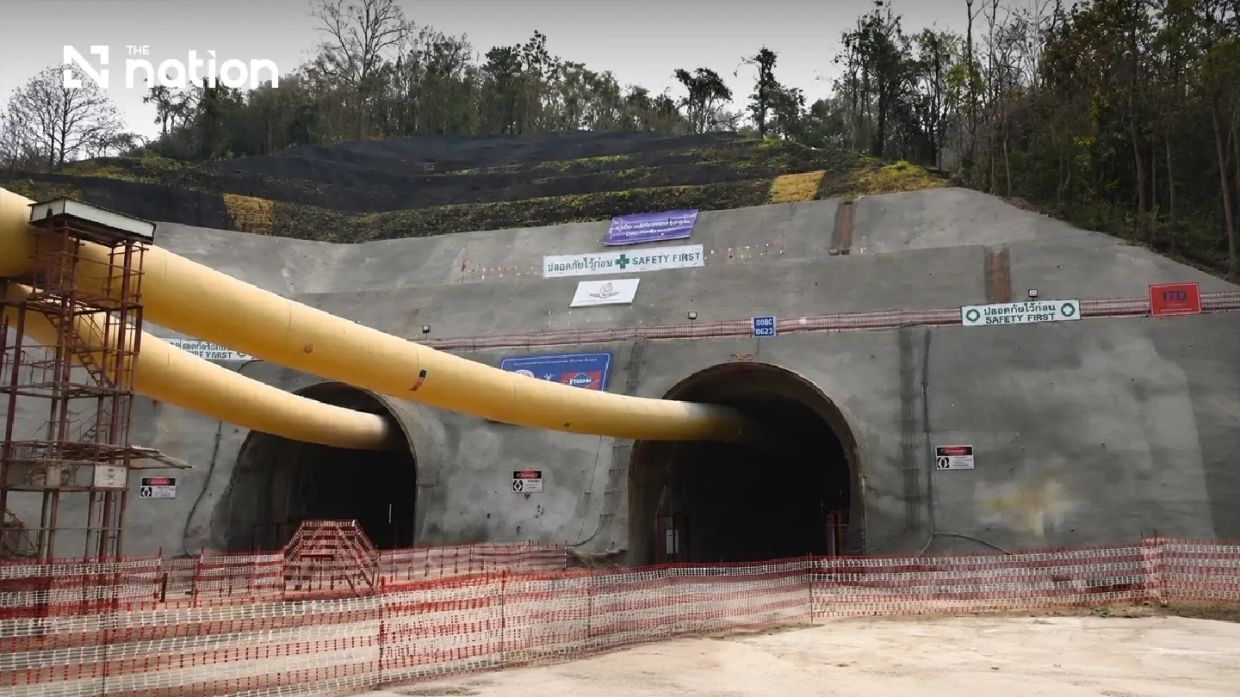
A catastrophic accident at a major Thai railway construction site has claimed two lives and left seven workers injured, highlighting fresh safety concerns within the country's ambitious rail infrastructure expansion programme. The incident occurred within the Doi Luang railway tunnel in Chiang Rai's Chiang Saen district on Saturday evening, during ongoing construction work on the State Railway of Thailand's Den Chai-Chiang Rai-Chiang Khong railway line, one of the country's significant connectivity projects linking the northern provinces.
According to initial reports received at 8.35pm, Deputy Transport Minister Siripong Angkasakulkiat indicated that the collapse was triggered when rocks dislodged from the tunnel wall and fell onto workers who were engaged in installing waterproofing systems at the site. Earlier accounts had suggested the structural failure occurred in the shotcrete construction zone, though subsequent investigation has refined understanding of the sequence of events. The exact mechanics of the incident remain subject to formal inquiry, with officials still compiling evidence to establish a definitive causal chain and identify any systemic or procedural failures that may have contributed.
The human toll of the accident extends beyond the two confirmed fatalities. Among the injured workers, three sustained serious injuries requiring intensive medical intervention, whilst four others suffered minor trauma. All casualties, both deceased and injured, have been transported to hospital facilities for treatment and formal examination. The immediate response by emergency services and site personnel appears to have prevented further escalation, though the incident raises troubling questions about working conditions and safety protocols in Thailand's construction sector, which has faced recurring criticism for inadequate worker protections.
The accident site was swiftly secured following the collapse, with the area cordoned off to prevent additional incidents and preserve evidence for investigation purposes. The project's dedicated safety unit assumed operational control of the location and implemented enhanced monitoring protocols to ensure no further deterioration of structural conditions. Transport officials emphasised that "the situation is now under control" in their initial public statements, though such assurances do little to address the gravity of what has transpired or the broader implications for worker safety across similar projects nationwide.
The Doi Luang tunnel represents a critical component of the expanding rail infrastructure in northern Thailand. At 3.4 kilometres in length, the tunnel has already been fully excavated through the mountainous terrain, and work is currently concentrated on internal systems installation and finishing works. This phase of construction, whilst less visually dramatic than the boring operations that preceded it, carries substantial technical complexity and inherent risks that demands rigorous management and adherence to international safety standards.
The tunnel forms part of Contract 3 of the larger Chiang Rai-Chiang Khong railway section, a massive undertaking valued at 19.385 billion Thai baht. This particular contract encompasses approximately 87 kilometres of both at-grade and elevated railway track construction, three full passenger stations, three railway halts, complete signalling and telecommunications infrastructure, and comprehensive related engineering works. The sheer scope of the project creates multiple vulnerability points where coordination lapses or safety oversights can have fatal consequences for workers employed at any stage of construction.
The contractor responsible for executing this critical contract is the CKST-DC3 Joint Venture, an alliance of three major Thai construction enterprises: CH. Karnchang Public Company Limited, Sino-Thai Engineering & Construction Public Company Limited, and Chiangmai Construction Co., Ltd. This consortium structure, while common in large infrastructure projects, distributes responsibility across multiple parties, which can sometimes complicate accountability mechanisms and safety oversight if coordination protocols are not exceptionally well-defined and enforced.
The Den Chai-Chiang Rai-Chiang Khong railway line forms a critical artery in Thailand's broader strategy to enhance regional connectivity and integrate northern provinces more effectively into the national transport network. Projects of this magnitude are essential for economic development and improved mobility across Southeast Asia, yet they must be executed with uncompromising commitment to worker safety. The region's development ambitions cannot be pursued at the cost of workers' lives, and incidents like Saturday's collapse demand thorough examination of whether current safety regimes are adequate or whether fundamental reforms in oversight and enforcement are necessary.
The State Railway of Thailand's Special Projects and Construction Department has mobilised to conduct detailed inspections of the accident scene, documenting every aspect of the structural failure and operational circumstances preceding the incident. Deputy Minister Siripong undertook to release further updates as investigations progress, though the initial timeline for completing comprehensive analysis remains unspecified. Such accidents typically trigger formal inquiries that examine not only the immediate triggering factors but also systemic issues including worker training, equipment maintenance, site management practices, and compliance with Thai and international construction safety standards.
For Malaysian readers and Southeast Asian observers, this incident carries important implications. Thailand's construction sector faces recurring criticism from international labour organisations regarding safety standards, worker protections, and enforcement mechanisms. As Malaysia and other regional economies undertake their own major infrastructure initiatives, this collision in Chiang Rai serves as a sobering reminder of the necessity for maintaining rigorous, independently monitored safety protocols regardless of project scale, contractor capabilities, or development pressures. The human cost of cutting corners in worker protection ultimately exceeds any financial or schedule benefits that might seem apparent to project managers focused narrowly on delivery metrics.
The broader context of Thailand's rail expansion programme reveals a nation pursuing genuinely transformative infrastructure development across multiple corridors simultaneously. Yet the effectiveness of such programmes depends entirely on the quality of execution and the protection afforded to the thousands of workers whose labour makes these projects possible. Saturday's tragedy underscores that development and worker welfare are not competing priorities but rather interconnected objectives that must be pursued in concert. Moving forward, stakeholder accountability—from contractor management through Transport Ministry oversight to international safety standards bodies—will determine whether similar incidents can be prevented or whether they represent merely the opening chapter of an unfortunate pattern.
%22%2F%3E%3C%2Fpattern%3E%3C%2Fdefs%3E%3Crect%20width%3D%22100%25%22%20height%3D%22100%25%22%20fill%3D%22url(%23ph1a04ig)%22%2F%3E%3Crect%20width%3D%22100%25%22%20height%3D%22100%25%22%20fill%3D%22url(%23ph1a04ip)%22%2F%3E%3Ctext%20x%3D%2250%25%22%20y%3D%2250%25%22%20text-anchor%3D%22middle%22%20dominant-baseline%3D%22central%22%20fill%3D%22rgba(255%2C255%2C255%2C0.95)%22%20font-family%3D%22Georgia%2C%20'Times%20New%20Roman'%2C%20serif%22%20font-weight%3D%22700%22%20font-size%3D%22151%22%20letter-spacing%3D%22-0.02em%22%3EBezzecchi%3C%2Ftext%3E%3C%2Fsvg%3E)