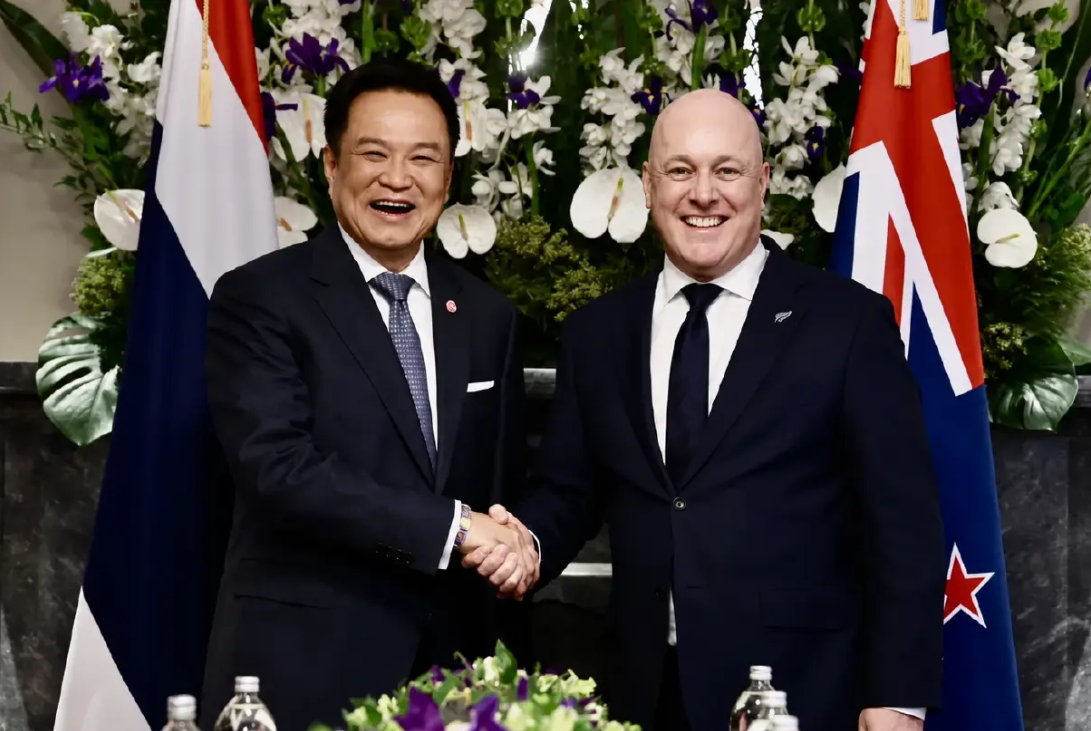
Thailand and New Zealand have formalised a strategic partnership aimed at substantially deepening economic and diplomatic ties between the two nations. Prime Minister Anutin Charnvirakul and his New Zealand counterpart Christopher Luxon signed the Joint Declaration on the Strategic Partnership during Anutin's official visit to Wellington on Friday, marking a significant upgrade from their previous bilateral arrangement. The timing of this upgrade coincides with the 70th anniversary of diplomatic relations, a symbolic moment chosen to underscore the historical foundations upon which this new chapter will be built.
Central to the partnership is an ambitious economic target: both countries aim to triple bilateral trade to US$7.5 billion, equivalent to approximately 246 billion baht, by 2045. This goal represents a substantial expansion from current trade volumes and reflects confidence in the complementary strengths of the two economies. For Malaysian observers, this development illustrates the increasingly sophisticated trade relationships being forged across the Asia-Pacific region, extending beyond traditional Southeast Asian partnerships. The bilateral trade target also highlights how smaller developed economies like New Zealand are pursuing strategic depth with major regional economies rather than pursuing purely multilateral arrangements.
The strategic partnership framework is structured around four distinct pillars of cooperation, each addressing specific areas of mutual interest and benefit. The political and security dimension emphasises enhanced coordination in combating transnational threats, including organised crime, sophisticated online scams, and human trafficking. Both nations have agreed to strengthen information-sharing mechanisms between their law-enforcement agencies, recognising that criminal networks increasingly operate across borders and jurisdictions. This security cooperation carries particular relevance for Southeast Asia, where transnational crime remains a persistent challenge affecting the region's stability and development.
The economic and innovation pillar represents perhaps the most consequential element of the partnership for business communities in both countries. Beyond the headline trade target, both governments commit to expanding investment flows and fostering collaborative innovation initiatives. Particular emphasis has been placed on food security, energy transition, sustainable agriculture, and environmental conservation—domains where New Zealand's advanced agricultural technology and conservation expertise can complement Thailand's position as a major regional agricultural producer. The two countries will further develop the Thailand–New Zealand Closer Economic Partnership to create new commercial opportunities, potentially opening market access in sectors ranging from dairy products to renewable energy equipment.
Education and cultural exchange form the third strategic pillar, reflecting recognition that sustainable bilateral relationships require strong people-to-people connections. Both governments plan to expand cooperation in skills development, innovation capacity-building, and educational exchanges. This dimension becomes particularly important given that travel connectivity has historically constrained deeper engagement between Thai and New Zealand citizens and institutions. Enhanced educational partnerships could create long-term benefits through shared knowledge development and professional networks that transcend governmental arrangements.
Regional and multilateral cooperation constitutes the fourth pillar, positioning the Thailand–New Zealand relationship within broader Asia-Pacific frameworks. Both nations intend to coordinate more closely through Mekong cooperation initiatives, Asean-led mechanisms including the East Asia Summit, and the Asia-Pacific Economic Cooperation forum. This approach reflects how middle-power nations like Thailand and New Zealand increasingly pursue strategic objectives through regional institutions rather than bilateral channels alone. For Malaysia, this development underscores the importance of mechanisms like Asean in facilitating cooperation among diverse regional actors with varying interests and capabilities.
Transport connectivity will receive a significant boost through Thai Airways' planned restoration of direct Bangkok–Auckland services, targeting March 2027 for commencement. Anutin indicated his desire to accelerate this timeline if commercially feasible, emphasising that direct flights constitute essential infrastructure for supporting tourism flows, educational mobility, and business travel between the two countries. The restoration of this route, previously suspended, signals confidence in sustained demand and represents a tangible manifestation of the strategic partnership beyond formal declarations and agreements. For regional aviation markets, this development reflects broader trends toward point-to-point connectivity as carriers seek to serve emerging middle-class travel demand across the Pacific.
The four cooperation documents signed alongside the strategic declaration demonstrate the breadth of engagement across governmental and private sectors. Cultural cooperation agreements will facilitate artistic and cultural exchanges, while education sector memoranda establish frameworks for institutional partnerships and student mobility. A significant agreement between Thai and New Zealand police forces creates formal mechanisms for information exchange and joint capacity-building initiatives addressing contemporary security challenges. A private-sector agreement involving Chata Instruments and Aeroqual Limited signals commercial interest in deepening business-to-business relationships, potentially establishing models for sectoral cooperation that governments can subsequently support through policy frameworks.
Thailand's aspirations regarding Organisation for Economic Co-operation and Development membership received explicit support from New Zealand during these discussions. Luxon's commitment to backing Thailand's OECD accession bid carries symbolic weight, as New Zealand's endorsement could facilitate dialogue with other OECD members. For Thailand, OECD membership represents validation of economic governance standards and could enhance its attractiveness to foreign investors concerned about institutional quality and regulatory transparency. This support also reflects how strategic partnerships increasingly incorporate support for partners' longer-term development objectives within international organisations.
The strategic partnership framework consciously incorporates acknowledgment of broader regional and global challenges requiring coordinated responses. Both nations reaffirmed commitment to a rules-based international order and multilateral systems as essential foundations for peace, stability, and sustainable development. This language carries particular significance given contemporary debates about multilateralism's efficacy and various nations' varying commitments to international institutions. For Southeast Asia, consistent support for multilateral frameworks from developed democracies like New Zealand reinforces institutional legitimacy during periods of geopolitical uncertainty.
From a Malaysian perspective, the Thailand–New Zealand strategic partnership demonstrates how bilateral relationships increasingly incorporate multiple dimensions of state capacity and commercial interest. The ambition to triple trade while simultaneously strengthening security cooperation, educational exchange, and regional coordination reflects sophisticated understanding of how national interests are advanced through layered, multifaceted engagement rather than narrow bilateral transactions. The structural framework around four pillars provides clarity regarding cooperation parameters while allowing flexibility as circumstances evolve and new opportunities emerge.
Looking forward, the success of this strategic partnership will depend substantially on implementation capacity and genuine prioritisation of agreed initiatives by relevant governmental agencies and commercial actors. The 2026–2030 Joint Plan of Action provides a concrete roadmap, yet translating policy frameworks into sustained cooperation typically requires consistent political attention and adequate resource allocation. Regional observers will monitor whether the dramatic trade-tripling target attracts sufficient private investment and whether restored air connectivity generates the anticipated tourism and business travel demand that makes such ambitious economic goals achievable.

