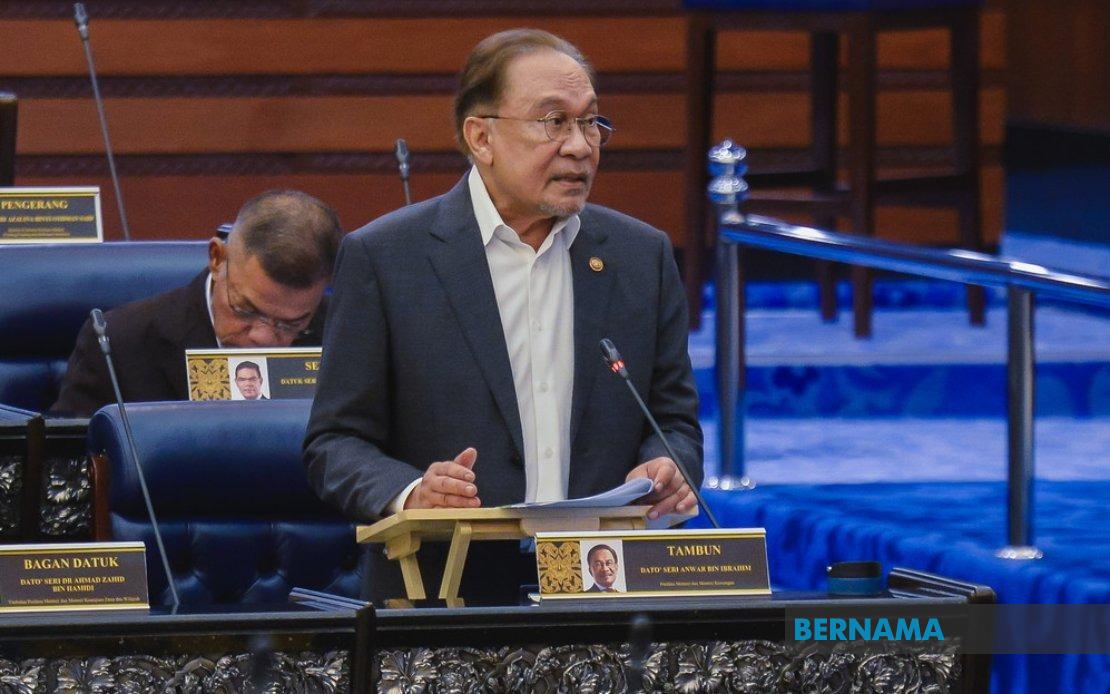
Prime Minister Datuk Seri Anwar Ibrahim has drawn a firm line on how development project cost overruns should be handled, declaring that state governments cannot unilaterally secure additional federal funding when they issue Notices of Change for their infrastructure schemes. Speaking in Parliament on June 30, he established that any state request for supplementary allocations or loans triggered by an NOC must go through a fresh negotiation process with the Federal Government, rather than proceeding on an assumption of automatic approval.
The Prime Minister's statement addresses a structural tension in Malaysia's federal system: state governments often initiate and manage development projects, yet cost escalations invariably involve the Federal Government's financial commitments. Anwar's position essentially resets the boundary between state autonomy and federal responsibility, signalling that Putrajaya will no longer simply rubber-stamp spending increases without scrutiny. This approach represents a tightening of fiscal discipline across the federation at a time when both state and federal governments face budgetary pressures.
Anwar explained that an NOC carries substantive financial implications beyond the simple reallocation of existing funds. When a contractor issues a Notice of Change—typically to document variations to the original contract scope, design modifications, or unforeseen site conditions—it fundamentally alters the project's cost structure. The Federal Government, as the ultimate guarantor of sovereign and public sector creditworthiness, cannot afford to treat these requests as procedural formalities. Instead, each NOC-driven funding request must be assessed on its merits, with particular attention to determining who bears responsibility for the cost increase.
A critical component of Anwar's framework involves accountability mechanisms. He emphasised that authorities must first investigate whether the contractor bears culpability for the cost escalation. This distinction matters significantly: if the contractor failed to manage site conditions, provide adequate planning, or meet contractual specifications, responsibility and financial liability should rest with the contractor or the state government, not transfer automatically to federal coffers. Conversely, if cost increases stem from genuine changes in project requirements or unforeseeable circumstances beyond any party's control, the justification for federal support becomes stronger. This differentiated approach suggests the Federal Government will demand evidence before committing additional taxpayer funds.
The Prime Minister's intervention was prompted by Datuk Awang Hashim, the Pendang MP from Perikatan Nasional, who raised the case of Kedah's Pulau Bunting Water Treatment Plant project. That specific scheme requires approval of an NOC due to cost pressures, making it a concrete test case for Anwar's new framework. Rather than simply granting or denying Kedah's request in isolation, the Federal Government now signals it will use the case to establish precedent and reinforce the principle that state-level spending decisions, however well-intentioned, do not automatically obligate federal resources.
This development has broader implications for how Malaysian states approach infrastructure financing. Historically, some state governments have viewed federal support as responsive to cost pressures, creating situations where projects are initiated with preliminary estimates that subsequently balloon. By insisting on renegotiation, the Federal Government incentivises states to conduct more rigorous initial planning, secure firmer contractor quotes, and exercise tighter supervision during implementation. States that maintain better cost discipline and fewer variations will find it easier to access federal support when legitimate needs arise, while those with persistent overrun patterns may find themselves required to fund incremental costs from their own resources or through alternative financing.
The assertion that the Federal Government cannot be bound by state government decisions represents a clarification of constitutional and fiscal principles. Malaysia's federation operates through a system where states retain significant powers over land and local development, yet federal resources ultimately underpin large-scale infrastructure. Anwar's statement essentially rebalances this arrangement, ensuring that the Federal Government retains decisional authority over its own financial commitments rather than being automatically conscripted to cover state spending escalations. This is particularly important given the pressures on federal finances from debt servicing, defence spending, and social welfare commitments.
Deputy Prime Minister Datuk Seri Fadillah Yusof, who holds the Energy Transition and Water Transformation portfolio, was tasked with providing detailed explanation on the Kedah water project matter. Fadillah's involvement signals that the water and energy sectors—critical infrastructure domains in Malaysia's development agenda—will be subject to the same rigorous assessment standards. This is significant for states and federal agencies planning expansion of water treatment capacity, renewable energy installations, or grid modernisation, all of which require substantial capital investment and sometimes necessitate mid-project variations.
The timing of this statement also reflects broader fiscal consolidation efforts underway in Malaysia. The Federal Government has been progressively tightening spending controls and improving budget discipline as part of its medium-term fiscal framework. Signalling stricter scrutiny of state-level cost overruns fits within this broader narrative of responsible governance and prudent resource allocation. It also sends a message to international investors and credit rating agencies that Malaysia is serious about managing public finances—an important consideration given the country's debt levels and ongoing refinancing needs.
For contractors and state procurement teams, the implication is clear: cost variations and NOCs will face heightened scrutiny. They will need to submit detailed justifications supported by evidence of changed circumstances, cost investigations, and comparative quotes. This may slow down some project implementation but could ultimately improve outcomes by catching problem areas earlier and holding all parties—contractors, state authorities, and federal agencies—to higher standards of documentation and accountability.
Looking forward, Anwar's stance establishes a framework that states and the Federal Government will navigate in future infrastructure disputes. The willingness to engage in renegotiation, rather than blanket rejection, suggests the Federal Government recognises that legitimate cost increases sometimes occur. However, the insistence on fresh assessment and proof of contractor culpability creates a clear expectation that such increases will not be accommodated lightly. For Malaysia's federal infrastructure programme, this represents a shift toward greater discipline and clarity in how public resources are deployed across state boundaries.

