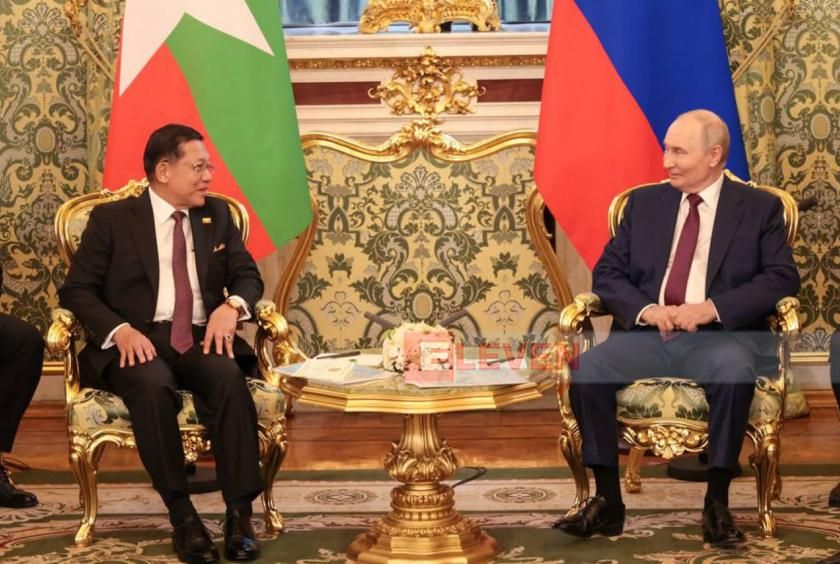
Russian President Vladimir Putin has signalled Moscow's readiness to deepen economic partnership with Myanmar, pledging active support for joint ventures in offshore oil and gas exploration alongside a broader infrastructure agenda spanning nuclear power, industrial facilities, and maritime development. The commitment emerged during a media engagement on August 18 as Myanmar's President U Min Aung Hlaing concluded discussions in Russia, culminating in the signing of a dozen bilateral memorandums of understanding that underscore the two nations' intention to substantially expand their footprint across multiple economic sectors.
The energy dimension of the Russia-Myanmar relationship represents perhaps the most strategically significant area of convergence. Putin specifically highlighted Russia's capacity to supply liquefied natural gas to Myanmar, framing such exports as viable both for domestic consumption and potential onward sales to regional partners. This proposal carries particular weight given Myanmar's energy infrastructure challenges and the growing demand for reliable fuel sources across Southeast Asia. Russia's ability to leverage its substantial LNG production capacity offers Myanmar an alternative to traditional suppliers, potentially diversifying the country's energy security profile at a time when regional demand for stable, long-term power supplies continues mounting. The offshore exploration dimension similarly positions Russia as a technical partner capable of unlocking Myanmar's untapped marine hydrocarbon reserves, though such ventures would require substantial foreign direct investment and advanced maritime engineering expertise.
Beyond hydrocarbons, Putin articulated a comprehensive vision of industrial cooperation spanning multiple sectors. Coal-fired power generation, oil refining, steel manufacturing, and fertiliser production constitute an interlinked industrial ecosystem that Russia proposes to develop within Myanmar's borders. These projects would represent substantial capital commitments and technology transfer, potentially reshaping Myanmar's industrial base. The most ambitious infrastructure initiative under discussion involves constructing a deep-sea port facility in southern Myanmar, a project with profound implications for regional trade flows and Myanmar's role as a maritime hub within the broader Indo-Pacific shipping network. Such a facility could significantly enhance Myanmar's attractiveness as a logistics hub, offering alternative routing options for regional commerce whilst generating substantial employment and tax revenue.
The nuclear power dimension of Russia-Myanmar cooperation, anchored in an agreement signed the previous year, signals Moscow's confidence in extending its nuclear technology and expertise into Southeast Asia. While Putin characterised this as a foundational project for both nations, the nuclear venture necessarily involves complex regulatory frameworks, international safeguarding mechanisms, and technical training requirements that will shape Myanmar's energy trajectory for decades. This development reflects broader Russian strategy to position itself as a leading provider of nuclear infrastructure across Asia, complementing similar initiatives elsewhere in the region.
Historical context significantly shapes contemporary Russia-Myanmar relations, with Putin explicitly invoking Soviet-era developmental assistance spanning the 1950s and 1960s. Hospitals, universities, and social infrastructure constructed during that period continue functioning, reinforcing a narrative of enduring Russian commitment to Myanmar's modernisation. This historical foundation provides diplomatic capital that newer partnerships lack, grounding contemporary cooperation within a longer arc of bilateral engagement that predates Myanmar's recent political transformations.
Cultural and educational dimensions form equally important pillars of the bilateral relationship. Putin noted that approximately 400 Myanmar nationals currently study at Russian universities, with 17,000 having graduated over preceding decades. This educational pipeline creates ongoing people-to-people connections and facilitates technology transfer through returning graduates. The expansion of Russian-language instruction at Myanmar universities and military institutions indicates intentional investment in human capital development, whilst visa-free arrangements facilitate scientific exchange, tourism, and athletic competition. Russian Orthodox Christian churches and cultural centres across Russian regions, coupled with Myanmar's reciprocal establishment of cultural organisations in Moscow and regional Russian cities, testify to mutual interest in cross-cultural understanding beyond purely commercial transactions.
Military-technical cooperation represents another significant dimension of Russian-Myanmar engagement. Putin highlighted the frequency of naval exercises conducted in Myanmar's territorial waters and regular visits by Russian naval vessels, indicating ongoing military interoperability development. This dimension carries geopolitical implications for broader Indo-Pacific security dynamics, reflecting Russia's interest in maintaining strategic presence in maritime Southeast Asia despite international isolation resulting from its Ukraine conflict. Myanmar's geographic position along crucial sea lanes and its relative openness to Russian military engagement distinguish it from many other regional states navigating complex security relationships.
The payment system anchored in mutual trust that Putin referenced reflects both nations' interest in reducing dependence on Western financial infrastructure and sanctions-vulnerable mechanisms. Such bilateral arrangements enable trade continuation despite international restrictions and represent pragmatic responses to geopolitical fragmentation. For Myanmar, this financial autonomy offers operational flexibility, whilst for Russia, it provides important economic counterweight to Western-imposed limitations.
Myanmarspecialist observers note that Russia's comprehensive engagement strategy across energy, infrastructure, defence, and cultural dimensions reflects a long-term commitment to anchoring Myanmar within its strategic orbit. This approach contrasts with engagement models emphasising narrow sectoral relationships, instead pursuing deep institutional linkages that create interdependencies difficult to unwind. For Myanmar, Russian partnership offers technological capacity, capital provision, and strategic alternatives to partners whose approaches may come encumbered with political conditionality regarding governance and human rights standards.
The twelve memorandums signed during this visit establish frameworks for implementing these ambitious proposals, though translating agreements into operational projects requires sustained political commitment, technical capability, and financial capacity across both nations. Success depends partly on Myanmar's ability to navigate international legal obligations regarding nuclear safeguards, environmental protection, and maritime law, alongside Russia's ability to deliver promised capital and expertise despite international sanctions constraining its financial and technological resources.
For regional observers including Malaysia and Southeast Asian nations, Russia's expanding Myanmar presence signals continued Russian strategic interest in Asian geopolitics beyond its traditional Central Asian focus. The breadth of cooperation spanning energy, infrastructure, defence, and cultural sectors indicates Moscow's determination to maintain Asian engagement despite Ukraine-related isolation. This development reshapes regional power dynamics and creates alternative partnerships that smaller nations can leverage when pursuing strategic autonomy and diversified international relationships.

