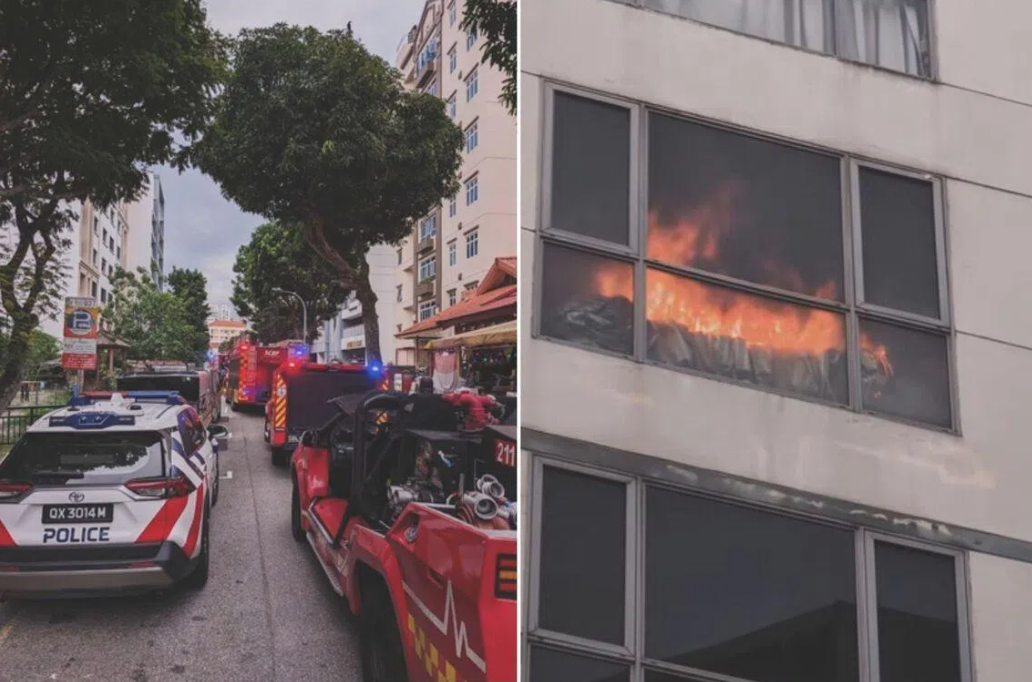
A fire originating from a charging power-assisted bicycle battery has prompted fresh safety concerns across Singapore's residential sector. The incident, which occurred at Casa Aerata condominium in Geylang on Sunday afternoon, forced the evacuation of five residents from neighbouring units as a precautionary measure, with emergency services responding swiftly to contain the threat. The Singapore Civil Defence Force was alerted to the blaze at 9 Lorong 26 Geylang at 5.35pm, where the battery had been left unattended whilst charging in the living room of a seventh-floor unit.
Emergency responders brought the fire under control using standard equipment including a hosereel and compressed air foam backpack apparatus, but the incident underscores a growing pattern of electrical fires linked to active mobility devices across the island. Preliminary investigations by the SCDF determined the fire's origin as electrical malfunction stemming from the power-assisted bicycle battery itself. Fortunately, no injuries resulted from the incident, though the potential danger became evident when heat from the flames caused a window to shatter, prompting nearby MP Cai Yinzhou to clear the area below the burning unit after he arrived at the scene.
The fire reflects broader challenges facing urban Singapore as the popularity of active mobility devices continues to surge. Power-assisted bicycles, personal mobility devices, and related micro-mobility solutions have transformed commuting patterns across Southeast Asia, offering convenient and environmentally friendly alternatives to car travel. However, the rapid adoption of these technologies has outpaced public awareness about proper charging practices and the inherent risks associated with battery management. What began as a niche segment has matured into a mainstream transportation option, yet safety protocols have not uniformly evolved alongside this adoption curve.
Authorities are now reinforcing critical safety guidelines following this latest incident. The SCDF has issued explicit warnings against purchasing or using non-original batteries for active mobility devices, emphasising that counterfeit or substandard battery components significantly elevate fire risk. Additionally, users should avoid charging batteries for extended periods or overnight, practices that can degrade battery integrity and increase the likelihood of thermal runaway—a cascade failure where battery temperature rises uncontrollably, ultimately leading to combustion.
Statistical data from the current year reveals the magnitude of the problem across residential Singapore. Of 304 electrical fire incidents reported at residential premises through mid-2025, 34 involved active mobility devices—representing approximately 11 percent of all residential electrical fires. This concentration highlights how concentrated the risk has become within certain device categories. The broader AMD category, which encompasses personal mobility devices, power-assisted bicycles, and personal mobility aids, has established itself as a significant contributor to residential fire emergencies.
Year-on-year comparisons provide some reassurance but also reveal troubling trends within specific subcategories. Total AMD-related fires declined from 67 incidents in 2024 to 49 in 2025, suggesting that awareness campaigns and safety interventions may be yielding measurable results. However, this overall improvement masks a concerning shift: personal mobility device fires specifically surged from 25 cases to 31 cases during the same period. This divergence suggests that whilst power-assisted bicycle users may be heeding safety messages more effectively, personal mobility device owners have not yet embraced equivalent precautionary measures.
For Malaysian readers and residents across Southeast Asia, the Singapore experience carries significant implications. Malaysia's own active mobility ecosystem is expanding rapidly, with similar pressures on charging infrastructure and user safety awareness. Cities like Kuala Lumpur, Penang, and Johor Bahru have witnessed explosive growth in personal mobility device usage, yet regulatory frameworks and public safety campaigns have not uniformly kept pace with adoption rates. The incidents documented in Singapore serve as a cautionary blueprint for what can occur when technological adoption races ahead of safety infrastructure and public education.
The charging of high-capacity lithium-ion batteries—the standard power source for virtually all modern active mobility devices—remains a technically complex process that many users treat casually. Battery degradation, manufacturing defects, physical damage from transport or use, and exposure to extreme temperatures all contribute to failure risk. When users employ substandard replacement batteries or charging equipment, these risks amplify substantially. The economics of counterfeit batteries, which cost significantly less than original components, create powerful incentives for cost-conscious users, particularly in price-sensitive markets across the region.
Infrastructural considerations compound these challenges throughout Southeast Asia. Residential buildings typically lack dedicated charging stations with proper electrical oversight, forcing residents to charge devices in living spaces using standard household outlets. This practice, whilst convenient, concentrates risk in areas where fires pose maximum danger to occupants. By contrast, commercial charging hubs with monitored infrastructure and automatic cutoff systems represent a demonstrably safer alternative, yet such facilities remain sparse and underutilised across most regional cities.
The case of MP Cai Yinzhou's rapid response at the scene also highlights how community vigilance and swift public action prevented potential escalation. His presence allowed immediate evacuation of the area below the burning unit, potentially preventing serious injuries from falling debris or glass fragments. This underscores how individual awareness and civic responsibility function as critical safety layers, complementing formal emergency response systems. In densely populated residential environments typical of major Southeast Asian cities, such community consciousness becomes integral to fire prevention and management.
Moving forward, regional authorities face mounting pressure to implement comprehensive safety frameworks governing active mobility device batteries and charging practices. These frameworks should encompass mandatory use of original or certified batteries, labelling requirements clearly communicating fire risks, installation of charging stations in common areas rather than individual units, and sustained public education campaigns targeting both users and residential building operators. Such measures proved effective in other technical domains and could meaningfully reduce incidents without substantially impeding the legitimate growth of the micro-mobility sector.
The Geylang condominium fire represents neither an isolated anomaly nor an inevitable consequence of technological progress. Rather, it exemplifies a critical juncture where policy choices, infrastructure investments, and consumer behaviour collectively determine whether active mobility devices remain safe transportation options or evolve into household fire hazards. For Malaysia and neighbouring countries racing to adopt similar technologies, the path forward demands deliberate attention to safety infrastructure before incidents force reactive policy changes that could undermine the entire sector's legitimacy and growth trajectory.

%22%2F%3E%3C%2Fpattern%3E%3C%2Fdefs%3E%3Crect%20width%3D%22100%25%22%20height%3D%22100%25%22%20fill%3D%22url(%23ph55nedg)%22%2F%3E%3Crect%20width%3D%22100%25%22%20height%3D%22100%25%22%20fill%3D%22url(%23ph55nedp)%22%2F%3E%3Ctext%20x%3D%2250%25%22%20y%3D%2250%25%22%20text-anchor%3D%22middle%22%20dominant-baseline%3D%22central%22%20fill%3D%22rgba(255%2C255%2C255%2C0.95)%22%20font-family%3D%22Georgia%2C%20'Times%20New%20Roman'%2C%20serif%22%20font-weight%3D%22700%22%20font-size%3D%22170%22%20letter-spacing%3D%22-0.02em%22%3EMalaysia%3C%2Ftext%3E%3C%2Fsvg%3E)
%22%2F%3E%3C%2Fpattern%3E%3C%2Fdefs%3E%3Crect%20width%3D%22100%25%22%20height%3D%22100%25%22%20fill%3D%22url(%23ph41529g)%22%2F%3E%3Crect%20width%3D%22100%25%22%20height%3D%22100%25%22%20fill%3D%22url(%23ph41529p)%22%2F%3E%3Ctext%20x%3D%2250%25%22%20y%3D%2250%25%22%20text-anchor%3D%22middle%22%20dominant-baseline%3D%22central%22%20fill%3D%22rgba(255%2C255%2C255%2C0.95)%22%20font-family%3D%22Georgia%2C%20'Times%20New%20Roman'%2C%20serif%22%20font-weight%3D%22700%22%20font-size%3D%22170%22%20letter-spacing%3D%22-0.02em%22%3EMalaysia%3C%2Ftext%3E%3C%2Fsvg%3E)