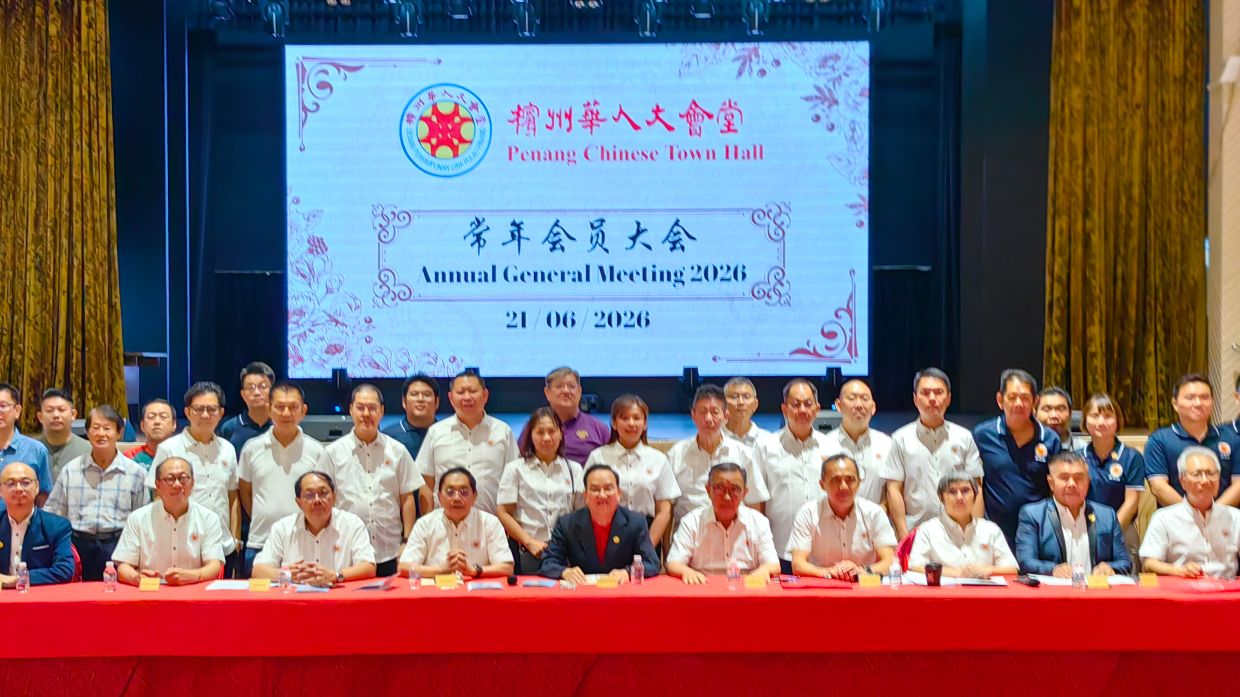
Penang Chinese Town Hall has reported healthy financial performance for the year ended December 31, 2025, with total income reaching RM12.61mil against expenditure of RM12.55mil, leaving a slim surplus of RM59,191. The relatively balanced budget reflects the organisation's careful management of resources whilst navigating operational demands across its Penang headquarters and community programmes.
Donations proved to be the lifeblood of PCTH's revenue model, contributing RM11.24mil or approximately 89% of total income according to the annual report presented at the organisation's annual general meeting. This heavy reliance on philanthropic support underscores both the strength of donor commitment to the institution's mission and the challenges facing community organisations that depend on voluntary contributions in an increasingly competitive fundraising environment. Supplementary income streams, whilst modest, demonstrate diversification efforts: rental and maintenance fees generated RM439,671, auditorium rental brought in RM361,245, and anniversary-related activities contributed RM222,498 to the coffers.
On the expenditure side, donations distributed to beneficiaries and charitable causes dominated spending patterns, totalling RM11.12mil and accounting for 88.6% of total outlays during the year. This reflects PCTH's core mission of channelling resources back into the community and supporting worthy causes. However, the organisation saw donations rise from RM11.12mil in 2025 compared to RM12.35mil in 2024, suggesting either a contraction in donor giving or a strategic shift in distribution patterns. Operational costs also increased, with salaries and allowances climbing to RM502,625 from RM452,761 in the prior year—a rise of approximately 11% that likely reflects wage adjustments and potentially expanded staffing to support facility enhancements.
The annual general meeting, held on June 21 and attended by approximately 200 members, provided a platform for chairman Tan Sri Prof Tan Khoon Hai to address broader societal concerns alongside routine organisational matters. Drawing connections between institutional governance and national civic responsibility, he emphasised the importance of voter participation and informed decision-making in upcoming elections, particularly in light of state polls scheduled for Johor and Negri Sembilan during 2025. His remarks reflected an understanding that community organisations like PCTH carry moral weight in encouraging civic engagement beyond their immediate mandates.
Tan's electoral message resonated with calls for rational assessment of competing political parties based on their track records and policy platforms. He argued that voters should evaluate candidates on their capacity to forge national unity, stimulate economic expansion, and maintain social cohesion rather than on parochial or personality-driven grounds. The linkage between electoral choices and long-term nation-building represented a departure from purely transactional political discourse, positioning PCTH as an institution concerned with governance quality and institutional integrity.
Beyond financial reporting and civic exhortation, the organisation unveiled significant capital improvements to its physical infrastructure. The newly renovated Ping Zhang Hall emerged as a centrepiece of these investments, having undergone comprehensive modernisation to enhance user experience and broaden its appeal. The upgraded facility now boasts contemporary aesthetics, improved spatial configurations, and sophisticated technical systems including professional-grade sound, lighting, and LED technology. This repositioning of Ping Zhang Hall as a premium event venue targets corporate clients, professional associations, and community groups seeking high-quality settings for dinners, celebrations, charity galas, and networking functions.
The facility upgrade strategy reflects recognition that community organisations must compete in the modern hospitality and events sector by matching technological standards and environmental quality offered by commercial counterparts. By investing in physical plant and technical infrastructure, PCTH positions itself to generate additional revenue streams through facility rental whilst simultaneously enhancing the member experience and creating attractive venues for internal gatherings. This approach bridges traditional community mission with contemporary entrepreneurial thinking.
Looking beyond Penang's borders, PCTH announced an ambitious initiative to co-organise the 2026 China-Asean Artificial Intelligence Cooperation Forum scheduled for November in Penang. This partnership with business and technology organisations from China and Southeast Asian nations signals the organisation's ambitions to establish itself as a nexus for regional technological dialogue and industrial collaboration. The forum will convene experts, corporate leaders, and industry specialists to examine emerging AI applications, industrial deployment pathways, and transnational business opportunities across the region.
Penang's historical positioning as the Silicon Valley of the East and its established credentials as Malaysia's electrical and electronics manufacturing heartland provide natural foundations for AI sector development. Tan articulated a vision of Penang as a natural hub for artificial intelligence advancement, capitalising on existing industrial clusters and technical expertise. The AI cooperation forum represents an attempt to elevate Penang's profile within regional technology ecosystems whilst positioning PCTH as more than a charitable or social welfare body—rather, as an institution capable of convening high-level business and academic discourse.
The organisation's strategic pivot toward hosting technology forums and AI cooperation discussions reflects broader trends amongst traditional community institutions seeking relevance and influence in knowledge-economy contexts. By facilitating dialogue between Chinese, Asean, and Malaysian stakeholders in artificial intelligence, PCTH extends its reach beyond conventional charitable activities into realms of industrial policy, technological transfer, and business networking. This diversification of institutional purpose may also create fresh fundraising opportunities and attract new categories of corporate and government sponsors.
Tan's invitation for members with relevant technological expertise to participate in forum planning and execution represents an attempt to harness internal intellectual capital and deepen member engagement beyond annual meetings and social gatherings. By positioning the organisation as a serious participant in regional technology governance and business development, PCTH aims to strengthen community identity and member pride whilst building Penang's reputation as a nexus for Asia-Pacific technological cooperation. The 2026 forum, if successfully executed, could establish a model for recurring regional engagement and position the organisation at the intersection of community service, business development, and international relations.


%22%2F%3E%3C%2Fpattern%3E%3C%2Fdefs%3E%3Crect%20width%3D%22100%25%22%20height%3D%22100%25%22%20fill%3D%22url(%23ph25js3g)%22%2F%3E%3Crect%20width%3D%22100%25%22%20height%3D%22100%25%22%20fill%3D%22url(%23ph25js3p)%22%2F%3E%3Ctext%20x%3D%2250%25%22%20y%3D%2250%25%22%20text-anchor%3D%22middle%22%20dominant-baseline%3D%22central%22%20fill%3D%22rgba(255%2C255%2C255%2C0.95)%22%20font-family%3D%22Georgia%2C%20'Times%20New%20Roman'%2C%20serif%22%20font-weight%3D%22700%22%20font-size%3D%22151%22%20letter-spacing%3D%22-0.02em%22%3EPerikatan%3C%2Ftext%3E%3C%2Fsvg%3E)