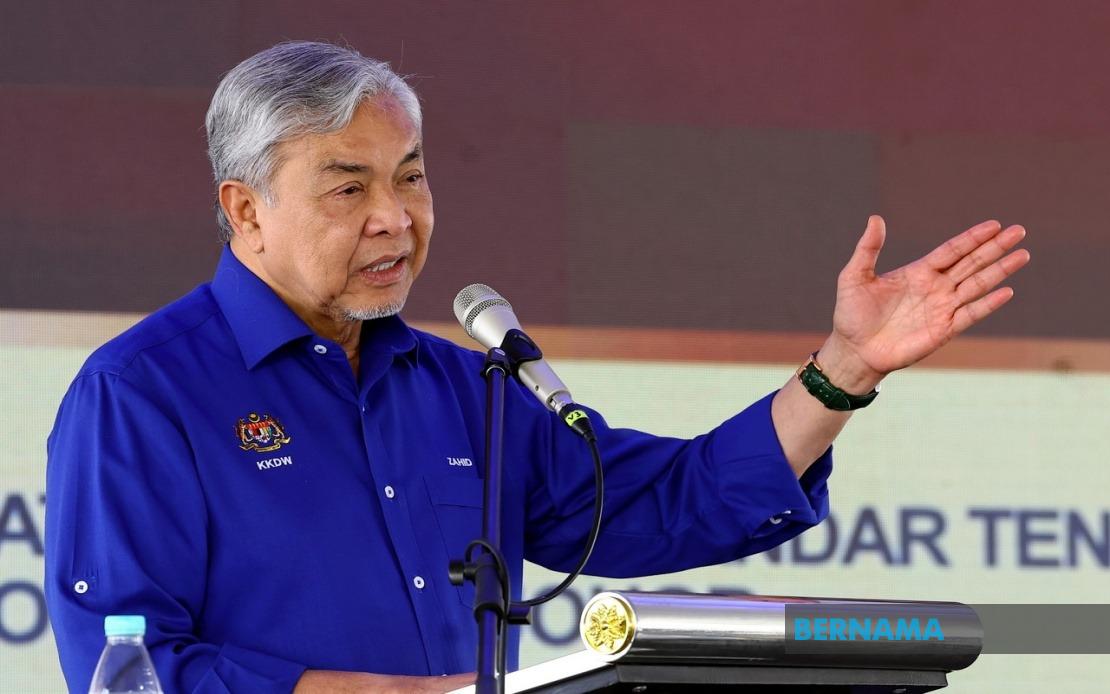
Malaysia's government has set an ambitious target to halve its food import dependency over the next three decades, addressing a spiralling annual bill that currently stands at approximately RM80 billion. Deputy Prime Minister Datuk Seri Dr Ahmad Zahid Hamidi, who also oversees the Ministry of Rural and Regional Development, announced the long-term food security strategy during an official event in Kota Tinggi, outlining a phased implementation that will fundamentally reshape the nation's agricultural landscape and reduce its vulnerability to global food market volatility.
The three-decade roadmap divides the objective into achievable milestones, beginning with a 15 per cent reduction in food imports by 2030, escalating to a 30 per cent cut by 2040, before reaching the ultimate 50 per cent target in 2050. This structured progression reflects an acknowledgment that transforming Malaysia's food production infrastructure requires sustained investment, technological advancement, and systematic development of domestic agricultural capacity. The phased approach also allows policymakers to assess outcomes and adjust strategies based on market conditions and production capabilities as the initiative unfolds across multiple electoral cycles and government administrations.
The ministry's strategy hinges on activating and optimising land currently owned by government agencies but left idle or underutilised. Rather than acquiring new territory, which would prove economically inefficient and administratively complex, the Rural and Regional Development Ministry plans to convert existing holdings into productive Agro MADANI projects and livestock farming zones. This land-optimisation approach represents a pragmatic solution to Malaysia's historical challenge of balancing agricultural productivity with competing land-use demands from urbanisation, industrial development, and conservation initiatives.
Three key agencies will drive this agricultural transformation: RISDA, the rubber industry stabilisation and development authority; FELCRA, which manages cooperative land schemes; and the Department of Veterinary Services, alongside state-level agricultural authorities. This multi-agency collaboration signals recognition that food security requires coordinated action across separate institutional domains, breaking down bureaucratic silos that have historically fragmented Malaysia's agricultural policy. The partnership model essentially leverages existing government infrastructure and expertise rather than creating new administrative structures, thereby minimising implementation costs while accelerating programme rollout.
Livestock farming emerges as a particular focus area within this integrated framework. Domestic broiler chicken and layer egg production have already demonstrated their capacity to stabilise consumer prices when supply volumes increase sufficiently, according to Ahmad Zahid's statement. These sectors offer particular advantages for Malaysia: they require less land than crop farming, can be scaled rapidly through controlled management practices, and directly address essential food categories with consistently high demand. The success of previous chicken and egg initiatives provides empirical evidence that government-supported livestock expansion can tangibly improve affordability for Malaysian households while reducing dependency on international suppliers.
Ahmad Zahid emphasised that government involvement in livestock production does not constitute market competition against existing commercial farmers. Rather, the ministry frames its role as supply-augmentation designed to achieve price stability for consumers. This positioning attempts to address longstanding tensions between government agricultural initiatives and private sector operators, who fear unfair competition from state-backed projects. By framing government production as a complementary supply mechanism rather than a replacement for commercial farming, the ministry seeks political space to expand public-sector agricultural involvement without triggering coordinated opposition from established agricultural businesses.
The announcement reflects deeper anxieties about Malaysia's structural vulnerability to food security disruptions. At present, the nation spends an estimated RM80 billion annually on food imports, representing a substantial fiscal drain and exposing the country to currency fluctuations, supply chain disruptions, and price volatility in global agricultural markets. The 2022 global food crisis, triggered by the Russia-Ukraine conflict and exacerbated by climate-related production failures across multiple continents, demonstrated how rapidly food-importing nations can face affordability crises and availability shortages when international supply tightens. Malaysia's experience during pandemic-related supply chain disruptions underscored similar vulnerabilities, creating political impetus for import-substitution strategies.
The food security initiative actually commenced nationwide three years prior to Ahmad Zahid's July 2024 announcement, suggesting this represents a matured policy framework rather than novel bureaucratic initiative. The extension of this programme through Rural and Regional Development Ministry coordination indicates an attempt to accelerate and institutionalise gains from the initial rollout phase. By embedding food security objectives within permanent ministry structures and multi-agency frameworks, policymakers seek to ensure continuity beyond individual political tenures and protect the initiative from budgetary cuts or policy reversals accompanying electoral transitions.
For Malaysian consumers, successful implementation of this strategy could translate into more affordable protein sources and greater price predictability for essential food categories. The emphasis on chicken and eggs addresses the most economically accessible animal protein options for lower and middle-income households, potentially alleviating inflationary pressures that have squeezed household budgets in recent years. However, achieving these outcomes requires sustained funding commitments, technological investment in modern farming practices, workforce training programmes, and effective supply chain logistics to distribute increased domestic production efficiently across the country.
The broader context involves Malaysia's ongoing effort to enhance competitiveness and self-sufficiency across strategic sectors. Food security resonates politically across diverse constituencies, transcending typical partisan divides because affordable nutrition affects all demographic groups. The government's willingness to commit to a fifty-year horizon reflects recognition that agricultural transformation demands patience and continuity incompatible with shorter political cycles. Whether successive administrations will maintain commitment and funding for this three-decade initiative remains uncertain, yet the announcement signals serious governmental intent to rebalance Malaysia's food system toward greater domestic production capacity and reduced import vulnerability.

