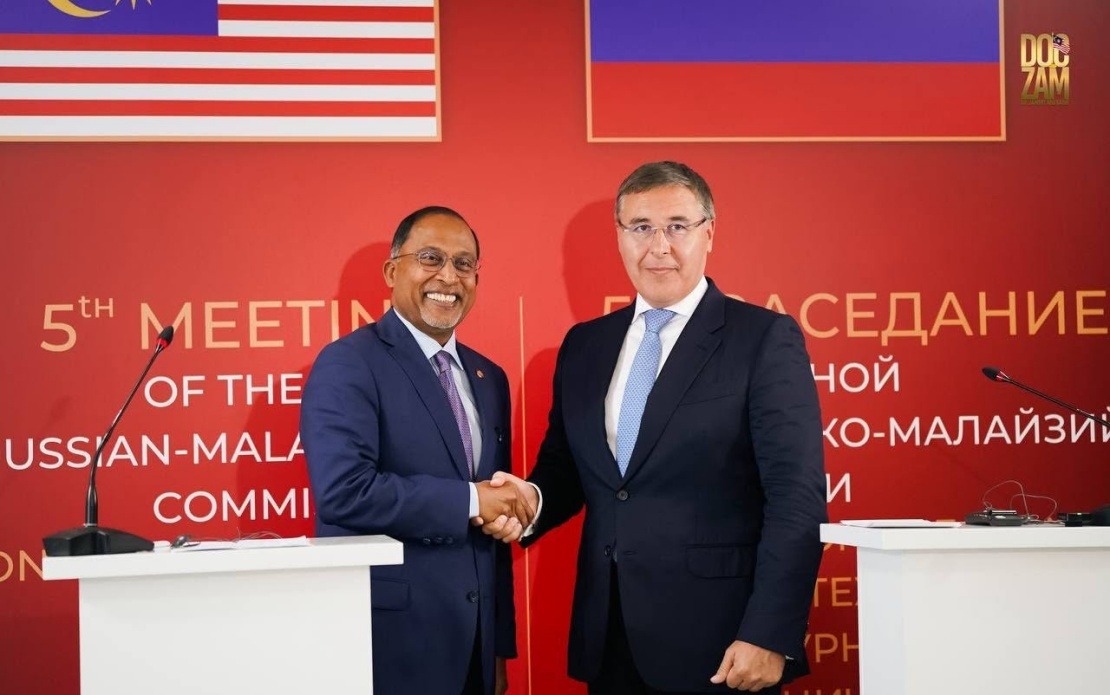
Malaysia and Russia have pledged to complete their 2027 Joint Action Plan by the end of this year, signalling a renewed push to transform their bilateral relationship into more systematic and tangible outcomes. Higher Education Minister Datuk Seri Dr Zambry Abd Kadir made the announcement following the Fifth Meeting of the Malaysia-Russia Joint Commission for Economic, Scientific, Technical and Cultural Cooperation, held in Vladivostok with Russian Minister of Science and Higher Education Valery Falkov. The commitment reflects an effort to capitalise on strengthened political ties at the highest levels, including engagement between His Majesty Sultan Ibrahim, King of Malaysia, Russian President Vladimir Putin and Prime Minister Datuk Seri Anwar Ibrahim.
The significance of finalising this action plan lies in its potential to provide Malaysia and the broader Southeast Asian region with enhanced institutional frameworks for cooperation with Russia. By establishing clear structures and measurable objectives, the two nations aim to move beyond symbolic gestures towards concrete collaborative initiatives that deliver demonstrable benefits to their populations. This approach aligns with Malaysia's strategy of diversifying international partnerships while maintaining balanced relations with major powers. For Malaysian policymakers, the plan represents an opportunity to leverage Russian expertise in specific sectors where technological advancement and capacity-building remain priorities.
Higher education stands out as a cornerstone of the evolving partnership. Russia will continue offering forty government scholarships annually to Malaysian students, a programme that has historically provided access to quality education in engineering, science and technology fields. Beyond scholarship provisions, the two countries have embraced an ambitious agenda that includes establishing the first Malaysia-Russia Rectors' Forum in 2027, a platform designed to foster institutional dialogue and collaborative research between universities. The expansion of the MAI-UniKL Russian Aerospace Programme represents another dimension of this commitment, reflecting Malaysia's growing interest in advanced aerospace technology and engineering capabilities. These educational initiatives carry particular weight for Malaysian students seeking alternatives to traditional Western educational pathways, while simultaneously building human capital connections that sustain diplomatic relations across generations.
Trade and agricultural cooperation emerged as critical discussion points during the meeting. Both nations recognised the need to expand market access and strengthen commercial ties, with particular emphasis on fertiliser supply, including urea, to bolster Malaysia's food security objectives. This focus on agricultural inputs acknowledges the vulnerability of Southeast Asian food systems to external shocks and supply chain disruptions. For Malaysia, securing reliable sourcing arrangements with Russia—a major fertiliser producer—could provide strategic stability in commodity markets often subject to volatility. The dialogue also explores broader investment opportunities, suggesting that Russian capital may increasingly flow into Malaysian sectors beyond traditional energy partnerships.
Strategic sector cooperation has expanded significantly across multiple domains. Artificial intelligence, digital technology, smart cities and information security represent forward-looking areas where both nations recognise mutual advantage in knowledge exchange and technological development. Renewable energy and liquefied natural gas cooperation underscore Russia's continued relevance to Malaysia's energy transition agenda, while exploration of peaceful nuclear energy applications opens longer-term possibilities subject to regulatory compliance. The breadth of these partnerships indicates that Malaysia views Russia not merely as an energy supplier but as a multifaceted technological partner capable of contributing to the country's transformation into a digital economy and green energy nation.
Financial cooperation has reached a new phase involving direct engagement between Bank Negara Malaysia and the Bank of Russia. Discussions around Labuan's potential role as an international financial centre and gateway to ASEAN suggest innovative thinking about regional financial architecture. Malaysia's position as a gateway to ASEAN markets, combined with Labuan's established regulatory frameworks for international finance, creates a distinctive opportunity for Russian investors and financial institutions seeking deeper Southeast Asian market access. Additionally, exploration of Islamic finance cooperation and digital assets reflects the cosmopolitan nature of modern bilateral relations, where religious and cultural contexts shape financial innovation rather than constrain it.
The exchange of formal cooperation agreements between Malaysian and Russian higher education institutions demonstrates commitment beyond rhetoric. Universiti Teknologi MARA has partnered with Moscow Power Engineering Institute and the Institute of Experimental Medicine, while Universiti Tun Hussein Onn Malaysia has established ties with the State University of Land Use Planning. These institutional linkages create channels for ongoing academic collaboration, student mobility and research partnerships that extend beyond government-level negotiations. The diversity of participating institutions suggests that cooperation encompasses multiple academic disciplines, from engineering and technology to medicine and environmental planning.
Industrial cooperation, healthcare advancement, transport development, green technology and space sector engagement represent emerging frontiers in the bilateral relationship. The inclusion of space cooperation particularly reflects both nations' recognition that technological competition at the global level demands sustained investment in cutting-edge capabilities. Malaysia's aspiration to develop indigenous space technology capacity aligns with broader regional interests in space applications for environmental monitoring, telecommunications and scientific research. Healthcare cooperation may facilitate knowledge transfer in medical technology and pharmaceutical development, sectors where Russia maintains significant capabilities despite international isolation in recent years.
The selection of Malaysia as host for the sixth Joint Commission meeting in 2027, coinciding with the sixtieth anniversary of Malaysia-Russia diplomatic relations, carries symbolic weight alongside practical importance. This decision demonstrates confidence in Malaysia's capacity to host high-level meetings while celebrating six decades of continuous bilateral engagement. The convergence of the sixth meeting with the diplomatic anniversary creates opportunity for comprehensive reflection on the relationship's trajectory and forward strategic planning. For Malaysia, hosting this meeting positions the country as a serious stakeholder in Russia's Southeast Asian strategy during a period of geopolitical recalibration.
The overarching framework emphasises mutual respect and mutual benefit, principles that resonate with Malaysia's broader foreign policy orientation. Rather than subservient alignment with any major power, Malaysia has consistently pursued partnerships that serve national interests while maintaining diplomatic flexibility. The 2027 Joint Action Plan represents this pragmatic approach applied to Russia relations. As Malaysia navigates complex regional dynamics involving China, the United States and India, Russia's role in technology transfer, educational provision and strategic sector cooperation offers complementary benefits that enhance rather than constrain Malaysia's room for manoeuvre.
For Southeast Asian observers, Malaysia's deepening engagement with Russia carries broader implications. As regional nations seek to balance great power competition through strategic autonomy, Malaysia's model of institutionalised partnership with Russia while maintaining other critical relationships offers instructive lessons. The emphasis on practical cooperation in education, technology and commerce suggests that bilateral relationships can flourish in challenging geopolitical contexts when built on genuine complementarities rather than ideological alignment. Malaysia's experience demonstrates that Russian partnership remains viable and beneficial for Southeast Asian nations willing to engage constructively on shared interests.

