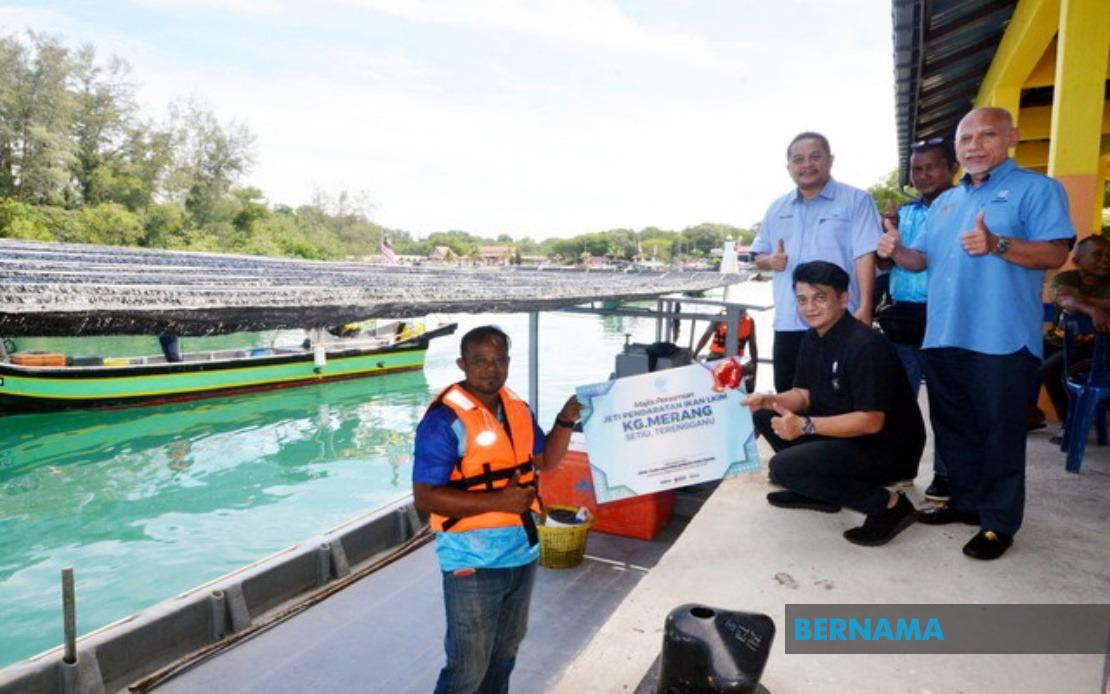
The Malaysian Fisheries Development Authority (LKIM) is making significant strides in modernising fishing infrastructure across the nation, having allocated RM2 million since the previous financial year towards repairing, upgrading and constructing fish landing jetties in communities from Peninsular Malaysia to the maritime states of Sabah and Sarawak. The initiative represents a targeted effort to address long-standing challenges in the fishing sector, where outdated or inadequate landing facilities have constrained the ability of fishermen to efficiently process and market their catches.
LKIM chairman Muhammad Faiz Fadzil announced during the official handover of the Kampung Merang Fish Landing Jetty in Setiu, Terengganu that the current financial year has already witnessed the successful completion of the Merang project, while two further ventures in Perak and Labuan remain in preparatory stages involving design finalisation and competitive tendering. This phased approach reflects the methodical manner in which LKIM is deploying capital across geographically dispersed fishing communities, ensuring that projects meet structural and safety standards before deployment.
The Merang installation cost RM500,000 and represents a substantial physical upgrade from its predecessor, which villagers had constructed and maintained through informal arrangements. That original structure had deteriorated to the point where it posed safety risks and operational inefficiencies for landing and sorting activities. The new concrete jetty now provides a purpose-built facility capable of handling regular commercial operations, addressing decades of infrastructure deficit in this particular community.
With 372 fish landing jetties currently under LKIM's stewardship nationwide, alongside 48 dedicated fisheries complexes and ancillary port facilities, the authority manages an extensive network designed to serve the entire value chain of commercial fishing. Yet this substantial portfolio masks significant disparities in facility quality and capacity, with many older installations requiring systematic refurbishment to meet contemporary standards. The RM2 million allocation, while meaningful, represents only a fraction of the investment required to comprehensively modernise facilities across the archipelago's numerous coastal communities.
Muhammad Faiz has consequently signalled that LKIM intends to petition the government for substantially enhanced funding allocations in the forthcoming annual budget cycle. The authority recognises that the present expenditure level, though productive, cannot deliver the comprehensive infrastructure transformation that Malaysia's fishing sector requires. This appeal reflects the reality that coastal fishing communities have historically received proportionally fewer development resources compared to other agricultural sectors, despite their critical importance to food security and rural employment in maritime states.
The Merang facility is projected to directly benefit 124 licensed fishermen operating a combined fleet of 68 vessels, representing a concentrated impact within a single locality. These operators previously faced practical obstacles in landing, sorting and preparing their catches for sale, with inefficient facilities adding friction and costs to their commercial activities. The availability of modern landing infrastructure reduces post-harvest losses, enables faster market access and supports higher-grade product presentation to wholesalers and retailers.
Current annual fish landings in the Setiu district amount to approximately 243 metric tonnes, with LKIM expressing confidence that this volume will rise once fishermen fully utilise the newly constructed facility. This projection rests on the assumption that improved operational efficiency and safer working conditions will encourage greater productive effort among the fishing community. However, actual output growth will also depend on broader factors including fish stock availability, market demand and fuel costs.
The fundamental economic case for investing in landing infrastructure rests on straightforward market mechanics. Fishermen depend almost exclusively on daily catch sales for household income, and any reduction in the time, effort or loss associated with landing and marketing activities directly translates to earnings enhancement. A jetty that permits rapid offloading, sorting and transfer to cold storage or transportation reduces spoilage, improves product quality and strengthens the fisherman's negotiating position with buyers. These efficiency gains compound over time as fishermen can redirect labour and capital previously consumed by logistics towards expanded fishing operations.
Beyond immediate income effects, modernised landing infrastructure generates secondary benefits throughout coastal economies. The employment ecosystem around fishing docks—ice suppliers, transport operators, maintenance workers, traders and processors—becomes more viable and formalised when facilities meet professional standards. This creates spillover opportunities for women and youth in value-added activities including fish processing, packaging and distribution, potentially diversifying livelihood options beyond primary fishing.
For Malaysian policymakers, the investment in jetty infrastructure represents a politically pragmatic and economically sound intervention within the fishing sector. Coastal constituencies, particularly in states like Terengganu, Kelantan and Sabah, maintain substantial fishing populations whose electoral significance merits sustained government attention. Visible improvements in landing facilities deliver tangible demonstrations of state capacity and commitment to rural communities, reinforcing the social contract between government and peripheral populations.
The challenge now lies in sustaining momentum and securing the budgetary commitments necessary to replicate the Merang model across the remaining 371 jetties under LKIM management. Many facilities in less politically prominent locations require comparable rehabilitation, yet lack the profile or advocacy capacity of more organised fishing communities. Systematic needs assessments would identify priority renovation sites based on utilisation levels, age and safety concerns, allowing finite resources to generate maximum impact across the dispersed geographic footprint of Malaysia's fishing sector.

