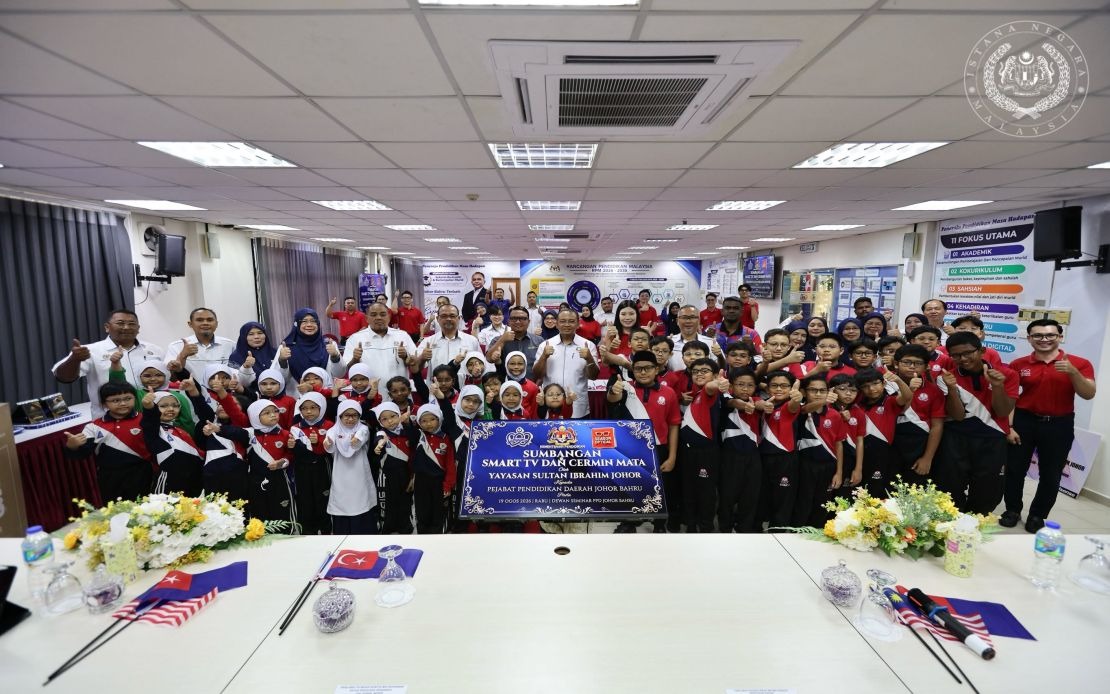
The Yayasan Sultan Ibrahim Johor (YSIJ) has reinforced its commitment to educational advancement and student wellbeing by delivering substantial resources to schools within the Johor Bahru district. The foundation's latest initiative, unveiled through an official announcement, encompasses the distribution of ten 75-inch smart televisions alongside 2,000 pairs of spectacles to institutions and learners supported by the Johor Bahru District Education Office. This multi-faceted programme demonstrates a strategic approach to addressing both technological infrastructure gaps and healthcare accessibility challenges that continue to affect Malaysian classrooms.
The deployment of the smart television units across ten schools represents a deliberate investment in modernising teaching environments and enabling schools to transition towards digital-first instructional methods. Large-format display technology of this calibre facilitates multimedia presentations, interactive learning modules, and real-time visual demonstrations that conventional teaching aids cannot replicate. For Malaysian educators working within resource-constrained settings, such equipment substantially enhances pedagogical capacity and student engagement, particularly in subjects demanding visual conceptualisation or data interpretation. The technology bridge between rural and urban educational experiences remains a persistent concern across Malaysian state systems, and targeted technology donations address this disparity directly.
Paralleling the technological initiative, the spectacles distribution programme targets specifically B40 category students—those from households earning below RM4,000 monthly—across twenty schools. This demographic faces compounded disadvantages when vision impairment remains uncorrected, as optical expenses frequently exceed family budgets and visual difficulties compound academic underperformance. By removing financial barriers to eye correction, YSIJ enables students to engage more fully with classroom materials and reduces a significant obstacle to equitable learning outcomes. The partnership framework with Season Optical, a commercial optical retailer, illustrates how private-sector cooperation can amplify charitable impact without entirely placing burden upon philanthropic organisations.
A particularly innovative component involves the deployment of Columba Vision Screener technology, an automated eye-scanning apparatus capable of detecting visual abnormalities within ten seconds. This device accelerates the screening process substantially, addressing a common constraint in school-based health programmes where time availability and clinical expertise remain limited. Rather than requiring trained optometrists to conduct manual assessments, the technology democratises preliminary vision screening and flags cases requiring professional intervention. For Malaysian schools lacking dedicated medical facilities or regular optometric visits, this represents a practical solution enhancing early detection of vision problems that might otherwise progress unaddressed throughout critical developmental years.
The quality specifications of distributed spectacles—emphasising durability and suitability for student use—signal attention to practical realities often overlooked in charitable distribution. Children and adolescents subject spectacles to substantial wear from daily classroom activities, sports, and typical youthful exuberance. Providing robust frames reduces likelihood of damage necessitating replacement and ensures that recipients maintain visual correction throughout academic terms. The logistics coordination required to screen 2,000 students, accurately determine prescriptions, and deliver personalised corrective lenses demonstrates substantial operational complexity beyond simple donation of merchandise.
From a Malaysian policy perspective, this initiative reflects broader concerns regarding educational equity and health accessibility within developing economies. Vision impairment disproportionately affects socioeconomically disadvantaged populations, creating feedback loops wherein academic difficulties stemming from uncorrected vision lead to reduced educational attainment and diminished economic prospects. Government health systems, whilst providing subsidised services, frequently operate at capacity constraints that limit routine screening in school settings. Private philanthropic intervention therefore addresses genuine market and systemic failures, though sustainability questions persist regarding long-term maintenance and replacement cycles for both technology and optical provisions.
The formal handover ceremony, conducted at Johor Bahru PPD offices, involved multiple stakeholder representatives including YSIJ management, education department officials, and commercial partners. This institutional coordination model demonstrates how structured philanthropy operates within Malaysian bureaucratic frameworks, requiring alignment across government departments and documentation of delivery mechanisms. The involvement of Season Optical's managing director underscores the visibility accorded to corporate social responsibility participation, potentially incentivising continued private-sector engagement in educational support initiatives.
Within Johor's broader educational landscape, this contribution assumes particular significance given the state's substantial student population and geographic distribution across rural and urban zones. Johor's economy, anchored substantially in manufacturing and services sectors, encompasses considerable numbers of lower-income households where educational support becomes decisive for intergenerational mobility. Technology and healthcare access deficits within Johor's school system have previously drawn attention from state administration, making targeted interventions by well-resourced foundations increasingly prominent within educational policy implementation.
The scaling of this programme to twenty schools and 2,000 students suggests YSIJ has developed operational capacity for managing complex, multi-stakeholder charitable initiatives. Replication potential extends to other Malaysian states and districts where similar demographic and infrastructure conditions exist. The model combining technology infrastructure, healthcare services, and commercial partnerships offers a template potentially applicable to broader educational equity challenges across Southeast Asia, where comparable resource constraints and demographic patterns characterise education systems in developing economies.
Looking forward, sustainability considerations merit attention. Smart televisions require ongoing maintenance, technical support, and integration into pedagogical frameworks to justify capital investment. Spectacles necessitate periodic replacement as prescriptions change and frames deteriorate. Whether YSIJ and partner organisations have established mechanisms ensuring long-term servicing and replacement provision remains undisclosed in available information. The success of such initiatives ultimately depends not merely upon initial distribution but upon sustained support maintaining equipment functionality and accessibility throughout intended beneficiary lifecycles.

