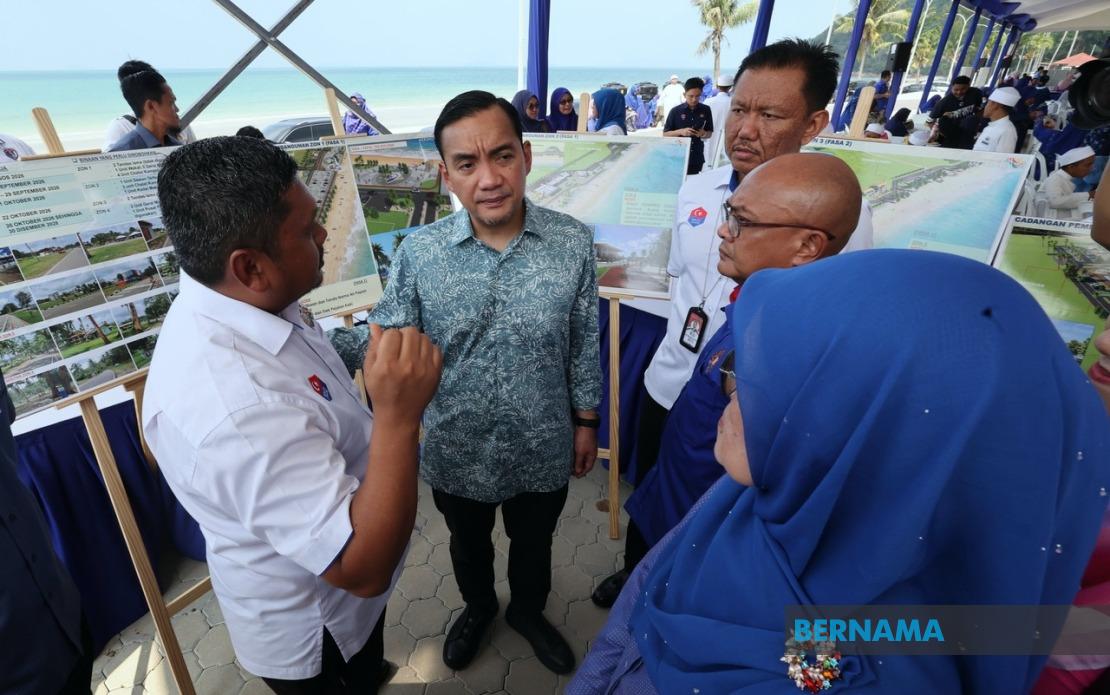
The Johor state government has committed RM1.5 million towards a comprehensive development initiative in Mersing, reflecting a deliberate strategy to channel growth benefits beyond the state capital into underserved districts. The funding announcement, made by Menteri Besar Datuk Onn Hafiz Ghazi, represents a significant injection of resources aimed at modernising the eastern coastal town's infrastructure while simultaneously addressing healthcare and recreational needs of its 80,000 residents.
Onn Hafiz's vision centres on replicating Johor Bahru's successful development trajectory across the state's broader geography. Rather than allowing prosperity to concentrate in the northern urban corridor, the government is implementing a model that seeks to distribute economic opportunities more equitably. This approach acknowledges an important reality: infrastructure investment and job creation in peripheral districts remain crucial for social stability and preventing rural-urban migration that strains cities while leaving smaller towns stagnant.
The Johor Economic Transformation Plan (JETP) forms the conceptual backbone for this initiative. The comprehensive framework sets targets across short, medium, and long-term horizons, moving beyond superficial growth metrics to focus on employment generation and livelihood improvement. For Mersing specifically, this means translating tourism potential and regional assets into tangible jobs for younger residents who currently face limited career prospects beyond traditional sectors like fishing and agriculture.
Healthcare receives substantial attention within the allocation, with RM500,000 dedicated to upgrading the Mersing Hospital Haemodialysis Unit. This investment carries immediate practical significance for residents requiring dialysis treatment, reducing the necessity for journeys to larger medical facilities. For a coastal community with an ageing population profile, such healthcare infrastructure upgrades directly impact quality of life and longevity. The decision reflects understanding that economic development disconnected from essential services fails to genuinely improve community welfare.
Religious and cultural infrastructure development forms another component, with RM200,000 allocated for carpet replacement at Kampung Sri Lalang Mosque. While seemingly modest, such projects sustain community gathering spaces and demonstrate respect for local identity within modernisation frameworks. Infrastructure spending that overlooks cultural and spiritual facilities risks creating resentment among residents who perceive development as externally imposed rather than community-responsive.
Sports and recreational facilities receive considerable focus, indicating acknowledgment of youth engagement priorities. The package includes RM200,000 for a new futsal court at Taman Sri Mersing and RM200,000 for repairs at the Felda Nitar facility, plus RM80,000 for sepak takraw court construction in Felda Tenggaroh 6. These investments create spaces for community activity and youth sport participation, offering alternatives to idleness while building social cohesion. In Malaysia's context, where futsal and sepak takraw maintain strong grassroots appeal, such facilities serve genuine community purposes rather than purely symbolic functions.
Marginalised communities receive specific attention through solar-powered streetlight installations in Orang Asli villages of Kampung Peta and Kampung Tanjung Tuan, allocated RM100,000 each. This intervention addresses both security and modernisation concerns in indigenous settlements historically underserved by state infrastructure. Improved lighting improves nocturnal safety while symbolising government commitment to inclusion of marginalised populations in development narratives.
FELDA settlements, which comprise significant portions of Mersing's population, feature prominently in the allocation strategy. Beyond the futsal court repairs, RM100,000 funds upgrades to the Kami Anak Felda Malaysia (KAF) building in Felda Tenggaroh Timur. FELDA communities represent an important but often politically volatile constituency, particularly regarding perceptions of fairness in resource distribution. Strategic investment in settler facilities demonstrates responsiveness to this demographic's concerns.
Beyond immediate infrastructure expenditure, Onn Hafiz outlined ambitious longer-term initiatives. Plans to establish a Religious Affairs Office and Technical and Vocational Education and Training (TVET) campus represent capacity-building investments that address skills deficits constraining youth employment. A proposed petrol station serving military personnel at Camp Iskandar suggests deliberate economic diversification, anchoring service sector growth around existing institutional anchors. Such facilities attract ancillary commercial activity, potentially catalysing broader economic clustering.
The announcement carries significance within Malaysia's broader regional development context. Johor's approach of explicitly linking infrastructure investment to employment creation and community welfare improvements contrasts with development models focused narrowly on headline GDP figures. For other Malaysian states and at the federal level, Mersing's package demonstrates how targeted, community-responsive investment can address legitimate grievances regarding unequal growth distribution.
Challenges remain in implementation. Infrastructure projects require skilled management, timely completion, and ongoing maintenance to deliver promised benefits. Job creation aspirations depend on broader economic conditions beyond the state government's direct control, including tourism sector performance and private investment decisions. Success ultimately hinges not merely on funding allocation but on coordinated efforts between state agencies, local authorities, and community participation in identifying and addressing genuine development priorities.
Mersing's trajectory will merit monitoring as a case study in inclusive development approaches within Malaysia's federal structure. If implemented effectively, the RM1.5 million initiative could establish templates for equitable growth distribution applicable across other economically peripheral regions, while demonstrating to residents that state governments can translate growth benefits into tangible community improvements beyond capital-centric development patterns.

