Navigating George Town, Penang becomes considerably more manageable when visitors organise their exploration around the city's distinctive zones and arterial roads. The most visible landmark remains the heritage area recognised as a Unesco Historic Site, where major thoroughfares such as Beach Street, Armenian Street, Carnarvon Street, Chulia Street and Pengkalan Weld converge to showcase painstakingly restored colonial-era structures. However, the city extends well beyond this primary tourist corridor, and increasingly travellers are venturing outward to discover secondary streets that reveal equally compelling narratives about Penang's multicultural past and vibrant present.
Jalan Burma exemplifies this expanded exploration, functioning as one of the longest arterial roads in George Town at nearly five kilometres. The thoroughfare stretches from the heritage zone's perimeter through increasingly residential neighbourhoods before reaching the affluent Pulau Tikus district. What makes this route particularly compelling for Malaysian and regional visitors is its seamless integration of culinary reputation, historical significance, and contemporary hospitality—a microcosm of how heritage cities can evolve without sacrificing authenticity.
The road itself carries multiple linguistic and cultural identities layered across centuries. Historical signboards and maps bear the anglicised name "Burmah Road," yet local designations reveal older naming conventions reflecting the street's original purpose. Jalan Tarek Ayer, or Water Cart Road in English, references the bullock carts that transported water through the settlement during Penang's colonial expansion. Hokkien and Cantonese nomenclature such as Gui Chia Chui similarly documented these practical functions before the road acquired its contemporary designation following the establishment of a significant Burmese community in the adjacent Pulau Tikus area during the nineteenth century.
This Burmese settlement left indelible cultural markers that persist in the contemporary landscape. The Dhammikarama Burmese Temple, established two centuries ago, remains accessible via lanes adjacent to Jalan Burma and represents one of Southeast Asia's oldest Burmese Buddhist structures outside Myanmar itself. Surrounding thoroughfares bear Burmese geographical nomenclature—Rangoon Road, Mandalay Road, and Moulmein Close—creating a distinct cultural enclave within George Town's diverse urban fabric. For visitors interested in understanding how immigrant communities have shaped Penang's identity, this area provides tangible evidence of historical settlement patterns and cultural continuity.
The emergence of the Komtar Octopus Pedestrian Bridge has transformed pedestrian accessibility along Jalan Burma, enabling safer exploration of what was previously an automobile-dominated corridor. An information board positioned beneath this modern infrastructure provides simplified English translations of the road's historical nomenclature, serving as an informal educational marker for curious walkers. Despite occasional gaps in formal pedestrian pathways, the overall walking environment proves safe and navigable, making it feasible for visitors to traverse the entire route and discover establishments that guidebooks frequently overlook.
From a gastronomic perspective, Jalan Burma has emerged as an unlikely destination for food pilgrims seeking Michelin-recognised venues. George Town currently hosts 74 establishments receiving Michelin recognition across three tiers: two one-star fine dining restaurants, 33 Bib Gourmand venues, and 39 Michelin Selected establishments. Notably, a substantial portion concentrate within the heritage zone, yet notable outliers operate along Jalan Burma and adjacent areas. Duck Blood Curry Mee operates from a simple storefront on this thoroughfare, serving its eponymous dish to morning customers seeking authentic regional comfort food. The stall's proximity to Restoran Old Green House, home to the Bib Gourmand-listed Green House Prawn Mee & Loh Mee, creates an informal cluster of celebrated food vendors within walking distance of one another.
The distinction between Restoran Old Green House and the similarly-named Green House Prawn Mee/Law Mee Corner situated further along Jalan Burma towards Jalan Penang illuminates how Penang's food culture operates within nuanced hierarchies of authenticity and provenance. Local consensus identifies the original Restoran Old Green House location as the authoritative source, despite claims of operational equivalence from competitors. This attachment to specific venues reflects how Malaysian food culture privileges direct lineage and personal reputation alongside culinary technique—considerations that transcend the more standardised assessment criteria underlying Michelin's recognition framework. For regional visitors accustomed to such distinctions, navigating between competing claims of authenticity represents a familiar cultural practice rather than confusion.
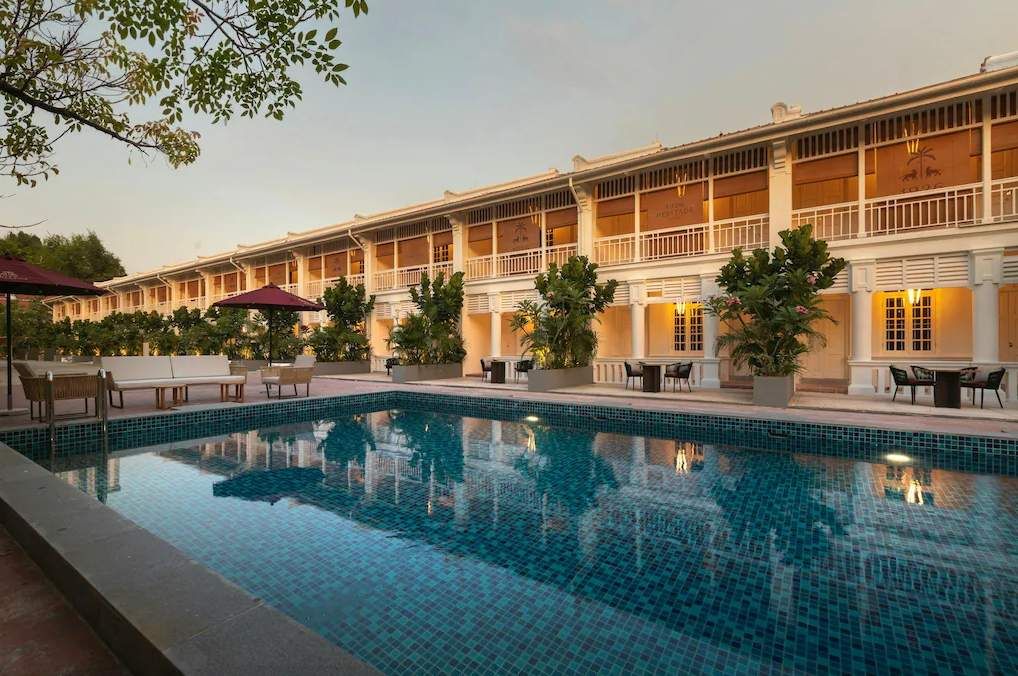
The recently renovated heritage hotel situated on Jalan Burma provides contemporary accommodation within a structure dating from 1926, marking its centennial anniversary. The building originally functioned as residential quarters for British and locally-recruited government personnel, exemplifying the Anglo-Malay architectural conventions that dominated George Town's colonial development. The structure comprises 24 interconnected link houses, a configuration that presented obvious adaptive challenges when the Penang Development Corporation converted the property into a hotel in 1999. Rather than demolishing and reconstructing, developers retained the original link house configuration while subdividing spaces to accommodate 78 individual rooms and suites across six categories. The Heritage Room caters to solo travellers seeking intimate spaces, whilst the Straits Suite represents the maximum spatial allocation, appealing to visitors prioritising comfort and amenities. This conservation-based approach to hospitality development demonstrates how heritage preservation can coexist with contemporary service expectations—a model increasingly relevant for Southeast Asian cities balancing heritage tourism with modernisation pressures.
The hotel's architectural character directly reflects Penang's colonial experience and subsequent demographic evolution. The Anglo-Malay stylistic synthesis evident in structural details, spatial configurations, and decorative elements narrates the encounter between British administrative sensibilities and local building traditions. For Malaysian visitors, such properties offer opportunities to inhabit and observe historical spaces from interior perspectives unavailable through casual tourism. The provision of modern amenities—including high-technology water filtration systems equipped with WiFi connectivity—demonstrates how heritage properties can integrate contemporary convenience without architectural compromise, a balance frequently debated within conservation circles throughout Southeast Asia.
Root House by Gen, the hotel's in-house modern Chinese restaurant, represents another layer of contemporary commercial activity within a heritage structure. The establishment curates contemporary interpretations of Chinese culinary traditions, appealing to visitors seeking refined dining experiences without venturing into George Town's heritage zone. This configuration reflects a broader trend wherein heritage hotels function as destination restaurants, attracting diners motivated by culinary reputation and atmospheric ambiance rather than accommodation needs. For Malaysian visitors planning extended stays in George Town, such integrated hospitality-dining venues reduce logistical complexity whilst supporting preservation economics through sustained revenue generation.
The broader George Town tourist experience reveals multiple approaches to navigating the city, each reflecting distinct visitor preferences and motivations. Some tourists adhere strictly to heritage zone boundaries, collecting experiences within Unesco-designated perimeters. Others organise exploration around food categories—halal establishments, pork-free options, street food stalls, cafes, and the omnipresent nasi kandar restaurants that function as Penang's gastronomic signature. The nasi kandar phenomenon particularly demonstrates how specific dishes anchor visitor behaviour; loyal clienteles attach themselves to particular vendors and operators, generating the kinds of passionate advocacy and criticism that simultaneously simplifies and complicates visitor navigation. Michelin recognition provides an alternative organising framework, enabling visitors to structure itineraries around formally validated quality indicators rather than personal networks or social media recommendations.
Jalan Burma ultimately exemplifies how secondary routes within heritage cities often contain more revealing narratives than primary tourist corridors. The street accommodates divergent visitor motivations—gastronomic exploration, historical investigation, contemporary hospitality, and cultural encounter—within a single linear geography. The nearly five-kilometre walking route between heritage zone boundaries and Pulau Tikus presents manageable distance without exhausting casual walkers, particularly when supplemented by contemporary amenities such as high-tech hotel water filtration systems and shaded pedestrian bridges. For Malaysian and regional visitors seeking experiences beyond standard George Town itineraries, Jalan Burma offers accessible complexity: colonial architecture coexisting with Burmese cultural markers, Michelin-recognised food stalls operating alongside casual local establishments, and heritage accommodation integrating modern service expectations. The street's safety and walkability, combined with its historical depth and contemporary dynamism, position it as an increasingly valuable counterpoint to the heritage zone's concentrated tourism infrastructure.

%22%2F%3E%3C%2Fpattern%3E%3C%2Fdefs%3E%3Crect%20width%3D%22100%25%22%20height%3D%22100%25%22%20fill%3D%22url(%23phcx4tg)%22%2F%3E%3Crect%20width%3D%22100%25%22%20height%3D%22100%25%22%20fill%3D%22url(%23phcx4tp)%22%2F%3E%3Ctext%20x%3D%2250%25%22%20y%3D%2250%25%22%20text-anchor%3D%22middle%22%20dominant-baseline%3D%22central%22%20fill%3D%22rgba(255%2C255%2C255%2C0.95)%22%20font-family%3D%22Georgia%2C%20'Times%20New%20Roman'%2C%20serif%22%20font-weight%3D%22700%22%20font-size%3D%22151%22%20letter-spacing%3D%22-0.02em%22%3EMalaysian%3C%2Ftext%3E%3C%2Fsvg%3E)