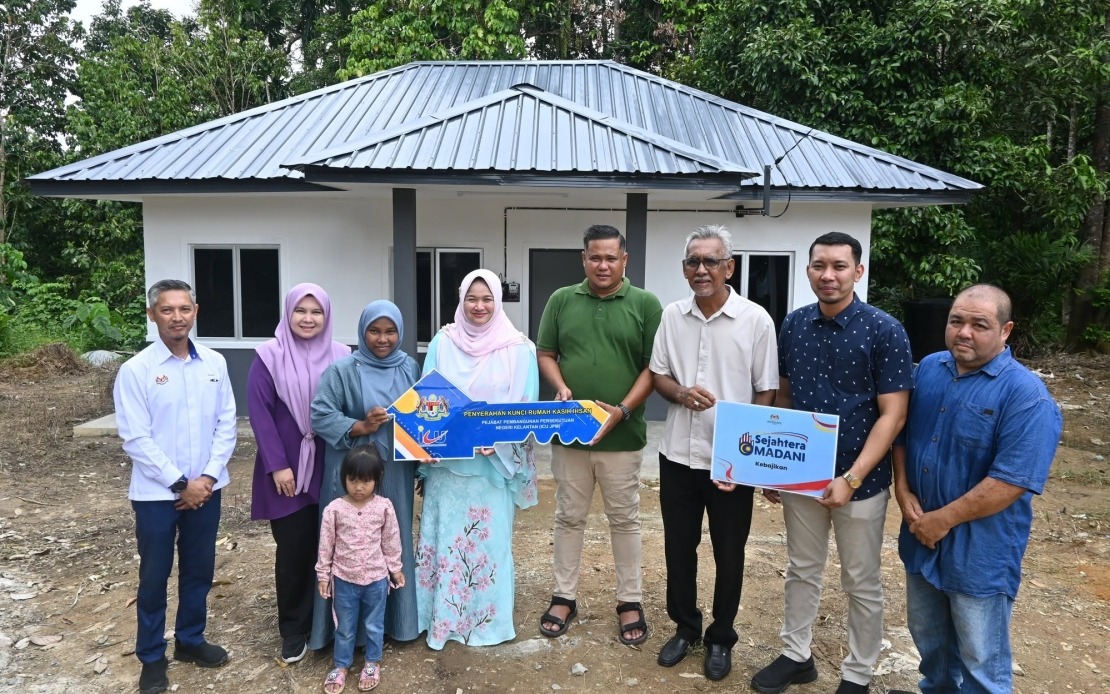
The Malaysian government has underscored its dedication to elevating standards of living among vulnerable communities by distributing Rumah Kasih Ihsan homes to deserving families in Jeli, Kelantan. Prime Minister Datuk Seri Anwar Ibrahim announced the initiative through a social media post, noting that the programme represents a tangible expression of the administration's broader agenda to ensure equitable access to safe, dignified housing nationwide.
The Kelantan Implementation Coordination Unit (ICU), operating under the Prime Minister's Department (JPM), orchestrated the handovers with support from the PMX Coordination Team. Dr Wan Nur Ibtisam Wan Ismail, the ICU director for Kelantan, formally presented the homes to their recipients. The dual approach of the programme—combining new construction with completed units—demonstrates an attempt to address housing shortages through both immediate delivery and phased implementation strategies.
Yusof Mohamed Nawawi from Kampung Renyut, Jeli, received formal documentation confirming construction of a replacement residence that promises superior safety standards and living conditions compared to his current accommodation. Simultaneously, Shamsul Bahri Che Musa took possession of a fully constructed home ready for immediate occupancy. Both beneficiaries received supplementary assistance in the form of food baskets, signalling government support extending beyond housing provision to encompass broader welfare considerations.
For Malaysian policymakers and development officials, the Rumah Kasih Ihsan programme reflects a philosophical shift towards measuring developmental success through tangible improvements in citizens' daily lives rather than purely statistical growth indicators. The initiative acknowledges that physical infrastructure alone—roads, industrial zones, commercial districts—fails to capture genuine progress unless ordinary families experience concrete benefits in their residential circumstances. This approach resonates particularly in rural and semi-rural districts like Jeli, where infrastructure development historically lagged urban centres.
Kelantan, as one of Malaysia's economically vulnerable states, frequently appears in national discourse regarding poverty alleviation and rural development. The strategic deployment of housing initiatives there reflects recognition that state-level disparities in housing quality directly correlate with broader socioeconomic inequalities. By concentrating such programmes in identified need areas, the government attempts to reverse patterns of regional disadvantage that have persisted across decades of national development planning.
The conceptual framework underpinning Rumah Kasih Ihsan extends beyond utilitarian housing provision. Officials articulate that secure, comfortable homes function as psychological anchors, establishing the stability necessary for families to pursue education, employment, and personal development objectives. This perspective aligns with international development research emphasizing housing security as foundational to breaking intergenerational poverty cycles. When families no longer struggle with inadequate shelter, resources previously devoted to emergency home repairs redirect toward health, education, and economic participation.
For Southeast Asian observers monitoring Malaysia's social policy evolution, this initiative illustrates how middle-income nations attempt to address persistent poverty pockets despite macroeconomic growth. The programme suggests governmental acknowledgment that market mechanisms alone fail to ensure housing access for disadvantaged populations, necessitating direct state intervention. Such approaches increasingly characterise policy responses across the region as governments confront urbanisation pressures and rural-urban migration dynamics.
The programme's emphasis on recipient dignity—formal handover ceremonies, official documentation, supplementary assistance—indicates awareness that poverty alleviation extends beyond material transfer to include restoration of agency and social recognition. Beneficiaries receive public acknowledgment of their circumstances and government support, potentially reducing stigma associated with assistance-dependent status. This dignity-conscious approach may enhance programme effectiveness by fostering recipient engagement with other government services and social mobility initiatives.
Implementation through dedicated coordination units reflects institutional capacity-building within Malaysian public administration. Rather than relying on conventional ministerial bureaucracies, the ICU model concentrates resources and decision-making authority, potentially accelerating project completion and reducing administrative friction. This structure has become increasingly prevalent in Malaysian governance, suggesting confidence in specialised implementation agencies for targeted social programmes. However, sustainability questions persist regarding whether such parallel structures adequately integrate with mainstream government systems for long-term programme maintenance.
The geographical focus on Jeli specifically indicates data-driven targeting, presumably based on poverty surveys, housing assessments, and needs identification. This contrasts with earlier distributive approaches often characterised by political patronage rather than systematic prioritisation. Contemporary social programmes increasingly employ welfare databases and geographic information systems to identify beneficiaries, suggesting professionalisation of poverty-alleviation administration. Such methodological improvements enhance programme legitimacy and resource allocation efficiency, though implementation quality depends ultimately on field-level execution.
Beyond immediate beneficiaries, Rumah Kasih Ihsan likely generates broader community effects in participating districts. New housing construction stimulates local employment, supports building suppliers, and potentially attracts ancillary services. Improved housing stock contributes incrementally to district-level infrastructure perception, potentially influencing investment decisions and migration patterns. Accumulated small-scale interventions across multiple districts may generate cumulative improvements in regional development trajectories.
Looking forward, programme scalability represents critical policy consideration. Successfully delivering homes to two families in Jeli demonstrates logistical feasibility but requires examination of implementation constraints that might impede nationwide expansion. Budget allocation, construction capacity, beneficiary identification processes, and maintenance responsibility frameworks must accommodate significant scaling if Rumah Kasih Ihsan transitions from demonstration project to comprehensive national housing strategy. Regional governments across Malaysia will watch Kelantan's implementation outcomes to inform their own social programme planning.

