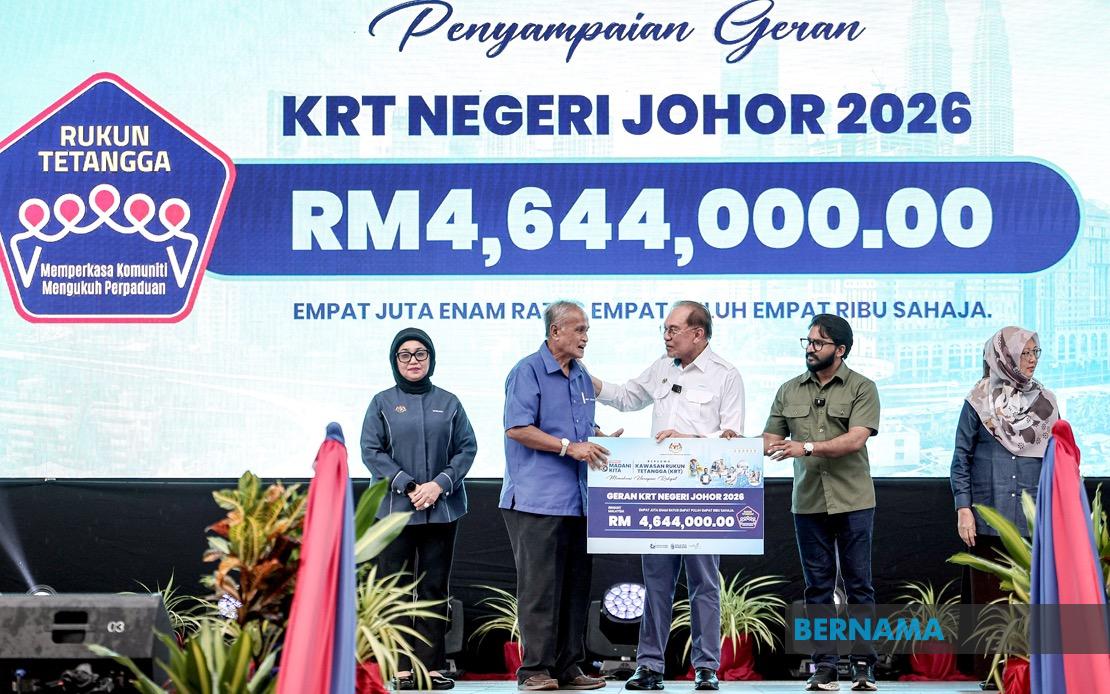
Prime Minister Datuk Seri Anwar Ibrahim has approved a substantial increase in annual funding for Neighbourhood Watch Areas (KRT) across Malaysia, raising the grant from RM6,000 to RM10,000 per group starting from January 1, 2027. The announcement came during the MADANI KITA Programme held at Dataran Segamat in Johor, where the Prime Minister emphasized the critical contributions these community organizations make toward addressing local challenges and strengthening social cohesion.
The decision to boost funding follows a decade-long freeze on KRT allocations, a gap that the government acknowledges does not reflect the evolving responsibilities and increasing operational costs these volunteer-led organizations face. By raising the grant to RM10,000, the administration signals a renewed commitment to supporting grassroots security and community welfare initiatives, particularly for groups that actively report on their activities and development progress. This adjustment represents a 67 percent increase in support, addressing long-standing concerns that static funding had constrained KRT effectiveness across diverse communities nationwide.
Anwar Ibrahim underscored the importance of KRT in preserving Malaysia's multicultural fabric and social stability. He noted that these neighbourhood-based organizations play an instrumental role in reviving the spirit of consensus and democratic participation at the community level, while simultaneously supporting law enforcement and government agencies in tackling both security concerns and welfare issues. The emphasis on strengthening KRT reflects a broader policy recognition that sustainable peace and development depend on robust local institutions that can mediate between citizens and authorities.
The Prime Minister used the occasion to reaffirm Malaysia's foundational commitment to harmony among its diverse racial, cultural, and religious communities. He stressed that demographic differences should not become vehicles for division but rather sources of national strength and pride. This framing places the KRT funding increase within a larger narrative about institutional safeguards for national unity, positioning community watch groups as bulwarks against divisive narratives at the neighbourhood level.
Beyond the KRT allocation, the government announced an immediate disbursement of RM3.205 million for basic infrastructure repairs at Islamic educational institutions across Johor. The funds will address critical maintenance and upgrading needs at religious schools, madrasahs, study centres, and tahfiz institutions in districts including Batu Pahat, Muar, and Segamat. This investment reflects government commitment to providing conducive learning environments for students in Islamic education, a sector that has historically faced resource constraints despite serving significant student populations.
The allocation for Islamic educational facilities demonstrates a deliberate effort to address infrastructure gaps in religious schooling that can affect educational quality and student welfare. By prioritizing these repairs now rather than deferring them, the administration signals recognition that adequate facilities are essential for maintaining the appeal and effectiveness of Islamic education as an alternative to fully secular schooling. For parents and communities relying on these institutions, the funding injection offers tangible improvements that extend beyond curriculum delivery.
Additionally, the Prime Minister approved RM1.0 million in immediate funding for urgent repair work at Royal Malaysian Police (PDRM) quarters in Johor. This allocation underscores the government's commitment to ensuring that security personnel have satisfactory living conditions, a factor that officials argue is integral to maintaining morale and operational effectiveness. Well-maintained quarters contribute to the welfare of police officers and their families, aspects that can influence recruitment and retention in a sector where working conditions have periodically drawn public attention.
The combined announcements from the Segamat event reflect a coherent policy approach emphasizing institutional strengthening across multiple fronts: community safety, religious education, and law enforcement welfare. By channelling resources toward these areas simultaneously, the government is attempting to address interconnected aspects of local governance and social stability. The timing of these announcements, coupled with the ceremonial nature of the MADANI KITA Programme, suggests this is part of a broader campaign to reinvigorate community-level governance structures.
For Malaysian readers and regional observers, these developments carry implications for how the government is calibrating its approach to internal security and social cohesion. The elevated emphasis on KRT and similar grassroots organizations indicates a policy preference for decentralized, community-based approaches to addressing local problems rather than relying solely on top-down enforcement. This aligns with international trends in community-oriented policing and participatory governance, though implementation quality will depend on how effectively increased funding translates into enhanced KRT capacity and legitimacy.
The infrastructure investments in religious schools also signal an attempt to balance secular and religious educational pathways, recognizing that Islamic institutions serve important demographic constituencies and contribute to educational pluralism. By improving physical facilities, the government aims to enhance the competitive position of madrasahs and tahfiz centres, which often operate with more limited budgets than fully government-funded schools. This attention to religious education infrastructure reflects demographic and political realities in Malaysian governance.
The staggered implementation timeline—with KRT funding beginning in January 2027—allows the government time to prepare administrative mechanisms for the increased disbursement while providing advance notice to community groups for budgeting purposes. The immediate allocation for police quarters and Islamic school repairs, by contrast, addresses more urgent operational needs, suggesting a tiered approach to resource deployment based on urgency and administrative feasibility.
Moving forward, the effectiveness of these initiatives will hinge on transparent administration, meaningful community participation in KRT governance, and sustained political will to maintain these funding levels despite competing budgetary pressures. For Southeast Asia more broadly, Malaysia's emphasis on KRT and community-based security mechanisms offers a case study in how governments attempt to balance institutional modernization with grassroots engagement in an era of social fragmentation and competing political narratives.