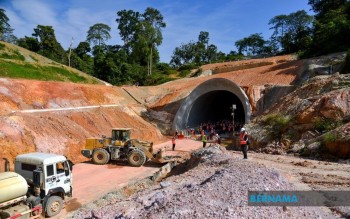
The Malaysian government has moved to accelerate economic development in the Pasir Puteh parliamentary constituency in Kelantan by approving a comprehensive package of 46 projects worth RM207.2 million through 2026. The initiative, announced in Parliament by Deputy Economy Minister Datuk Mohd Shahar Abdullah, signals a concerted push to position the region as a strategic economic node anchored by the East Coast Rail Link infrastructure and its associated cargo facilities.
The approved projects focus heavily on establishing industrial and logistics infrastructure in areas adjacent to the Pasir Puteh ECRL cargo station. This reflects a deliberate strategy to harness the rail link's potential as an economic catalyst rather than viewing it merely as a transportation corridor. Land preparation and infrastructure development for the Pasir Puteh downstream industrial area form the backbone of this initiative, designed to create the necessary conditions for private investment and industrial clustering around the station.
Mohd Shahar emphasized that the development approach transcends isolated project implementation. Instead, planning occurs within the broader framework of the ECRL Integrated Land Use Master Plan, a comprehensive spatial strategy that coordinates land use across the entire rail corridor. This integrated approach recognizes that the station's utility depends not simply on its technical specifications but on the surrounding ecosystem of storage facilities, processing plants, and warehousing infrastructure that would justify regular cargo operations.
The geographic positioning of Pasir Puteh offers inherent advantages that the government intends to maximize. Located near the Tok Bali Supply Base, the constituency sits at an intersection of maritime and rail logistics networks. This dual connectivity positions the area uniquely to capture supply chain activities that previously required movement between port and inland locations. By developing complementary infrastructure, planners aim to reduce transshipment costs and handling times, making the location attractive to logistics operators and manufacturing businesses seeking efficient distribution networks.
Mohd Shahar articulated the government's broader vision, underscoring that successful development hinges on synergy between the rail infrastructure and port facilities. When maritime and rail networks function as coordinated systems rather than competing alternatives, they create competitive advantages difficult for businesses to ignore. The potential for attracting private investment follows logically from these structural improvements—investors seek locations where infrastructure reduces operational costs and accelerates supply chain velocity.
The timeline for implementation extends across the 13th Malaysia Plan period, which runs from this year through 2030. This extended horizon reflects the realistic understanding that transforming a region from agricultural or light commercial use into an integrated logistics hub requires sustained investment and sequential development. Initial projects will establish foundational infrastructure, while later initiatives can build upon completed elements, creating positive feedback loops of development.
The government's commitment extends beyond simply allocating funds. Monitoring mechanisms through the MyRMK system will track project progress and enable course corrections if implementation lags or cost overruns emerge. Regular reporting to the Dewan Rakyat embeds accountability into the process, allowing parliamentarians to scrutinize resource deployment and outcomes rather than merely approving expenditure once.
Mohd Shahar's response to Nik Muhammad Zawawi Salleh reflected an understanding that development spending carries particular weight in a federal system where regional disparities persist. The 13th Malaysia Plan explicitly incorporates development equity as a policy objective, directing resources toward closing gaps between advanced regions and lagging areas. For Kelantan, historically a lower-income state, channeling more than RM207 million into infrastructure that generates local employment and attracts business activity represents a meaningful intervention.
The emphasis on place-based development strengths distinguishes the current approach from earlier strategies that imposed uniform solutions regardless of local circumstances. Pasir Puteh's logistics potential receives priority because the location possesses genuine advantages, not because planners decided manufacturing or tourism infrastructure would suit it equally well. This targeted approach theoretically produces superior outcomes because investments align with existing capabilities and market demand.
The Pasir Puteh initiative also demonstrates how the ECRL, which faced considerable political and fiscal scrutiny during its development, now functions as infrastructure through which subsequent development policies flow. Rather than standing as an isolated megaproject, the rail link becomes the anchor for a cluster of complementary investments designed to generate economic returns justifying the original capital expenditure. Success requires not merely completing the rail line but building the surrounding ecosystem that makes frequent cargo utilization viable.
For Malaysian policymakers and analysts, the Pasir Puteh case illustrates how major infrastructure projects should ideally integrate with land use planning and industrial policy. The coordination evident here—between the Economy Ministry, state authorities, and the planning framework—suggests lessons potentially applicable to other ECRL stations and economic corridors elsewhere in Malaysia. Whether the actual outcomes match the stated objectives will become apparent only as implementation progresses through 2030.
The approval also carries implications for Southeast Asian port competition. As Malaysia positions Pasir Puteh as a logistics node, it competes for supply chain activity with similar initiatives in Thailand, Vietnam, and Indonesia. Creating genuine cost and efficiency advantages requires executing the complementary investments outlined in these 46 projects rather than allowing them to become delayed or abandoned in the face of budgetary pressures or shifting political priorities.

