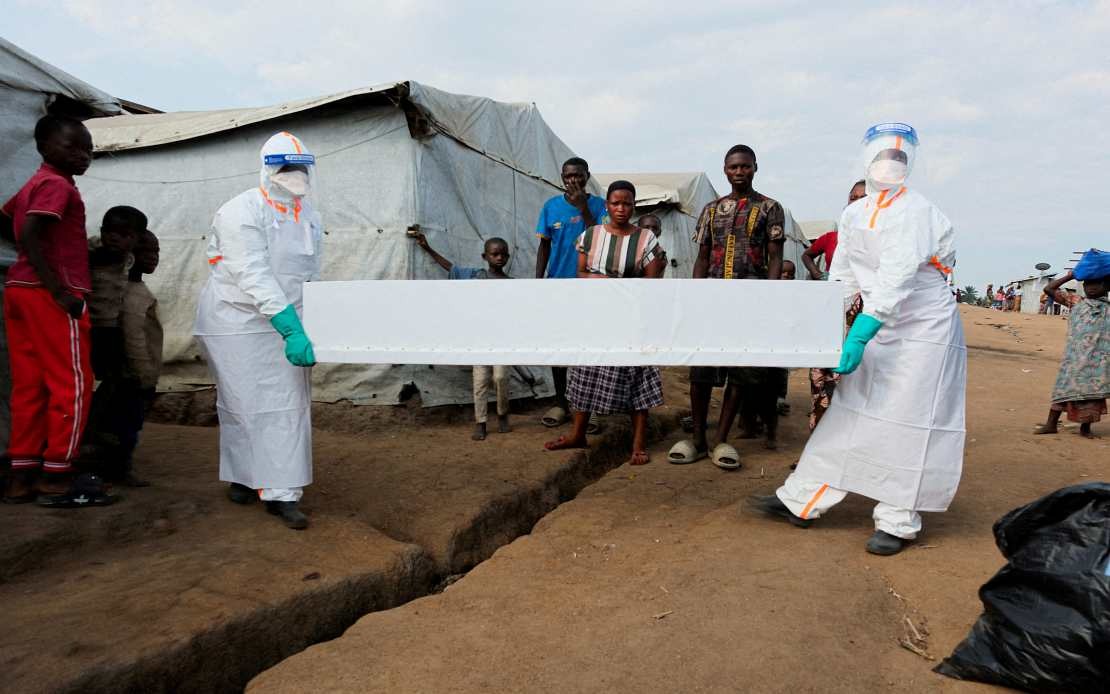
The Democratic Republic of Congo has crossed a grim milestone with confirmed Ebola virus cases now exceeding 1,000, signalling the severity of an outbreak that has captured international attention and raised alarm among disease specialists across Africa. As of Sunday, health authorities reported 1,003 confirmed infections accompanied by 254 deaths, translating to a mortality rate of 25.3 per cent since the disease was first declared on May 15. The progression of cases underscores the challenge facing response teams working in some of the world's most remote and conflict-affected regions.
Despite the alarming trajectory, the Democratic Republic of Congo's Health Ministry maintains that its teams continue to mount active investigations, maintain epidemiological surveillance, and execute prevention strategies in the hardest-hit communities. These efforts span three provinces—Ituri, North Kivu, and South Kivu—where transmission chains have proven difficult to interrupt due to factors including community mistrust of health interventions, limited healthcare infrastructure, and ongoing security challenges. The ministry's statement reflects both the scope of the current operation and the complexity of controlling a virus transmission in areas where basic health and security systems remain fragile.
Health Minister Roger Kamba highlighted mixed progress in the response, noting that recovery numbers have improved while simultaneously acknowledging a troubling decline in the rate at which health teams are able to track and monitor contacts of confirmed cases. This contact tracing failure represents a critical vulnerability in outbreak control, as Ebola's spread depends substantially on identifying and isolating individuals exposed to infected persons. At present, at least 100 patients have recovered from the infection, though 365 remain either hospitalised or under isolation, representing a substantial clinical burden on already stretched health systems.
The global health community has sounded increasingly urgent warnings about the trajectory of this outbreak. Last week, the Africa Centres for Disease Control and Prevention cautioned that the current epidemic could potentially eclipse the catastrophic 2014-2016 West African Ebola epidemic, which claimed more than 11,000 lives across Guinea, Liberia, and Sierra Leone. That warning carries particular weight given the established patterns of Ebola transmission and the demonstrated difficulties in controlling spread once community transmission becomes established. The Africa CDC's assessment implicitly suggests that without rapid and sustained containment, mortality figures could expand exponentially.
To counter this risk, Minister Kamba indicated that authorities are intensifying efforts in three critical areas: community engagement and communication, rapid diagnosis of suspected cases, and comprehensive case management protocols. Community communication proves especially vital in regions where historical mistrust of government and health authorities has sometimes hindered outbreak response. Effective messaging that emphasises local understanding of transmission risks and the importance of seeking early treatment can substantially alter population behaviour and reduce onward transmission.
A significant scientific breakthrough emerged from collaborative research between Uganda's Department of National Health Laboratory and Diagnostic Services and Congo's Institute of National Biomedical Research. Scientists identified the current strain as Ebola Bundibugyo and determined with considerable confidence that it originated from a new wildlife spillover event rather than persistence of a previously documented outbreak. This finding carries substantial implications for outbreak investigation and response strategy, as it excludes the possibility that undetected chains of transmission from an earlier epidemic were continuing to circulate in human populations.
The identification of Ebola Bundibugyo as a newly zoonotic spillover reinforces the sobering reality that the Democratic Republic of Congo—with its vast rainforests harbouring diverse wildlife populations—remains vulnerable to repeated Ebola emergence events. The country has experienced multiple Ebola outbreaks over recent decades, each originating from animal reservoirs and spilling into human populations through contact with infected wildlife or bushmeat. Understanding that this represents a novel transmission event rather than recrudescence of an older outbreak suggests that natural animal-to-human transmission pathways remain open and active.
For Malaysian and Southeast Asian observers, the Democratic Republic of Congo's struggle against Ebola carries important lessons about pandemic preparedness and the global interconnectedness of disease threats. While Ebola has not established transmission chains in Asia, the virus's presence in Africa and the continent's growing air connectivity to Southeast Asia mean that international biosecurity remains a shared concern. Malaysia's experience with disease outbreaks—from SARS to COVID-19—demonstrates the speed with which tropical pathogens can traverse borders and the critical importance of robust early warning systems and rapid response capabilities.
The current outbreak also underscores broader challenges facing public health responses in fragile states. The Democratic Republic of Congo's difficulties in maintaining contact tracing rates, securing community cooperation, and delivering consistent healthcare across affected regions reflect structural limitations that many developing nations confront when facing health crises. These constraints—including insecurity, limited laboratory capacity, insufficient trained personnel, and weak supply chains—compound the inherent difficulty of controlling a highly fatal virus with no approved vaccine at the time of this outbreak's declaration.
Moving forward, the international community's capacity to support the Democratic Republic of Congo's response will substantially influence whether this outbreak remains contained or evolves into a larger regional crisis. Sustained funding for response operations, deployment of diagnostic capacity and trained epidemiologists, and support for community-based prevention measures represent essential interventions. The Africa CDC's warning about potential escalation to West African epidemic scales serves as a clarion call for prioritising containment efforts before transmission becomes too widespread to control effectively.
%22%2F%3E%3C%2Fpattern%3E%3C%2Fdefs%3E%3Crect%20width%3D%22100%25%22%20height%3D%22100%25%22%20fill%3D%22url(%23ph38u31g)%22%2F%3E%3Crect%20width%3D%22100%25%22%20height%3D%22100%25%22%20fill%3D%22url(%23ph38u31p)%22%2F%3E%3Ctext%20x%3D%2250%25%22%20y%3D%2250%25%22%20text-anchor%3D%22middle%22%20dominant-baseline%3D%22central%22%20fill%3D%22rgba(255%2C255%2C255%2C0.95)%22%20font-family%3D%22Georgia%2C%20'Times%20New%20Roman'%2C%20serif%22%20font-weight%3D%22700%22%20font-size%3D%22272%22%20letter-spacing%3D%22-0.02em%22%3ESabah%3C%2Ftext%3E%3C%2Fsvg%3E)
%22%2F%3E%3C%2Fpattern%3E%3C%2Fdefs%3E%3Crect%20width%3D%22100%25%22%20height%3D%22100%25%22%20fill%3D%22url(%23ph4elz2g)%22%2F%3E%3Crect%20width%3D%22100%25%22%20height%3D%22100%25%22%20fill%3D%22url(%23ph4elz2p)%22%2F%3E%3Ctext%20x%3D%2250%25%22%20y%3D%2250%25%22%20text-anchor%3D%22middle%22%20dominant-baseline%3D%22central%22%20fill%3D%22rgba(255%2C255%2C255%2C0.95)%22%20font-family%3D%22Georgia%2C%20'Times%20New%20Roman'%2C%20serif%22%20font-weight%3D%22700%22%20font-size%3D%22226%22%20letter-spacing%3D%22-0.02em%22%3EHannah%3C%2Ftext%3E%3C%2Fsvg%3E)