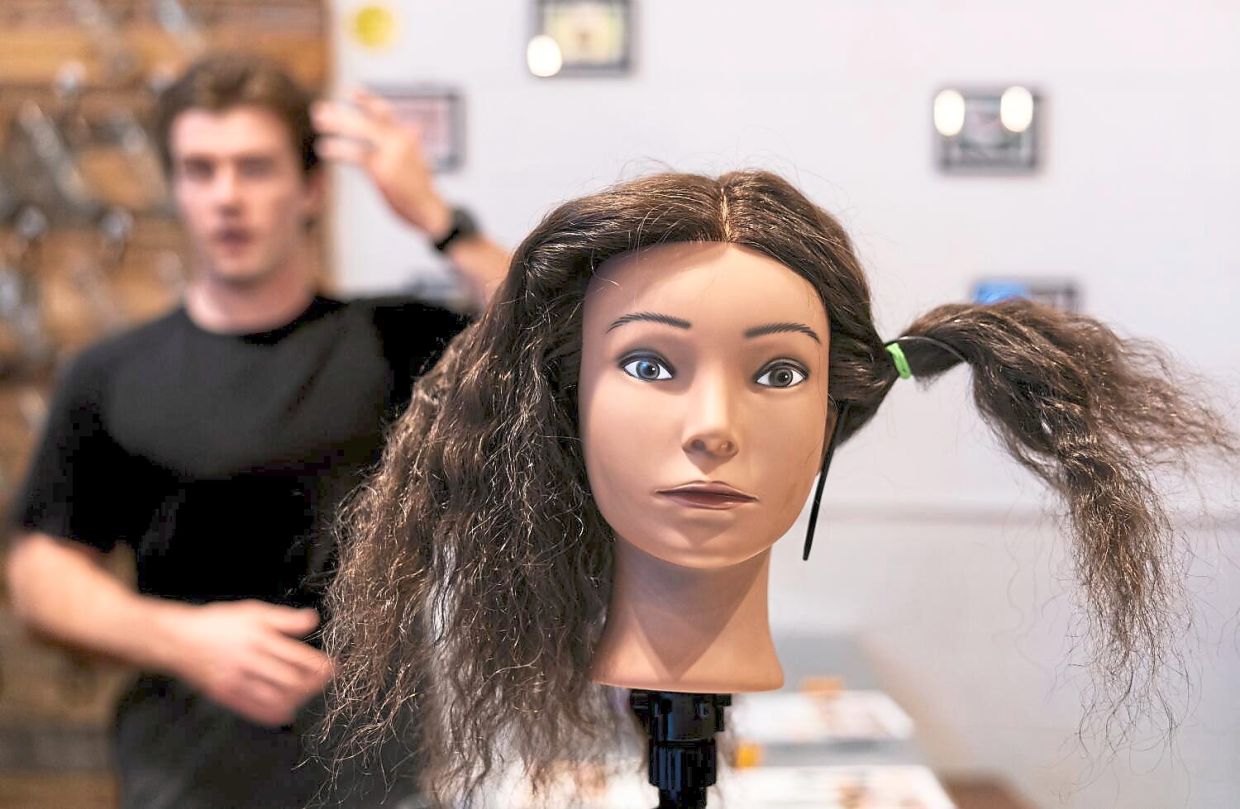
The brewery fell silent as fifteen men gathered on a Friday night in Santa Barbara County, their collective hesitation palpable. Austin Nieves, who had recently relocated to the area from Southern California, broke the tension by distributing drinks to the assembled fathers. Within minutes, inhibitions melted away as the group of men—ranging in age from their thirties to sixties—began an activity that many had never attempted: braiding hair. The event, inspired by a viral British concept called "Pints and Ponytails," was completely booked out, reflecting a genuine hunger among fathers for both practical training and male camaraderie in a judgement-free environment.
The hair-braiding session represented more than just a novelty activity. Nieves had specifically designed the evening using professional hairstylists and salon mannequins to teach fathers techniques they could apply with their own children. The strategy worked: initial awkwardness transformed into genuine engagement once the ice was broken. Men who had arrived hesitant found themselves enthusiastically experimenting with cornrows and ponytails, gaining confidence that many vowed to apply at home with their daughters and sons. This gathering was merely one offering from the Santa Barbara Dads group, a fledgling organization founded by Nieves that reflects a broader movement toward father-focused support networks across the United States.
Nieves' motivation for creating these groups stems from a stark personal observation. When his wife gave birth to their son, she immediately joined multiple mother groups and classes that provided guidance, practical advice, friendship, and structured training opportunities. As a first-time father, Nieves found himself with far fewer resources, relying mainly on conversations with his brothers who happened to have their own children. This disparity motivated him to establish a space where fathers could access the same type of social infrastructure and emotional support that mothers had long enjoyed. His experience reflects a broader reality that has been documented extensively in academic research: fathers taking on more active parenting roles often experience significant isolation.
The scientific evidence supporting father-focused groups is compelling and multifaceted. Research published in the Journal of Family Issues by scholars Chris Knoester and David J. Eggebeen demonstrated that increased paternal involvement in child-rearing correlates with declining feelings of wellbeing and reduced participation in social activities, as fathers necessarily devote less time to peer relationships. Clinical psychologists Hillary Halpern and Maureen Perry-Jenkins have documented that the transition to fatherhood frequently triggers an emotional rollercoaster characterized by confusion and self-doubt. A 2021 study from Stockholm's Karolinska Institute identified a specific window where fathers require structured support during their transition to parenthood. Notably, this same research determined that participation in father-focused groups produced measurably positive outcomes, with most participants reporting satisfaction and noting improvements in their relationships with partners and children.
For Nieves personally, the shift in identity became impossible to ignore. His leisure time and social circles underwent dramatic restructuring following his son Hudson's birth three years ago. While his friends discussed entertainment and television, his conversations centred on developmental milestones like his infant's ability to lift his head. This fundamental misalignment prompted Nieves to seek community elsewhere. In October 2023, while living in Costa Mesa, he established the Orange County Dads club, which quickly demonstrated that fathers were eager for such spaces. The group organised coffee shop meetups, zoo visits, holiday jam sessions, and even CPR training classes. Despite being explicitly a fathers-only initiative, the group expanded through organic sharing on social media, with wives and partners recognising that such a community would benefit their husbands.
The expansion of these networks reveals how fathers value peer connection during intensive parenting years. Mikhail Alfon, founder of Blue Light Media, a social media strategy agency, exemplifies this demographic: he brought his son Santos to multiple Orange County Dads meetups, finding the experience invaluable. As a first-time parent, Alfon recognised that life fundamentally transforms with a newborn, and discovering peers navigating the same life stage provided essential normalisation and friendship. His public testimonial acknowledging how fathers often wear multiple hats—spouse, parent, professional—while receiving minimal institutional support resonated with many others seeking similar communities.
When Nieves and his family relocated to Santa Barbara in April 2025 to purchase a home, he faced the challenge of rebuilding his support network from scratch. Rather than viewing this as a setback, he viewed it as an opportunity. Within a month, he had established a Santa Barbara chapter of the dads group. Their inaugural gathering occurred in May 2025, with a deliberate monthly meeting schedule ensuring consistency. This expansion demonstrates how valuable fathers perceived these groups to be—Nieves could not imagine life in a new location without recreating this infrastructure.
Austin Jones, a Santa Barbara real estate agent and investor, discovered Nieves' initiative through Instagram and immediately recognised its value. Jones articulated the compounding pressure that modern fathers often experience: balancing responsibilities as a husband, parent, and entrepreneur often leaves men without meaningful support systems. Finding peers who understand the specific challenges of this stage—what Jones colourfully described as "being in the trenches together"—provided both practical and emotional relief. Jones was particularly drawn to the hair-braiding workshop because he had been struggling to manage his two-and-a-half-year-old daughter Noa's textured, curly hair. Prior to the Pints and Ponytails event, his hair-care abilities extended only to applying headbands.
The practical skill acquisition represents a crucial dimension of these groups. Jones's experience demonstrates how such gatherings address genuine parenting challenges while simultaneously building community. After the workshop, Jones had developed sufficient confidence to confidently style a mannequin's hair into a ponytail and committed to attempting the technique with his daughter. This combination of tangible skill development with peer support addresses a gap that traditional parenting resources often miss. Fathers frequently face embarrassment or uncertainty around activities stereotypically associated with mothers, such as hair care, yet they need guidance and normalisation to overcome these barriers.
For Malaysian and Southeast Asian readers, the emergence of father-focused groups in Western contexts raises important questions about evolving family structures across the region. As urbanisation and dual-income households become increasingly common in Malaysia, Singapore, and neighbouring countries, fathers are assuming greater direct parenting responsibilities. Yet institutional support structures—whether through playgroups, classes, or community organisations—remain disproportionately oriented toward mothers. The American experience suggests that deliberately creating father-friendly spaces where men can access both practical skills and emotional support produces measurable wellbeing improvements and strengthens family relationships. This model could be adapted to regional contexts, potentially filling a genuine void in communities experiencing similar demographic and economic transitions.
The broader implications extend beyond individual family wellbeing to questions of gender equality and social infrastructure. Traditional support systems centred entirely on mothers inadvertently reinforce assumptions that child-rearing falls primarily within the female domain. By intentionally creating spaces where fathers gather specifically to develop parenting competencies, communities send a powerful signal that paternal involvement is valued, normal, and deserving of institutional support. Nieves' expansion from Orange County to Santa Barbara suggests that the demand for such spaces extends beyond a single region. As more fathers recognise that parenting isolation is not a personal failing but a systemic oversight, the replication of father-focused groups will likely accelerate across diverse communities seeking to support more engaged and emotionally healthy fathers.

