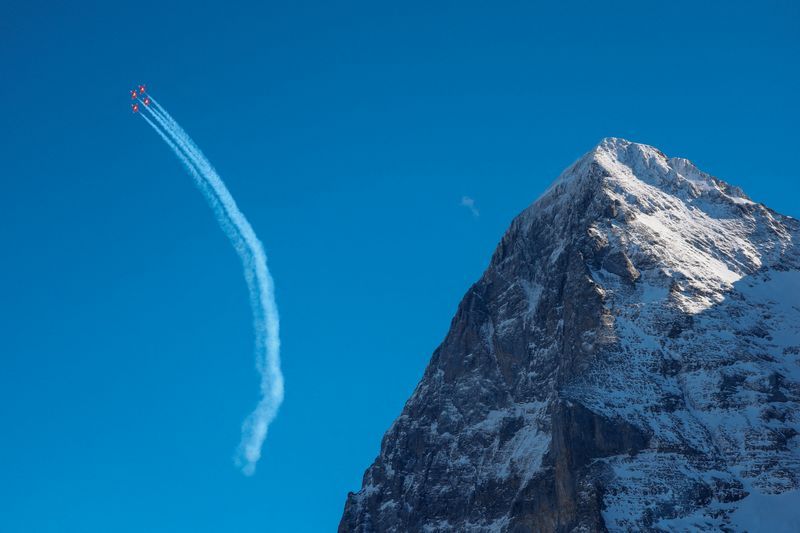
British alpinist Fay Manners has etched her name into mountaineering history this summer by achieving what no British woman has done before: establishing an entirely new route on the Eiger North Face. Alongside Swiss climbing partner Roger Schaeli, Manners spent 13 grueling days on the iconic Alpine wall carving out "Solar Eclipse," a 2,952-foot pathway spanning 33 pitches through previously unclimbed terrain. This accomplishment carries particular significance in a sport where the establishment of new routes remains overwhelmingly dominated by male climbers, raising questions about representation and opportunity in one of the world's most demanding athletic pursuits.
The Eiger North Face stands as one of mountaineering's most formidable challenges, a 5,900-foot expanse of rock and ice that forms part of the Swiss Alps' most notorious geography. Its harsh reputation was forged through decades of tragedy and near-misses, before a German-Austrian team finally achieved the first successful ascent in 1938. The wall's unforgiving nature—combining extreme weather, unstable ice fields, and constant rockfall hazards—means that even retracing established routes demands exceptional skill and nerve. Climbing here requires not merely physical strength but psychological fortitude and meticulous technical knowledge.
Manners' connection to the Eiger began four years before her summer achievement, when she climbed the established Heckmair Route. That experience fundamentally changed her perspective on what might be possible on the wall. Rather than accepting the known pathways available to climbers, she began researching the Eiger's topography obsessively, studying its features and identifying sections that no climber had yet attempted to forge into a continuous route. This transition from repeating existing climbs to imagining entirely new ones represents a philosophical shift in how climbers engage with mountains—moving from consumer to creator.
Establishing a new route differs fundamentally from climbing an established one in ways that speak to broader themes in mountaineering culture and beyond. When climbers follow a known path, they benefit from guidebooks detailing difficulty ratings, protection requirements, and directional guidance. They know it is possible because others have summited. By contrast, route pioneers venture into complete uncertainty. Manners articulated this distinction in describing her Solar Eclipse effort: climbers establishing new routes cannot know how technically demanding sections will prove, what rock and ice protection strategies will work, or whether reaching the summit remains feasible once committed to their chosen line. This uncertainty amplifies both the physical and mental demands exponentially.
Beyond the technical achievement, Manners emphasizes what route establishment symbolizes within professional climbing's structural inequities. She points to the fundamental messaging that permeates mountaineering culture: when aspiring climbers consult guidebooks and find that virtually every person credited with opening a route bears a male name, a subtle but powerful narrative emerges about who belongs in the sport's creative sphere. Women appear primarily as repeaters of routes established by men, rather than as innovators shaping the mountains themselves. This absence from the record of route development reinforces assumptions about women's capabilities and ambitions in mountaineering.
Women have undeniably contributed to the Eiger's climbing history, though often with their accomplishments undershadowed. Daisy Voog became the first woman to successfully climb the North Face in 1964, achieving this breakthrough despite having been rejected from a mountaineering section that excluded women from its extreme climbing activities. Japanese climber Michiko Imai served as the sole woman among six team members establishing the "Japanese Summer Direttissima" route just five years later. Yet these pioneering women remain comparatively unknown to contemporary climbers, and their route establishment efforts largely disappeared into mountaineering history's margins.
Manners probes deeper into the psychological mechanics through which gender shapes what women believe they can accomplish in climbing and beyond. She reflects on how subtle messages from childhood—comments suggesting that women cannot carry as much weight, or possess less innate strength—accumulate into internalized doubt. These seemingly minor remarks calcify into assumptions that women themselves unconsciously accept as natural limitations rather than recognizing them as socially constructed barriers. The insidiousness of these gendered expectations lies precisely in their invisibility; they operate below conscious awareness, shaping decisions and aspirations without obvious source or justification.
Manners' own journey to professional mountaineering illustrates how these subtle discouragements divert talent away from climbing careers. Growing up in England with genuine passion for sport, she initially imagined making athletics her profession. However, people around her—family, mentors, peers—consistently conveyed that women's sports careers offered insufficient financial prospects or long-term viability. This discouragement proved persuasive enough that she pursued data science instead, a more conventional path deemed safer and more stable. She eventually relocated to Chamonix, France, still working as a data consultant while climbing on weekends, straddling two distinct professional identities.
The transformation in Manners' life came through unexpected sponsorship when outdoor brand The North Face approached her about becoming a sponsored athlete. Initially, the arrangement allowed her to maintain both roles simultaneously. Within approximately a year, however, she made the decisive leap to pursue climbing full-time, abandoning her data science career entirely. Reflecting on this transition, she acknowledges how her own internalized skepticism nearly prevented her from recognizing that a women's sports career was even possible. The realization emerged only as it was actively occurring, suggesting that many potential climbers—male and female alike—never reach their achievements because they never received permission, sponsorship, or visible evidence that the path existed.
Manners' vision extends beyond her own accomplishment to imagining how her route might catalyze change within mountaineering culture. She explicitly states her dream of witnessing all-female teams attempt to repeat the Solar Eclipse route, imagining a future where women routinely appear both as route-openers and followers. This aspiration signals that meaningful progress requires not isolated female achievement but structural transformation in how climbing communities recognize, support, and celebrate women's contributions. Route establishment becomes a metaphor for broader representation: until women routinely appear in guidebooks as the people who discovered new possibilities, subtle messages about their place in the sport remain unchanged.
For Malaysian and Southeast Asian climbers and athletes broadly, Manners' achievement and her analysis of gender barriers resonate beyond Alpine mountaineering. The region has produced exceptional climbers, many of whom remain underrepresented in international climbing narratives and sponsorship structures. The psychological and structural obstacles that Manners describes—the absence of visible role models, the subtle messages discouraging ambition, the concentration of opportunity and recognition among certain demographics—operate across sports and geographies. Her insistence on the importance of women not merely achieving summits but establishing the routes themselves—creating the possibilities rather than simply navigating predetermined paths—offers a powerful framework for thinking about equity and representation in athletic development throughout Southeast Asia.

