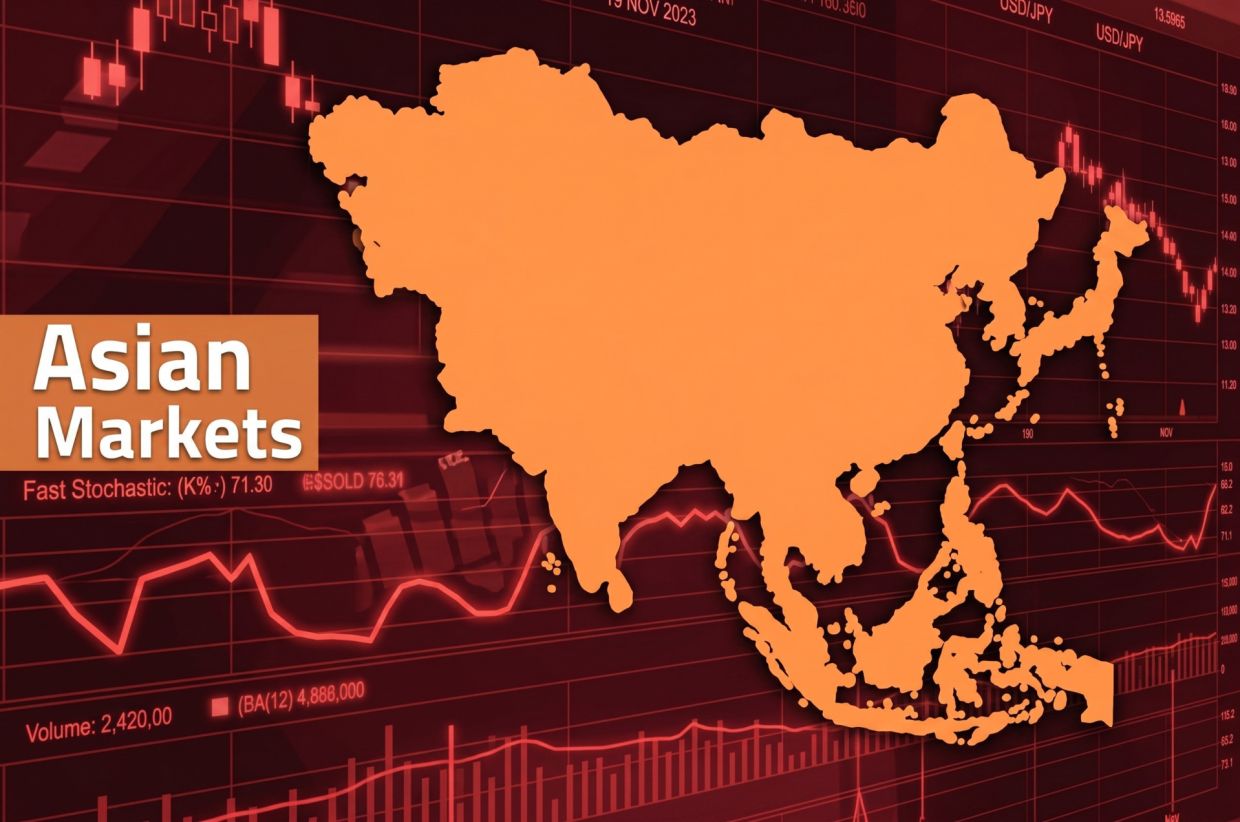
Asian equity markets faced headwinds on Monday as a convergence of geopolitical tensions and shifting monetary policy expectations weighed on investor sentiment across the region. The Strait of Hormuz closure announcement from Iran, coupled with fresh uncertainties surrounding the Middle East peace process, sent crude oil prices climbing and reverberated through global financial markets. Simultaneously, a hawkish shift in Federal Reserve messaging has compelled investors to recalibrate their forecasts for U.S. interest rate moves, creating a dual pressure that undermined confidence in risk assets throughout Asia-Pacific.
The geopolitical anxiety centred on Iran's latest move to restrict shipping through the Strait of Hormuz, one of the world's most critical energy conduits. Vessel tracking data revealed a sharp contraction in traffic through the waterway, with only 26 ships transiting on Saturday compared to 32 the previous day, suggesting the closure was being enforced. This development came even as Vice President JD Vance was meeting with Iranian officials to discuss the first substantive talks under an interim peace agreement. The disconnect between diplomatic engagement and escalatory rhetoric from Tehran created uncertainty about whether the nascent diplomatic framework could hold, prompting crude oil markets to price in additional risk premium. Brent crude futures rose 1.1 per cent to $81.43 per barrel, though the price remained substantially below its May peak of $126.41, indicating that markets viewed the current tensions as manageable relative to worst-case scenarios. U.S. crude climbed 2.7 per cent to $78.70 per barrel but hovered above the $67 level it commanded before broader Middle East hostilities began.
The oil market dynamics demonstrated how energy markets remain sensitive to any disruption of Strait of Hormuz traffic, given that roughly one-third of global seaborne oil transits through the passage. For Southeast Asia, where energy imports represent a significant economic component across nations like Indonesia, Malaysia, and the Philippines, sustained elevated oil prices pose inflationary risks that could complicate central bank policy decisions in the region. The region's oil importers face particular vulnerability should crude prices spike further, as they would immediately pressure manufacturing costs and transportation expenses, potentially cascading through supply chains.
Beyond geopolitics, the more significant market driver proved to be shifting expectations around U.S. monetary policy. The Federal Reserve's recent hawkish turn has reshaped market pricing for future rate movements, with traders now assigning a 75 per cent probability to a rate hike occurring as early as September. This represents a substantial repricing from earlier expectations of patience and delayed tightening. Futures contracts now embed expectations for 38 basis points of cumulative Fed tightening by year-end, a meaningful shift that has pushed 2-year Treasury yields to their highest levels since early 2025, settling at 4.2276 per cent following a 4 basis point intraday rise. This tightening of financial conditions creates headwinds for equity valuations, particularly in growth-sensitive sectors that had benefited from the assumption of extended monetary accommodation.
The pressure on bond markets reflects genuine uncertainty about the inflation trajectory that will guide Fed decisions. The Fed's preferred inflation gauge, core personal consumption expenditures, is due Thursday and is forecast to nudge upward to 3.4 per cent in May. Should the reading surprise to the upside, it could validate the Fed's more cautious stance and potentially accelerate the timeline for rate increases. Additional Fed speakers including Governor Christopher Waller and Federal Reserve Bank of New York President John Williams are scheduled to deliver remarks this week, offering opportunities for further policy signalling that could either reassure or unsettle markets depending on the tone and content of their comments.
Sector performance across Asian markets revealed a bifurcated market structure responding to these cross-currents. Japan's Nikkei index bucked the broader weakness by edging up 0.7 per cent, continuing momentum from an exceptional previous week that saw the benchmark climb nearly 8 per cent to touch all-time highs. However, South Korea's hyperdynamic semiconductor sector cooled markedly, with the KOSPI declining 0.9 per cent after surging more than 11 per cent in the preceding week. The reversal suggested some profit-taking after an extraordinary run higher driven by artificial intelligence-related demand for advanced chips. The broader MSCI Asia-Pacific ex-Japan benchmark eased 0.4 per cent, indicating that widespread weakness tempered enthusiasm even in resilient markets. Futures markets pointed to modest declines for U.S. opening, with S&P 500 futures off 0.5 per cent and Nasdaq futures lower by 0.7 per cent, while European futures suggested similar weakness, with EUROSTOXX 50 futures down 0.5 per cent.
Currency markets absorbed the cross-asset repricing with the dollar strengthening to 161.44 yen as the greenback benefited from higher U.S. yields and expectations of elevated interest rates for an extended period. The only constraint preventing further yen weakness appeared to be the implicit threat of Japanese government intervention, which kept the exchange rate below the 161.96 resistance level established in mid-2024. For Southeast Asia, a stronger dollar typically adds pressure to governments and corporations carrying dollar-denominated debt, a legacy challenge in the region following past crises. The euro weakened to $1.1462 after hitting a three-month low of $1.1418 on Friday, reflecting a combination of the dollar's strength and Europe's own economic uncertainties.
Sterling experienced particular pressure amid political turbulence in the United Kingdom, with Prime Minister Keir Starmer facing mounting internal Labour Party pressure following rival Andy Burnham's decisive parliamentary election victory. U.S. President Donald Trump amplified market concerns by posting on social media that Starmer was preparing to resign, though the Prime Minister had made no public announcement to that effect. The political uncertainty, combined with questions about the government's fiscal direction, prompted NAB market research chief Skye Masters to note that gilt yields would likely experience continued selling pressure at the beginning of the trading week. Sterling declined 0.2 per cent to $1.3210, a modest move but one reflecting the uncertainty premium attached to British assets amid potential leadership transitions.
Commodity markets beyond energy showed mixed performance as investors reassessed portfolio positioning. Gold, which generates no interest income and therefore faces headwinds from higher bond yields, declined 0.1 per cent to $4,154 per ounce. The slight weakness in the precious metal reflected the broader repricing dynamic in which higher real interest rates reduce the opportunity cost of holding non-yielding assets. JPMorgan's Fabio Bassi, head of cross-asset strategy, articulated a constructive medium-term outlook despite near-term volatility, noting that improving labour markets would support persistently elevated interest rates. His baseline forecast projects the first Fed rate hike in the second half of 2027, though he acknowledged meaningful risks of earlier tightening if inflation fails to moderate as expected. Bassi maintained a positive stance on risk assets, particularly quality growth, large-cap equities, and technology stocks, while targeting the S&P 500 at 8,000 with potential for upside surprises.
For Malaysian and Southeast Asian investors, the confluence of these dynamics warrants careful attention. The region's economies face a delicate balancing act between managing elevated oil prices that could reignite inflation pressures and navigating the implications of sustained higher U.S. interest rates. Central banks across the region that have gradually tightened policy over the past year now confront the prospect of a more restrictive global financial environment, complicating their own rate decisions. The uncertainty around the pace and magnitude of Fed tightening creates particular challenges for emerging market policymakers, who must weigh domestic economic conditions against the pull of higher U.S. yields that could attract capital outflows. Regional equities, having benefited from the technology and semiconductor boom, now face headwinds from both profit-taking and any broader rotation away from growth assets as rate expectations rise. The coming week's inflation data and Fed commentary will likely prove decisive in determining whether current volatility represents a temporary correction or signals a more sustained shift in market dynamics.
%22%2F%3E%3C%2Fpattern%3E%3C%2Fdefs%3E%3Crect%20width%3D%22100%25%22%20height%3D%22100%25%22%20fill%3D%22url(%23ph13aufg)%22%2F%3E%3Crect%20width%3D%22100%25%22%20height%3D%22100%25%22%20fill%3D%22url(%23ph13aufp)%22%2F%3E%3Ctext%20x%3D%2250%25%22%20y%3D%2250%25%22%20text-anchor%3D%22middle%22%20dominant-baseline%3D%22central%22%20fill%3D%22rgba(255%2C255%2C255%2C0.95)%22%20font-family%3D%22Georgia%2C%20'Times%20New%20Roman'%2C%20serif%22%20font-weight%3D%22700%22%20font-size%3D%22170%22%20letter-spacing%3D%22-0.02em%22%3ESelangor%3C%2Ftext%3E%3C%2Fsvg%3E)