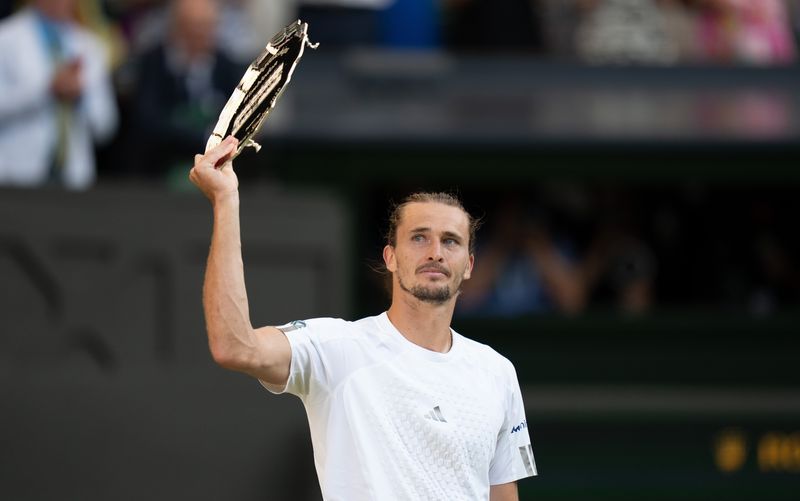
Alexander Zverev's run to the Wimbledon final represents a significant milestone in his career trajectory, propelling the German player to the number two ranking in the ATP world standings on Monday. Yet the 29-year-old's focus extends beyond the rankings achieved through his deep tournament runs. Sinner's victory over Zverev in Sunday's championship match—delivered in straight sets at 6-7(7) 7-6(2) 6-3 6-4—comes as the Italian and Spanish rival Carlos Alcaraz cement their dominance over the men's professional circuit. Despite this loss, Zverev remains optimistic that tactical refinements to his game, particularly an emphasis on aggressive striking and court control, can narrow the considerable gap separating him from these two titans of contemporary tennis.
The final itself provided evidence of Zverev's competitive capacity against the world's premier player. Facing Sinner for the tenth consecutive time without victory, Zverev finally demonstrated the kind of aggressive opposition that had eluded him throughout their previous encounters. The German had surrendered fourteen consecutive sets to Sinner before this match, making the competitive nature of their Wimbledon clash a marked departure from the established pattern of their rivalry. The opening two sets, both decided in tiebreaks, suggested that Zverev had indeed implemented the tactical blueprint necessary to trouble the defending champion.
A pivotal moment arrived at 3-3 in the third set when Zverev's sole break point opportunity evaporated. An unforced fall at that critical juncture would prove consequential not merely for the immediate point but for the trajectory of the match itself. Had this mishap not occurred, Zverev acknowledges he could have altered the course of the final, potentially becoming the first German male champion at the All England Club since Michael Stich in 1991. This near-miss underscores how tightly contested the encounter remained and highlights the slender margins separating the world's best players at championship moments.
Zverev's French Open victory last month at Roland Garros marked his first Grand Slam triumph after forty-one attempts, a breakthrough that injected psychological momentum into his subsequent performances. Sceptics note that Sinner fell in the second round at the Paris clay courts whilst Alcaraz remained sidelined with a wrist injury, circumstances that complicate narratives about the legitimacy of this major. Nevertheless, the confidence gained from finally capturing a Grand Slam—particularly the manner in which he defeated Flavio Cobolli—manifested clearly in his approach to grass-court play at Wimbledon.
The transformation in Zverev's tennis philosophy reflects a deliberate strategic evolution implemented throughout the current season. Rather than relying on the baseline consistency and defensive shot-making that characterised his earlier career, he has consciously shifted toward an attacking paradigm. His forehand, historically criticised for excessive caution and lack of penetration, has become a weapon deployed with considerably greater aggression and conviction. At Wimbledon, this stylistic recalibration proved particularly effective, with his serve percentage hovering around eighty percent throughout the final as he utilised his offensive capabilities to pressure Sinner consistently.
Zverev articulated this philosophical shift to reporters with conviction, emphasising his commitment to maintaining this attacking approach regardless of short-term results. "When I have the opportunity, I hit it. Whether I make it or miss it, that depends on the day. But I definitely go for it," he explained, framing his aggressive play not as a temporary tactical adjustment but as a fundamental reimagining of his tennis identity. He acknowledged that the early months of the year presented challenges as he integrated this new style, yet persistence with these principles has yielded tangible dividends in tournament performance. The evidence supporting his commitment lies not only in his French Open breakthrough but in reaching the Wimbledon final for the first time in his career.
The mathematical disparity between Zverev and his principal rivals remains striking. Collectively, Sinner and Alcaraz have accumulated twelve Grand Slam titles between them, establishing themselves as the generation's dominant figures. Zverev possesses only one major crown, a deficit that historically would suggest considerable separation in their respective levels. Yet Zverev's assessment of his recent performances against these adversaries warrants consideration. His near-victories against both players—an Australian Open encounter with Alcaraz and the Wimbledon final against Sinner—indicate he can compete effectively when implementing his attacking strategy with optimal execution.
Zverev's strategic positioning in the contemporary tennis landscape has evolved markedly over recent years. For some time, he has occupied the position of "the third guy" in discourse surrounding men's tennis, a designation reflecting his status outside the Sinner-Alcaraz duopoly yet above other competitors. The critical distinction Zverev emphasises is that he has primarily occupied this third position from considerable distance, observing rather than genuinely contending. His stated objective involves closing this gap sufficiently to position himself as a legitimate contender for the sport's most prestigious titles rather than merely a secondary observer.
The knee injury sustained during his fall at 3-3 in the third set became increasingly evident as the match progressed, with Zverev acknowledging that the physical trauma directly affected his serving mechanics. His ability to drive explosively into his serve—the foundation of consistent velocity and placement—diminished noticeably following the mishap. However, Zverev's overall assessment of his performance remained relatively positive despite this setback. He recognised that whilst his level dropped somewhat immediately after the injury, he recovered sufficiently to compete intensely in the fourth set, maintaining high-quality tennis throughout the encounter.
The broader implications of Zverev's ascent to the number two ranking and his demonstrated ability to trouble Sinner and Alcaraz extend beyond individual tournament outcomes. His new attacking methodology, refined through consistent implementation across multiple surfaces, suggests that the established order dominating men's tennis may gradually become more permeable. Southeast Asian tennis enthusiasts monitoring global developments will note that Zverev's emphasis on aggressive, attacking tennis reflects broader tactical trends reshaping the professional game. Where Zverev succeeds in translating this philosophical approach into consistent Grand Slam victories, the landscape of men's tennis could diversify beyond the current Sinner-Alcaraz monopoly.
Looking ahead, Zverev remains committed to this attacking paradigm as his strategy for the remainder of the season and beyond. He has articulated clearly his intention to sustain this approach regardless of immediate match outcomes, understanding that tactical transformation requires time to fully integrate and optimise. His performance at Wimbledon, whilst ultimately unsuccessful in capturing the title, validated his commitment to this new direction. The knowledge that he pushed the world number one to competitive limits in a major championship final provides tangible evidence that his strategic recalibration offers genuine prospects for future major victories and sustained challenge to the sport's dominant forces.

