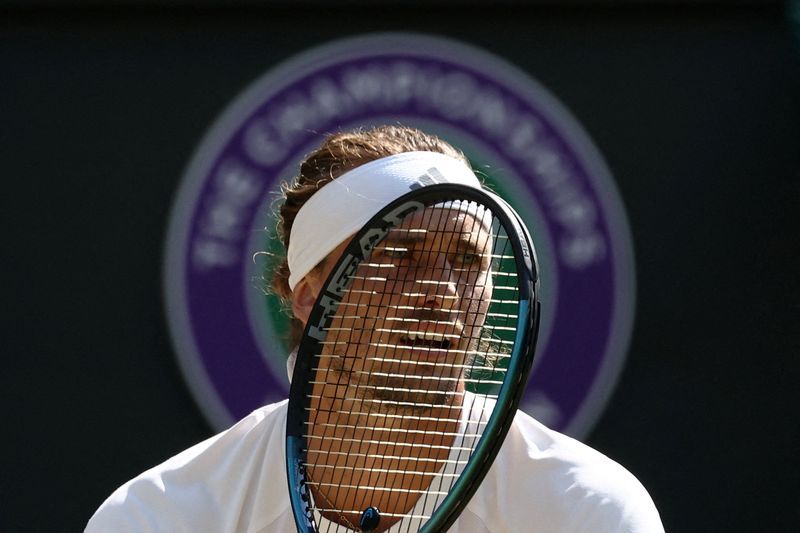
Alexander Zverev has dismantled the psychological barrier that Taylor Fritz represented, capturing a comprehensive 6-4 6-4 6-2 victory on Court One to advance to the Wimbledon semi-finals. The result marks a significant breakthrough for the German second seed, who had been unable to defeat Fritz in their last seven encounters dating back more than two years, including a loss at the All England Club in 2024. With this commanding performance, Zverev keeps alive his ambitions of securing consecutive Grand Slam victories, having triumphed at the French Open earlier this season.
The match unfolded with Zverev seizing control from the opening exchanges, establishing an early break to reach 5-4 in the first set before weathering a late resurgence from Fritz. The German's clinical execution under intense sun conditions reflected the mental fortitude required to overturn such a substantial head-to-head deficit. After securing the opening set, Zverev intensified his assault, capitalising on a medical timeout taken by Fritz for a right knee concern to extend his advantage in the second set through a crucial break that tilted the momentum decisively in his favour. The third set proved merely a formality, with Zverev constructing a commanding 4-1 lead punctuated by a striking backhand winner before closing out proceedings with minimal resistance.
This achievement represents a landmark moment in German tennis history at Wimbledon. By reaching his first semi-final at the grass-court major, Zverev joined an elite group of five German men to accomplish this feat during the professional era that commenced in 1968. He now stands alongside legendary figures Boris Becker, Michael Stich, Rainer Schuettler, and Tommy Haas in this exclusive pantheon. The significance of this milestone extends beyond mere statistics, reflecting the broader resurgence of German excellence in men's professional tennis at the highest echelon of competition.
Zverev himself acknowledged the burden of confronting Fritz, describing the psychological weight of facing an opponent against whom he harboured a recent winless streak. In his post-match remarks, he stressed that despite the apparent dominance of his performance, nothing on a tennis court is straightforward, emphasising how he had to maintain unwavering focus from the first game when he faced three breakpoints on his opening service. The player articulated that playing an nearly flawless match was the only viable pathway to victory given the mental baggage of previous defeats.
The German's upcoming opponent in the semi-finals will be Arthur Fery, who dispatched Flavio Cobolli to become the home hope advancing in the tournament. Zverev's path to the final intersects with British aspirations, as Fery is competing in his maiden Wimbledon semi-final, matching Zverev's own unprecedented presence at this stage of the grass-court championship. This pairing represents an intriguing cross-cultural narrative at a tournament steeped in tradition and national pride.
Zverev's commentary following his victory carried undertones of respect for the crowd's anticipated support for the British player while maintaining confidence in his own capabilities. He extended good-natured banter by acknowledging Fery's fairy-tale run, using wordplay on the British player's name while projecting confidence that his tennis would ultimately prove decisive. Such demeanour reflects the psychological maturity expected of a Grand Slam contender operating at the climactic stages of a major tournament.
From a broader tennis perspective, Zverev's breakthrough against Fritz carries implications for the competitive landscape at Wimbledon. The German has now accumulated twelve major semi-final appearances throughout his career, cementing his status among the sport's elite performers consistently capable of reaching the penultimate stages of the sport's most prestigious events. His ability to execute under pressure and dismantle a prolific serving threat like Fritz demonstrates the technical refinement and mental composure requisite for sustaining championship ambitions across multiple surfaces and tournaments throughout a demanding season.
The tactical dimensions of Zverev's victory merit examination. His aggressive groundstroke play, particularly his backhand construction, consistently disrupted Fritz's rhythm on grass. Rather than engaging in protracted baseline exchanges, Zverev imposed his game decisively, capitalising on the serve-and-volley opportunities that the grass surface invariably presents. The first-set performance proved crucially determinative, as Zverev's early break established momentum that Fritz, despite his physical exertions and medical intervention, could never successfully recover from during the subsequent two sets.
For Malaysian and Southeast Asian tennis enthusiasts, Zverev's trajectory through this Wimbledon campaign offers instructive lessons in professional athletic resilience. The manner in which he confronted and ultimately vanquished the psychological burden of a lengthy losing streak against a specific opponent illustrates the importance of sustained focus, technical excellence, and tactical adaptation at the highest competitive levels. As regional players aspire toward greater international recognition, Zverev's methodical progression through the tournament provides a compelling case study in how continental players, working within sophisticated support systems and maintaining disciplined preparation schedules, can compete meaningfully against the most formidable opponents.

