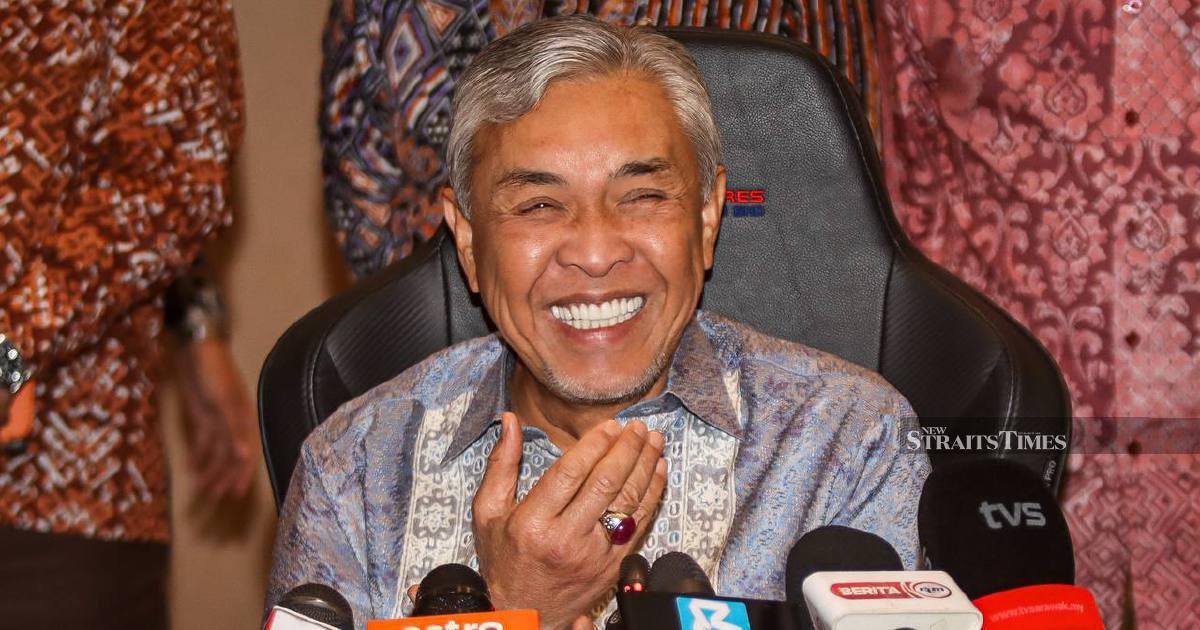
Deputy Prime Minister Datuk Seri Dr Ahmad Zahid Hamidi has chosen to respond to Prime Minister Datuk Seri Anwar Ibrahim's recent unity-focused pantun through an exchange steeped in Malaysia's literary traditions. Speaking in George Town, Zahid unveiled his own four-line Malay verse as a measured reply to the prime minister's poetic overture, signalling that the nation's top leadership continues to leverage classical forms of expression to communicate political messages and underscore shared values.
The use of pantun—a traditional poetic form that has been central to Malay-Muslim culture for centuries—as a vehicle for high-level political communication reflects a broader pattern in Malaysian public life where leaders invoke cultural touchstones to frame their agendas. By responding in kind rather than through conventional statement or speech, Zahid has acknowledged the symbolic weight embedded in Anwar's original composition whilst adding his own interpretive layer to the conversation around national unity.
Pantun, characterised by its distinctive four-line structure and intricate rhyme scheme, demands both linguistic precision and thematic coherence. The choice to communicate through this format signals intellectual engagement and a respect for the medium itself. For Malaysian audiences versed in their own literary heritage, the use of such verse carries weight beyond mere words; it invokes continuity with national identity and underscores the cultural foundations upon which political rhetoric rests. This approach stands in contrast to purely utilitarian political communication and suggests an attempt to elevate discourse to a more reflective register.
The exchange between Zahid and Anwar occurs against a backdrop of ongoing efforts to maintain cohesion within Malaysia's complex political landscape. Over recent years, the country's leadership has grappled with divisions stemming from coalition politics, regional disparities, and competing ideological visions. The recourse to shared cultural idioms—particularly those rooted in Malay-Islamic tradition—represents one strategy for transcending these fractures by appealing to deeper wells of commonality. The pantun exchange thus carries implications beyond the poetic: it suggests an attempt to reground political partnership in cultural authenticity rather than mere institutional arrangement.
For ordinary Malaysians, particularly those connected to Malay language and literature, such moments carry considerable cultural resonance. The readiness of top government officials to deploy pantun in their communications serves as a reminder that these art forms remain vital in contemporary society rather than relics confined to academic study or cultural museums. It also demonstrates that even within the highest echelons of power, where international protocols and modern management practices typically dominate, there remains space and value placed upon traditions that connect leaders to their constituents on cultural grounds.
The substance of Zahid's pantun remains important for understanding what message he sought to convey through this poetic response. The mention of roof and storm imagery in his verse suggests a thematic engagement with ideas of protection, stability, and weathering adversity—metaphors not unfamiliar in political discourse but rendered here through the metaphorical vocabulary of pantun. Such imagery resonates with audiences facing economic uncertainty, social challenges, and the practical concerns of daily governance that shape citizen expectations of their leaders.
Southeast Asia's broader political context also informs how such exchanges should be understood. Across the region, leaders increasingly face pressure to ground their legitimacy not merely in institutional performance or economic delivery, but in demonstrated connection to national and cultural identity. Malaysia's pantun exchange thus reflects patterns visible from Indonesia to Thailand, where political leaders invoke traditional forms and cultural reference points as a means of establishing authenticity and building affective connections with populations.
The reception of such poetic exchanges among different segments of Malaysian society varies considerably. Urban, English-dominant populations may view the practice as somewhat theatrical or performative, while speakers of Malay and those with deeper engagement with literary traditions likely perceive it as more substantive. This divergence itself speaks to underlying questions about national identity and whose cultural frameworks get centred in elite political communication. The pantun exchange thus becomes a microcosm of larger debates about what should constitute shared national idiom in an increasingly pluralistic Malaysia.
Looking forward, the willingness of both Anwar and Zahid to engage through traditional poetic forms suggests that cultural diplomacy and symbolic communication will continue to shape how Malaysia's leadership addresses internal cohesion. Whether such gestures translate into substantive policy alignment or functional working relationships remains to be determined through the practical work of governance. Nevertheless, the resort to pantun indicates an acknowledgement that political legitimacy in Malaysia cannot rest upon technical competence alone, but requires grounding in cultural forms that citizens recognise as authentically theirs.

