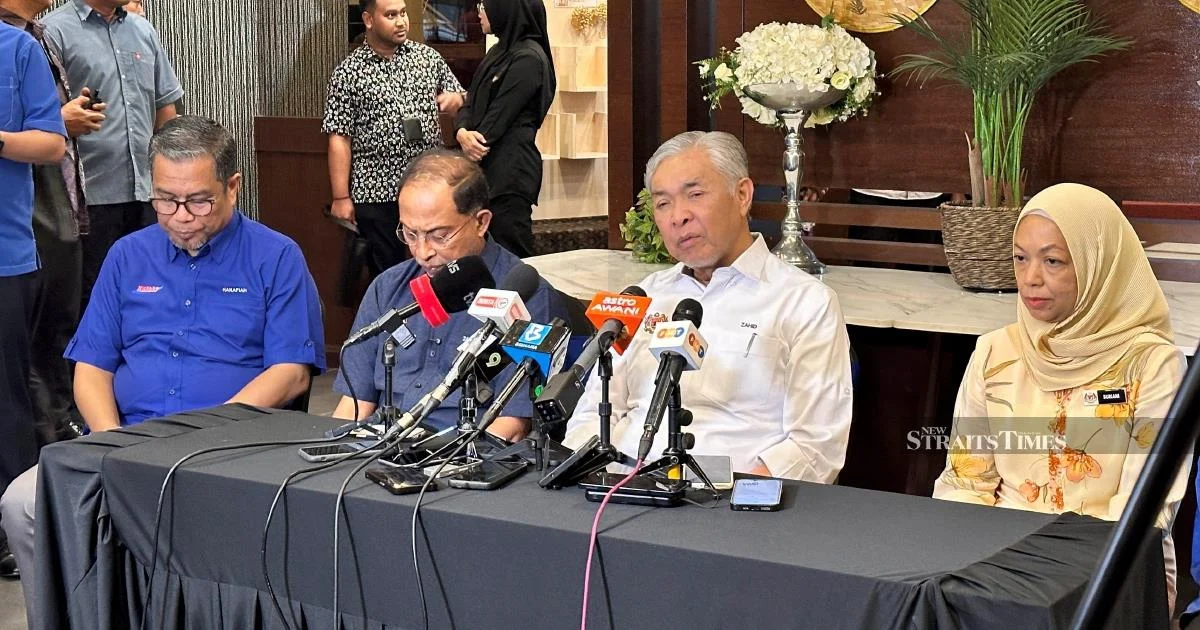
Barisan Nasional chairman Datuk Seri Dr Ahmad Zahid Hamidi has signalled that coalition partners within the unity government should redirect their focus away from controversies surrounding former leadership figures as the Johor election campaign takes shape. Speaking in Kluang, Zahid appeared to distance the ruling coalition from the use of imagery associated with Datin Seri Rosmah Mansor in promotional materials, underscoring an apparent tension within BN's alliance structure ahead of state-level polling.
The remarks carry significance for Malaysia's complex political landscape, where the unity government coalition—comprising BN, Pakatan Harapan, and other parties—has worked since 2022 to maintain a fragile consensus. The inclusion of both BN and opposition-aligned partners in a joint administration has repeatedly forced compromises on historical grievances, particularly regarding the 1Malaysia Development Berhad scandal and related convictions that defined the prior decade of Malaysian politics. Zahid's intervention suggests that internal pressures are mounting as parties prepare for competitive state elections that will test whether such cooperation can survive in electoral contests.
The Johor campaign presents a critical test case for this broader arrangement. The state, Malaysia's second-largest by population and a traditional BN stronghold, has shaped national politics for generations. A strong showing would reinforce the unity government's legitimacy; conversely, setbacks could embolden critics who argue that the coalition represents an unnatural and unsustainable partnership between ideological opponents. The imagery controversy appears to have sparked concern that references to earlier BN administrations might alienate non-BN coalition members or distract from the government's current policy agenda.
Rosmah, the former prime minister's wife, became a polarising figure in Malaysian public discourse following the 2018 electoral shift and subsequent investigations into financial wrongdoing. Her appearance in campaign materials would inevitably rekindle debate over governance failures and accountability during the previous administration—precisely the type of backward-looking discussion that unity government architects had hoped to minimise. For partners like PKR and DAP, who spent years in opposition criticising BN governance under that era, such imagery could create discomfort and suggest that BN allies were attempting to rehabilitate rather than distance themselves from past associations.
Zahid's intervention reflects a delicate balancing act. As BN chairman, he must maintain party morale and defend the coalition's record while simultaneously reassuring non-BN partners that the unity government remains committed to moving beyond sectarian divisions. The implicit rebuke of fellow coalition members who may have authorised such imagery suggests that some internal discipline is being exerted to prevent individual parties from pursuing nostalgia-driven messaging that could destabilise the broader partnership. This kind of behind-the-scenes coordination, while unglamorous, represents a key requirement for maintaining the unity arrangement in practice.
The timing of these remarks also reflects broader election management concerns. Malaysian state elections have become increasingly competitive in recent years, with voters demonstrating willingness to punish perceived arrogance or disconnection from contemporary concerns. A campaign that dwells on figures from the Najib administration—which ended in electoral defeat in 2018—risks appearing tone-deaf to voters who have moved beyond that chapter or who remain wounded by its scandals. Zahid appears acutely aware that the coalition must project forward momentum and a focus on future deliverables rather than past achievements or controversies.
For Southeast Asian observers, the scene illustrates how established power blocs attempt to adapt when confronted with genuine political pluralism. Malaysia's unity government represents neither a fully-fledged merger of disparate parties nor a genuine power-sharing arrangement on equal terms; rather, it is a modus vivendi designed to prevent either side from obtaining overwhelming dominance. Such arrangements require constant attention to prevent any single component from appearing to dominate discourse or resurrect pre-unity grievances. When that discipline slips, the entire structure comes under stress.
The coalition partners will face this same tension repeatedly as state elections approach across Malaysia. The temptation for individual parties to campaign on their own terms—using imagery, rhetoric, and personalities that resonate with their respective bases—will continually test the unity framework. Zahid's Kluang intervention suggests that BN recognises this risk and is willing to police its own messaging to maintain coalition cohesion, at least in the crucial period leading up to Johor polling. Whether this internal discipline holds across multiple campaigns, and whether non-BN partners are equally willing to avoid provocative positioning, remains an open question.
The broader implication extends beyond immediate electoral calculations. The unity government was, in many respects, an emergency arrangement designed to prevent political crisis and provide governance continuity after the 2022 elections produced no clear majority. Nearly three years into this arrangement, it has evolved from its crisis-management origins into something approaching normalised cooperation, despite its institutional awkwardness. Yet state elections represent moments when that normalisation is tested most severely, as parties must compete for legitimacy in their respective strongholds while maintaining national-level coalition discipline. Zahid's message to allies—that some figures and grievances must remain off-limits in competitive settings—is an acknowledgement that this balancing act, while functional, remains perpetually fragile.

