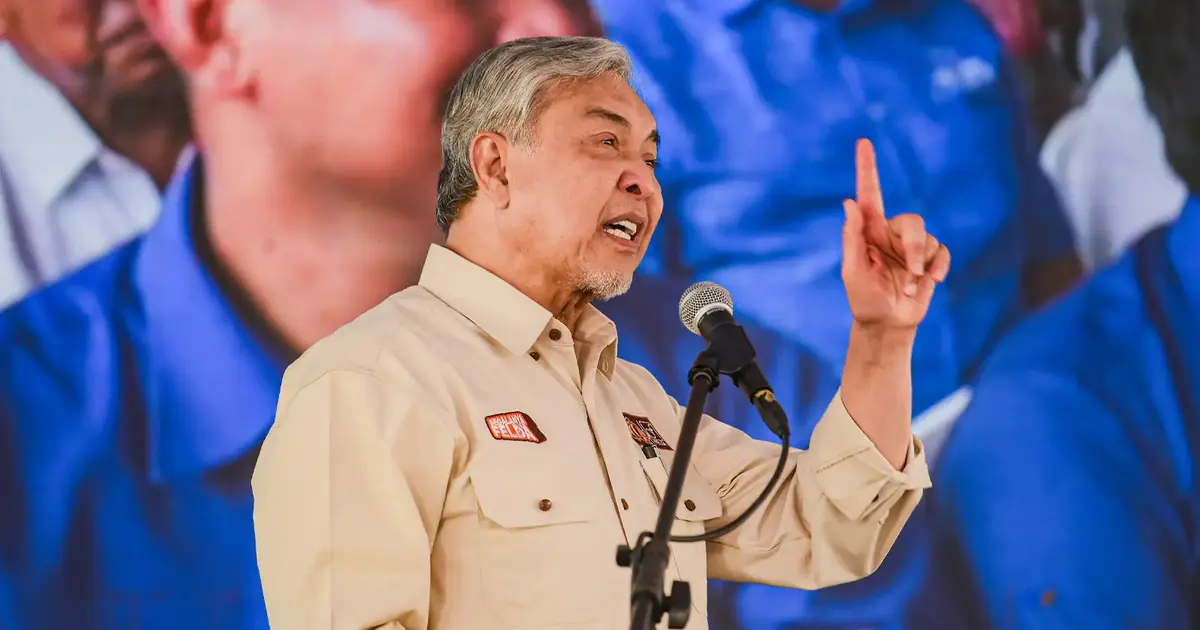
Barisan Nasional chairman Zahid Hamidi has signalled that the upcoming Negeri Sembilan state election will serve as a critical benchmark for assessing whether the informal electoral understanding between BN and Perikatan Nasional warrants extension to subsequent political contests, including the Melaka state polls and the next general election.
The remark underscores how contemporary Malaysian electoral politics relies increasingly on post-hoc evaluation of coalition performance rather than predetermined power-sharing agreements. Instead of negotiating terms upfront, the two coalitions appear to be adopting a pragmatic approach where success in one election informs decisions about cooperation in the next. This mechanism allows both sides flexibility whilst maintaining the appearance of strategic alignment, a particularly useful posture given the volatility of Malaysia's political landscape over the past decade.
Negeri Sembilan holds particular significance in this calculus. As a relatively compact state with a Malay Muslim-majority population and traditionally competitive politics, it serves as a microcosm for testing coalition dynamics. The state has historically been a BN stronghold, but recent electoral trends across Malaysia have demonstrated that no state is immune to shifts in voter sentiment. The results here will reveal whether BN and PN can effectively manage potential voter overlap, campaign coordination, and seat allocation without undermining each other's electoral prospects.
The implicit contractual nature of Zahid's statement reveals something fundamental about Malaysian coalition politics: alliances are provisional and contingent. Unlike established federal partnerships where coalition partners commit to specific legislative programmes and ministerial portfolios, electoral understandings remain deliberately vague. This ambiguity serves both organisations, as it permits rapid recalibration without the political cost of explicit betrayal or renegotiation of formal agreements.
For Zahid and BN, the calculus involves maintaining relevance in a political environment where neither coalition commands overwhelming dominance. BN's historic position as Malaysia's dominant political force has eroded considerably, making tactical alliances essential to securing parliamentary majorities or state government formation. An electoral understanding with PN allows BN to benefit from PN's voter base—particularly in rural and Malay-heartland constituencies—without formally merging or ceding strategic autonomy.
PN faces a parallel set of considerations. The coalition emerged as a significant political force only in recent years, achieving notable success in Perlis and elsewhere. An understanding with BN enhances PN's credibility and reach, particularly in states where BN remains institutionally entrenched. However, PN must balance this advantage against the risk of being perceived as subordinate to BN, which could alienate supporters attracted by PN's positioning as a fresh political alternative.
The prospect of extending the arrangement to Melaka polls adds another dimension. Melaka has historically been a competitive BN-held state with significant local political dynamics. A successful performance in Negeri Sembilan might provide both coalitions with confidence to attempt similar coordination in Melaka, though such extension would likely depend on whether their electoral understanding in Negeri Sembilan generates positive results without creating organisational friction or candidate resentment.
The reference to GE16—expected sometime before 2025—indicates that both coalitions are already contemplating how their current understanding might translate into federal-level cooperation. A general election involves far more complex dynamics than state polls, with national campaigns, Sabah and Sarawak considerations, and federal-level resource allocation complicating matters considerably. Testing the partnership in lower-stakes state elections allows both sides to identify potential problems and compatibility issues before committing to national-level coordination.
For Malaysian voters and observers, Zahid's statement illuminates the increasing pragmatism characterising contemporary politics. Rather than ideological alignment or shared policy platforms, modern coalitions often rest on naked electoral calculation: whether two political forces can together accumulate enough seats to form government. This transactional approach reflects the fragmentation of Malaysian politics, where no single coalition has proven consistently capable of dominant national performance.
The Negeri Sembilan election also occurs within a context where both BN and PN face pressure from internal factions and from each other's presence. For BN component parties, competition with PN candidates in the same constituencies could generate internal tension, particularly if BN members believe PN is poaching their traditional voter base. Similarly, PN grassroots activists in Negeri Sembilan must reconcile supporting an electoral understanding with BN—itself a historically hegemonic force—against PN's image as an insurgent political movement.
Zahid's conditional framing suggests that BN is keeping its options open whilst testing PN's viability as a coalition partner. If BN performs substantially better than PN in Negeri Sembilan, it might conclude that the electoral understanding provides limited additional benefit. Conversely, if PN's performance is strong, BN may view extension to Melaka and GE16 as strategically valuable. This results-oriented calculus epitomises modern Malaysian electoral pragmatism.
Ultimately, Zahid's remarks reflect the tentative, evaluation-based nature of contemporary Malaysian coalition politics. Rather than locked-in strategic partnerships determined by ideology or long-term institutional ties, coalitions now function as semi-permanent arrangements subject to continuous assessment. Negeri Sembilan becomes not merely a state election, but a test case for whether two major political coalitions can effectively coordinate voter acquisition and candidate placement without overwhelming mutual distrust. The outcome will likely shape federal-level politics for years ahead.

