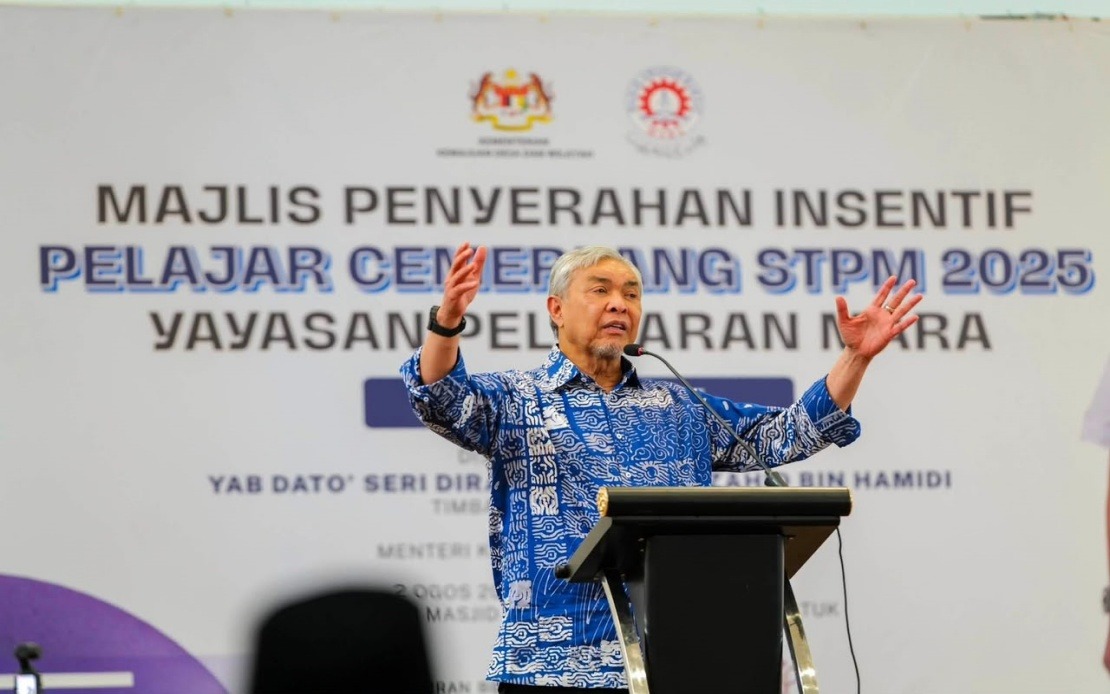
In a recognition of academic excellence, Yayasan Pelajaran MARA (YPM) has awarded the 2025 Sijil Tinggi Pelajaran Malaysia (STPM) Excellence Incentive to 38 high-achieving students from Bagan Datuk in Perak. The beneficiaries come from two secondary institutions: Sekolah Menengah Kebangsaan Khir Johari and Sekolah Menengah Kebangsaan Tun Abdul Razak, both of which have established themselves as academic centres in the district. The announcement was made by Deputy Prime Minister Datuk Seri Dr Ahmad Zahid Hamidi, who represents Bagan Datuk in Parliament and has taken a particular interest in advancing educational opportunities within his constituency.
The recognition extends beyond the STPM excellence awards themselves. According to Ahmad Zahid, three youths from the district have earned places at the prestigious Al-Azhar University in Cairo to pursue specialised studies in Islamic Syariah and Usuluddin, one of the highest honours available to Malaysian Islamic scholars. This placement reflects both the calibre of students emerging from Bagan Datuk schools and the growing regional competition for places at one of Islam's most respected institutions. Additionally, 23 students qualified for the YPM Education Compassionate Fund, a support mechanism designed to assist deserving learners from economically disadvantaged backgrounds in continuing their tertiary education.
Ahmad Zahid's public acknowledgement of these achievements carries significant political weight, signalling the government's commitment to nurturing talent in secondary towns beyond the metropolitan centres that typically dominate academic discourse. His statement emphasises that success among Bagan Datuk's youth is not accidental but rather the product of systematic investment in infrastructure, teaching quality, and student support mechanisms. The Deputy Prime Minister's framing of these results as evidence of latent potential awaiting proper conditions reflects a broader narrative in Malaysian education policy regarding the equitable distribution of opportunity across urban and semi-urban communities.
The STPM, Malaysia's principal pre-university qualification, remains the primary gateway for students seeking entry into public universities and international institutions. For YPM to single out students specifically for excellence in this examination underscores the organisation's role as a critical enabler of social mobility through educational attainment. The foundation's focus on both top achievers and students requiring financial assistance reveals a dual-track approach to educational development that acknowledges both merit and equity as essential drivers of national human capital development.
Bagan Datuk, while a parliamentary constituency with a population of around 80,000, occupies an important position within Perak's educational landscape. The district sits at the intersection of urban development and rural character, making its schools bridges between traditional and contemporary educational models. The success of students from SMK Khir Johari and SMK Tun Abdul Razak suggests that strong institutional management and dedicated teaching staff can cultivate excellence regardless of geographic location or perceived socioeconomic advantage. Such outcomes are particularly valuable in demonstrating to secondary school pupils across Malaysia's tier-two cities that academic distinction is achievable without relocation to Kuala Lumpur or other major metropolitan centres.
The Deputy Prime Minister's remarks about parental support and guidance highlight a recognition that academic success emerges from the interaction between school systems and family ecosystems. His appeal to parents to continue providing encouragement reflects awareness that formal education alone cannot bridge performance gaps; the home environment, parental expectations, and community values collectively shape educational outcomes. This perspective aligns with research in educational sociology that consistently demonstrates the multiplicative effects of strong institutional support combined with engaged families.
The connection between YPM's intervention and the measurable outcomes evident in Bagan Datuk raises important questions about programme design and resource allocation in Malaysia's student financing ecosystem. The foundation, established to support bumiputera students' advancement through education, has evolved beyond simple grant administration to include performance-based incentive schemes that reward excellence and recognise comprehensive achievement across multiple dimensions—academic performance, religious scholarship, and financial need. The layered recognition approach seen here, acknowledging not just STPM excellence but also university placements and compassionate fund recipients, suggests a maturation of how merit and need are conceptualised and addressed.
For Southeast Asian observers, the Malaysian approach to recognising STPM excellence carries relevance as other nations in the region grapple with educational equity and excellence simultaneously. The public celebration of these achievements by a senior political figure, combined with the role of a dedicated foundation, reflects a model where government and civil society institutions work in concert. This contrasts with systems where either state actors or private foundations dominate, and offers a potential template for other governments seeking to maximize educational outcomes across diverse demographic groups.
Looking forward, Ahmad Zahid's stated aspiration that more Bagan Datuk students will pursue higher education locally and internationally, then return to contribute to district development, articulates a brain gain strategy distinct from conventional brain drain discourse. Rather than lamenting outward migration, this perspective frames tertiary education as an investment vehicle through which secondary towns can cultivate leadership capacity and professional expertise among their own populations. The implicit assumption is that students who depart for universities and international experience will eventually bring enhanced capabilities back to their communities, creating a cycle of endogenous development.
The specific mention of success in securing places at Al-Azhar University deserves particular attention within Malaysia's Islamic education policy context. The prominence given to Islamic scholarship alongside secular STPM achievement indicates an institutional philosophy that does not view religious and modern education as competing priorities. Instead, the recognition of both domains—represented by the three Bagan Datuk students heading to Al-Azhar's Syariah and Usuluddin programmes and the broader STPM cohort—suggests an integrated educational vision where Islamic learning and contemporary academic excellence are complementary rather than mutually exclusive objectives.
The 23 recipients of the YPM Education Compassionate Fund represent a demographic often rendered invisible in excellence-focused discourse. These students, typically from households facing economic constraints, demonstrated sufficient academic performance to qualify for targeted financial support enabling continued tertiary study. Their recognition alongside merit-based award winners sends a signal that access to higher education should not be predetermined by family wealth. The foundation's dual investment—in top performers and in deserving but economically disadvantaged students—reflects understanding that national development requires both excellence and inclusion, and that talent is distributed across all socioeconomic layers.
The timing of this announcement, made publicly by the Deputy Prime Minister via official channels, underscores the political dimensions of educational achievement recognition in Malaysian governance. Such public acknowledgements serve multiple functions: they validate the experiences and efforts of students and teachers, they demonstrate the government's commitment to educational development within specific constituencies, and they generate positive narratives around institutional performance. For readers across the Southeast Asian region, this example illustrates how educational achievement can be mobilised as evidence of effective governance and sound policy direction.

