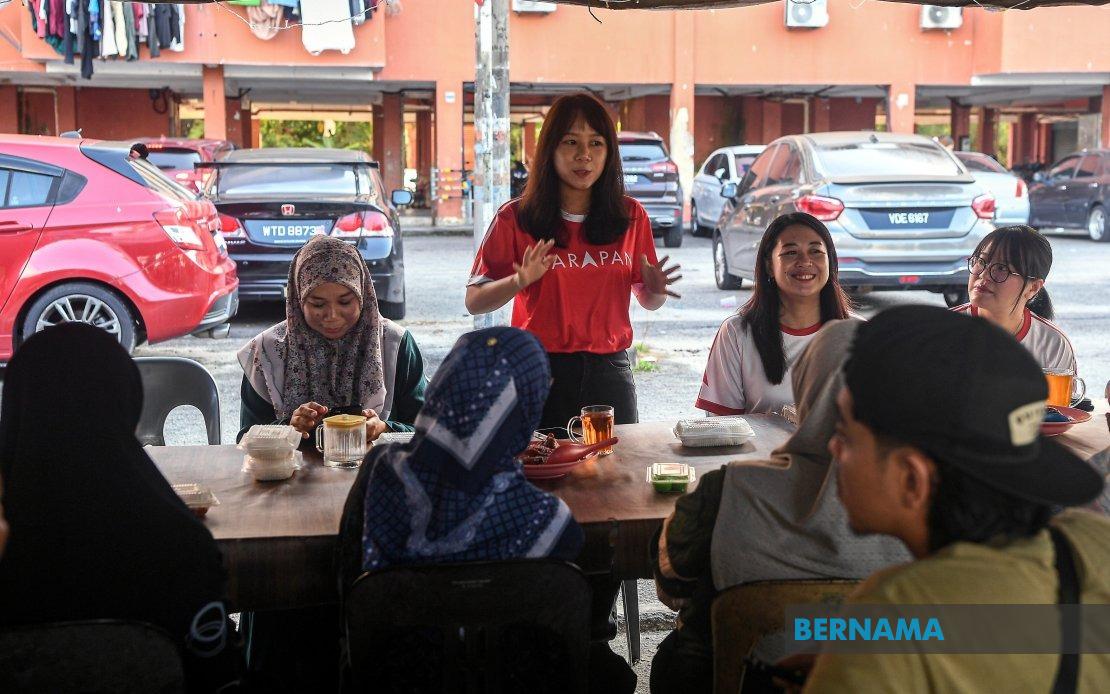
Two contrasting approaches to constituency development have emerged in the Johor Jaya state election contest, with Pakatan Harapan candidate Lee Wern Yiing and Barisan Nasional contender Chan San San presenting markedly different strategies for addressing the seat's economic and social challenges. The 30-year-old Lee, who leads the Johor DAP Socialist Youth (Dapsy), represents a generation of politicians seeking to reverse youth migration patterns, while Chan draws on more than a decade of grassroots activism and local government experience to anchor her campaign. Their competing platforms underscore broader debates within the 16th Johor state election about how to balance reform ambitions with established service records.
Lee's political journey began unexpectedly when she faced a career decision following her studies in Singapore in 2018. Rather than pursuing lucrative opportunities across the Causeway, she returned to Malaysia convinced of the country's trajectory toward meaningful change. This conviction led her to join the political apparatus as a special officer for then-Johor Jaya assemblyman Liow Cai Tung, an experience that crystallized her resolve to contest the seat. Her return reflects a deliberate choice to invest her professional future in domestic politics, a decision she frames not as sacrifice but as alignment with her belief in Malaysia's reform potential. This biographical detail carries particular significance for understanding her campaign's central theme: attracting and retaining young talent within Johor.
Central to Lee's electoral pitch is her rejection of the assumption that younger voters lack political engagement or interest in governance. Instead, she argues that young people conduct their own deliberations and respond to substantive policy information, which explains her dual-pronged outreach strategy combining digital communication with community-based initiatives. The Johor Jaya Run exemplifies her approach of embedding political messaging within social activities that naturally appeal to younger demographics. By framing politics as accessible and relevant to everyday concerns, rather than distant and institutional, Lee attempts to counter the conventional wisdom that youth disengagement reflects genuine apathy rather than unmet communication efforts. Her emphasis on job opportunities, housing affordability, and cost of living pressures demonstrates awareness of the material conditions driving youth outmigration from Johor.
The Johor-Singapore Special Economic Zone (JS-SEZ) figures prominently in Lee's economic vision for the constituency. She articulates a development framework where this regional project becomes the foundation for an integrated employment ecosystem capable of absorbing young talent and offering career pathways without necessitating relocation to Singapore or Kuala Lumpur. This approach reframes regional infrastructure investments as tools for demographic retention rather than mere economic statistics. Lee's proposal essentially suggests that successful utilization of the JS-SEZ could fundamentally alter migration calculations for young Johoreans, particularly those at educational crossroads comparable to her own decision point. The implicit message—that government policy can create conditions making return and settlement economically rational—challenges narratives of inevitable brain drain from peripheral regions.
Chan San San's campaign capital rests on distinctly different foundations. As an established member of Johor Bahru's civic infrastructure, having served on the city council (MBJB) and held positions within the MCA hierarchy, she possesses documented experience navigating municipal governance and community problem-solving. Her invocation of identity as an "anak Plentong"—a native of the area—establishes deep territorial legitimacy that cannot be readily constructed through campaign messaging. The decade-plus arc of her community engagement encompasses both institutional positions and grassroots volunteer work, creating a record of sustained presence rather than recent political entry. Chan frames her experience as conferring crucial insights into local dynamics, specifically the principle that community problems constitute tangible realities demanding immediate attention rather than abstract policy problems open to theoretical discussion.
Chan's platform centers on four programmatic pillars that address infrastructure, transportation, and economic foundation-building. Her vision of Johor Jaya functioning as a transportation hub within eastern Johor Bahru represents a different spatial conception than Lee's emphasis on direct employment creation. By connecting the constituency to the Rapid Transit System (RTS) project, Chan proposes enhanced regional integration that would improve access to wider economic opportunities while simultaneously addressing endemic traffic congestion. This infrastructure-first approach assumes that improved connectivity generates its own economic dynamism through reduced commute times and widened job market access. The strategy implicitly suggests that young people will remain in Johor if the friction costs of accessing opportunity decrease, even if primary employment remains geographically dispersed.
The contrast between these two candidates encapsulates a broader tension within Malaysian electoral politics. Lee represents the rising generation of reform-oriented politicians who believe that institutional change and policy innovation can arrest negative demographic trends, particularly concerning youth. Her confidence in Malaysia's trajectory fundamentally shapes her campaign narrative. Chan, conversely, grounds her appeal in demonstrable service records and institutional knowledge, suggesting that effective governance derived from experience matters more than aspirational visions. Neither candidate dismisses the other's central concern; both acknowledge economic development and youth welfare as priorities. Rather, they diverge on mechanisms—whether transformation emerges from new political energy and strategic investment or from deepened engagement with existing institutional structures by experienced hands.
The broader electoral context reveals the stakes of this contest. The Johor Jaya constituency exists within a 56-seat landscape where 172 candidates compete for representation, a density indicating significant political competition. The July 11 polling date approaches with early voting scheduled for July 7, compressing the campaign timeline and intensifying candidate efforts to establish differentiation. Four-way contests—as exists in Johor Jaya with the entry of Parti Bersama Malaysia's Lau Yi Leong and Independent candidate Lim Hun Peaw—create strategic complications for both major coalitions, requiring vote consolidation from their respective bases while expanding appeal beyond committed supporters.
For Malaysian and Southeast Asian readers, the Johor Jaya dynamics illustrate how state-level elections become laboratories for competing approaches to demographic and economic challenges increasingly common across the region. Youth retention, economic diversification, and regional integration represent issues affecting Thailand, Indonesia, and the Philippines alongside Malaysia. Lee's emphasis on policy-enabled opportunity creation reflects one response pattern observable across development-oriented political movements in Southeast Asia, while Chan's focus on institutional delivery and local stewardship parallels established governance narratives in the region. The election results in Johor will offer empirical data about which message resonates more powerfully with contemporary Malaysian voters, potentially informing campaign strategies in future contests throughout the region.
The competing visions also reflect differing assumptions about the relationship between government and young people. Lee's campaign presumes that youth disengagement from Johor reflects rational response to limited opportunity, addressable through deliberate policy intervention and strategic investment. Chan's approach implies that young people respond to visible evidence of governmental effectiveness and community-oriented service, suggesting that trust and institutional performance matter more than transformative vision. Both frameworks merit serious consideration as Johor voters prepare to decide between candidates on July 11. The constituency's outcome will likely influence how both coalitions approach youth engagement and regional development messaging throughout subsequent electoral contests across Malaysia and beyond.

