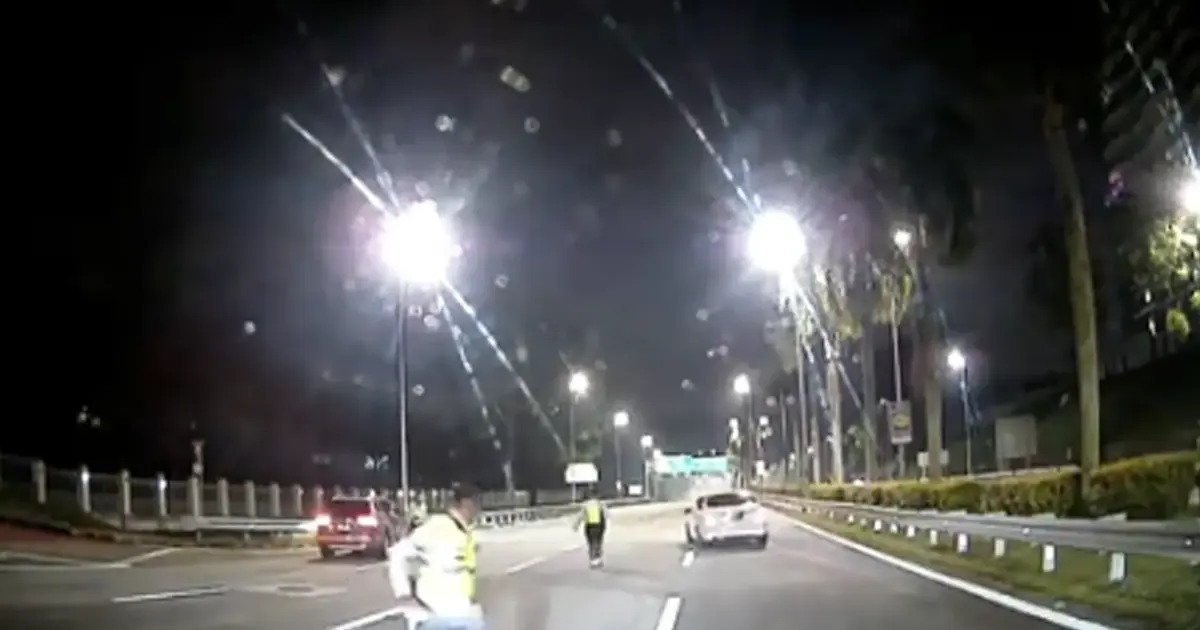
A 20-year-old man operating a Mercedes vehicle was taken into custody today after deliberately accelerating past a police roadblock, bringing renewed focus to the escalating problem of road users defying law enforcement checkpoints across Malaysia.
The driver's nervous demeanour at the checkpoint apparently triggered concern among attending officers, who subsequently moved to intercept the vehicle as it continued through the cordon. This incident exemplifies a worrying trend in Malaysian traffic enforcement, where motorists increasingly challenge police authority at routine inspection points established to enhance public safety and detect violations.
According to police records, the suspect now faces formal charges of wilfully disregarding explicit instructions issued by a lawfully deployed police officer. Such offences carry serious legal consequences under Malaysian traffic and criminal statutes, reflecting the government's determination to maintain order on public roads and ensure compliance with legitimate security operations.
Roadblocks serve multiple critical functions within Malaysia's law enforcement ecosystem. Beyond routine document and vehicle verification, these checkpoints enable officers to identify stolen vehicles, apprehend wanted individuals, and intercept drivers operating under the influence or without proper licensing. The deterrent value of such operations depends fundamentally on public cooperation and respect for police authority.
This arrest arrives amid broader concerns about deteriorating road discipline in urban and suburban areas. Malaysian traffic data consistently reveals that deliberate checkpoint evasion, reckless driving, and failure-to-comply incidents represent substantial contributors to enforcement costs and public safety risks. Police departments nationwide have intensified training and resource allocation toward managing such confrontations, yet incidents continue accumulating.
The psychological profile often observed in checkpoint evasion cases—including visible nervousness and erratic behaviour—frequently correlates with underlying motivations such as driving without valid documentation, vehicle defects, or attempts to conceal contraband. Law enforcement agencies have refined their screening protocols to identify such warning indicators, enabling early intervention before dangerous situations escalate.
For Malaysian drivers and regional road users, this case underscores the critical importance of understanding police authority and cooperation protocols. Attempting to bypass checkpoints—whether through acceleration, evasion manoeuvres, or intimidation—invariably results in more serious criminal exposure than whatever infraction initially prompted the stop. Regional jurisdictions consistently demonstrate that compliant behaviour substantially reduces legal penalties and safeguards driver safety.
The incident also highlights ongoing challenges facing Malaysian traffic police in managing increasingly congested road networks while maintaining operational effectiveness. Officers deployed to checkpoints regularly encounter confrontational situations requiring careful judgment and de-escalation skills. Training programmes emphasize patient communication whilst establishing clear boundaries regarding non-negotiable compliance requirements.
Vehicle-related offences in Malaysia carry proportionately severe sanctions, reflecting the government's commitment to reducing accident rates and fatalities on increasingly crowded highways and urban thoroughfares. Penalties for checkpoint violations can include substantial fines, licence suspension, and potential vehicle impoundment—consequences that far exceed the inconvenience of a five-minute checkpoint interaction.
The suspect's detention also reinforces an important principle within Malaysian legal tradition: that police officers conducting lawful duties possess legitimate authority to expect and compel cooperation from the public. Resistance or evasion transforms minor infractions into major criminal matters subject to prosecution and potential incarceration.
As Malaysia continues grappling with transportation safety challenges, incidents like this underscore the necessity for sustained public education campaigns emphasizing checkpoint compliance, proper documentation, and vehicle maintenance. Road safety ultimately depends on shared responsibility between law enforcement agencies and driving communities, requiring mutual respect and adherence to established protocols.
The case will proceed through Malaysia's criminal justice system, where courts will assess evidence and determine appropriate penalties. Regardless of ultimate verdict, this incident serves as cautionary reminder that Malaysian roads remain heavily monitored environments where regulatory compliance remains non-negotiable.

