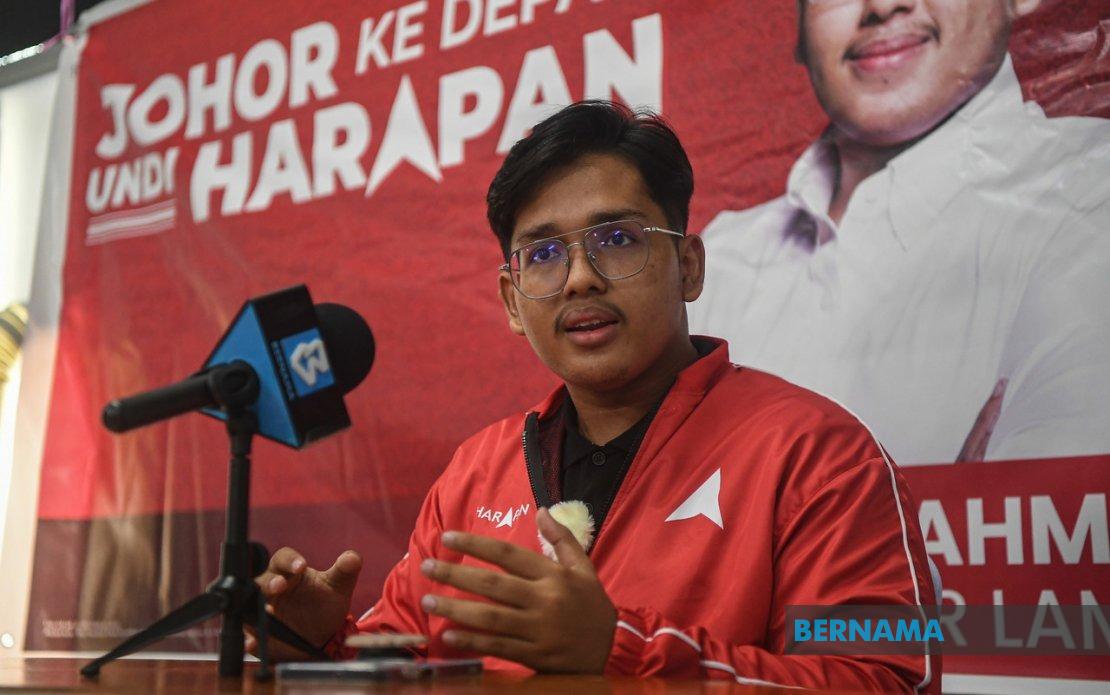
Danish Hossman Abd Rahman, at just 23 years old, represents a generational shift in Malaysian electoral politics. As the youngest candidate standing in the 16th Johor state election, the Pakatan Harapan representative for Johor Lama has translated voter interest into tangible confidence for his campaign, describing the reception across the constituency as an invigorating boost to his drive for change. Speaking in the final week before polling, Hossman emphasised how community engagement has reinforced his determination to compete vigorously in a three-way contest that includes incumbent Norlizah Noh of Barisan Nasional and Aisah Esa from Perikatan Nasional.
Hostman's candidacy reflects a broader pattern across Southeast Asia, where younger politicians challenge entrenched leadership structures by positioning youth as an asset rather than a liability. A Master of Information Technology student at Universiti Tun Hussein Onn Malaysia, he has invested considerable effort in door-to-door outreach, building familiarity through repeated constituency visits. This methodical approach contrasts sharply with established political norms in Malaysia, where frontline campaigning by candidates often intensifies only during critical election periods. His sustained fieldwork has afforded him direct exposure to diverse demographics, sharpening his understanding of constituent priorities beyond party messaging or polling data.
Particularly striking is Hossman's reception among older voters and military veterans—a cohort traditionally sceptical of youthful candidates. These elders, according to his account, welcome his earnestness and willingness to undertake ground-level investigation of local grievances. Crucially, veterans expressed fatigue with leadership from their own generation, viewing long-serving representatives as detached from community realities despite tenure in office. This sentiment carries implications beyond Johor Lama, suggesting that voter disillusionment with incumbency may transcend age and affect how constituencies evaluate candidate performance.
Instead of claiming that youth alone qualifies him for office, Hossman articulates a nuanced position: he frames himself as a strategic conduit linking the institutional knowledge of established leaders with the forward-looking priorities of younger Malaysians. This framing sidesteps potential criticism that he lacks experience while claiming added value through his position between generations. Whether voters accept this self-positioning will partly determine the viability of similarly young candidates in future elections across the country.
Hossman has zeroed in on two interconnected economic challenges that animate voter concern in Johor Lama: the scarcity of affordable housing and limited employment pathways for young professionals. Both issues have catalysed outmigration, as residents, particularly youth, seek opportunity elsewhere. This drainage of human capital weakens local economies and social cohesion, creating a feedback loop where diminished economic vitality further discourages investment and in-migration. His policy response emphasises industrial diversification aligned with existing regional strengths, including agriculture and livestock production, coupled with efforts to attract manufacturing downstream investment.
The proposed strategy reveals understanding of the constituency's economic realities. Johor Lama, less developed than urban Johor Bahru, depends substantially on primary industries and smallholder farming. Hossman's emphasis on cultivating downstream industries acknowledges that raw-commodity extraction alone cannot generate sufficient employment or wealth retention. By advocating investment in food processing, animal husbandry infrastructure, and related services, he signals an approach that builds on established local capacity rather than pursuing wholesale economic transformation. Whether his campaign rhetoric translates into deliverable policy depends partly on which coalition governs Johor after Saturday's polling.
Hossman's strategy targets women, youth, and small-business operators—segments whose economic precarities and aspirations often receive secondary consideration in Malaysian electoral debates. Small traders, in particular, have endured considerable disruption from larger retail chains and e-commerce consolidation, yet remain essential to rural and semi-rural economies. Youth unemployment and underemployment, especially among degree holders, remains an ongoing concern across Malaysia. Women often shoulder disproportionate caregiving burdens whilst navigating workforce participation, making affordable childcare and flexible employment crucial. By identifying these groups explicitly, Hossman acknowledges their distinct interests rather than subsuming them into generic voter categories.
The Johor Lama race itself unfolds within a broader electoral context. Of 172 candidates contesting 56 state seats, the intensity and stakes vary considerably by locality. Urban and semi-urban constituencies typically attract higher candidate calibre, greater media attention, and larger campaign budgets, whilst rural and Felda seats, like portions of Johor Lama, sometimes receive comparatively limited scrutiny. Hossman's youth and evident ground presence may confer advantage in such contexts, where voter connection to candidates carries particular weight. The three-cornered contest introduces unpredictability; vote splitting could result in unexpected outcomes, and candidate positioning becomes critical for consolidating support.
Hossman's emphasis on evidence-based evaluation—urging voters to judge candidates on capabilities rather than partisan tribalism or personal attacks—reflects aspirational rather than descriptive politics. Malaysian elections frequently feature hardened factional loyalty, personality-driven campaigns, and contentious rhetoric. His call for more substantive, capability-focused discourse acknowledges such realities whilst positioning his campaign as distinct. Whether he can maintain this tone if facing setbacks or opponent attacks remains untested; campaigning under pressure often forces candidates toward more combative strategies.
The candidate's commitment to repeated community visits, building familiarity over time rather than relying on name recognition or party machinery, offers insight into emerging campaign tactics. Digital natives and younger candidates increasingly leverage direct engagement and social media alongside traditional mechanisms. His approach, labour-intensive and geographically grounded, may prove replicable in similar constituencies but demands significant personal commitment and local organisational support. For Pakatan Harapan, a young, articulate, and engaged candidate in a marginal seat represents investment in future leadership bench strength, regardless of Saturday's outcome.
Hostman's campaign also reflects changing voter expectations. The prominence given to his youth, rather than downplayed, suggests constituencies increasingly value fresh perspective and energy. However, this preference remains contingent; voters will ultimately weigh novelty against other factors—party performance, local track records of contenders, economic conditions, and factional allegiances. Polling across 56 seats will reveal how extensively younger candidates penetrate electoral calculations and whether Hossman's groundwork translates into electoral traction in Johor Lama's competitive three-way contest.

