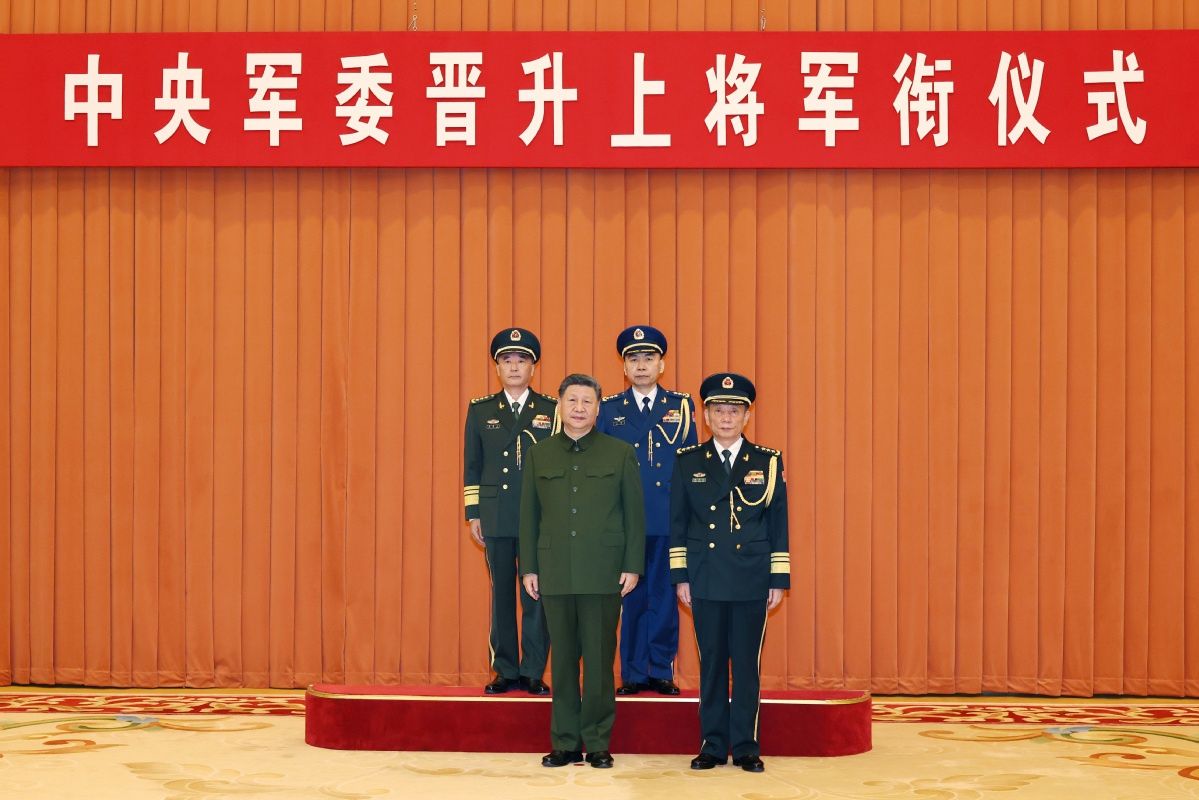
Chinese President Xi Jinping has fundamentally restructured the command of anti-corruption operations within the People's Liberation Army, signalling his continued determination to reshape the military's institutional leadership. Zhang Shuguang has assumed the role of secretary of the Central Military Commission's discipline inspection commission, marking a significant personnel shift announced through state media at a formal ceremony in Beijing on July 3rd. The reshuffle, which included the elevation of both Zhang Shuguang and newly appointed Air Force Commander Wang Gang to the rank of general, reflects the scale of leadership changes rippling through China's defence establishment as Xi consolidates control over military hierarchies.
The promotion of Zhang Shengmin from his position as the military's chief anti-corruption official to vice chairman of the Central Military Commission represents a substantial career advancement, though the precise focus of his new responsibilities remains undeclared. Meanwhile, the future assignment of Chang Dingqiu, the former Air Force Commander, has not been publicly disclosed, leaving questions about whether his removal signifies censure or lateral repositioning within the broader military structure. These personnel movements must be understood within the context of Xi's explicit commitment to rooting out what Beijing characterises as endemic corruption and factional disloyalty within the armed forces.
The origins of this extraordinary military purge trace to mid-2023, arriving just months after Xi secured his unprecedented third consecutive term as paramount leader of the Communist Party. This timing is significant for regional observers, as it demonstrates that consolidating personal authority over the military apparatus remained Xi's immediate priority following his political victory. The campaign has produced tangible casualties across multiple echelons of command: two vice military chairs have been removed, three additional Central Military Commission members have been sidelined, one defence minister has fallen from grace, and at least a dozen senior generals commanding major military operations have been dismissed or investigated.
For Southeast Asian nations and other regional powers assessing China's strategic stability, the scale of this military reorganisation carries profound implications. A military establishment undergoing such sweeping personnel changes and institutional restructuring may face periods of operational uncertainty, command ambiguity, and potential risk miscalculation during moments of regional tension. The removal of experienced commanders, regardless of the stated justification, typically generates friction and creates vacuum periods within institutional knowledge transfer and operational planning. Malaysia and other ASEAN members maintain delicate balances in their relationships with Beijing, and understanding the extent of internal Chinese military disruption provides important context for interpreting Chinese behaviour in disputed maritime zones and multilateral forums.
The investigation into Zhang Youxia, unveiled earlier this year, represents perhaps the most dramatic manifestation of Xi's willingness to pursue even his closest military confidants. Zhang Youxia's prominence as one of Xi's most trusted generals made his investigation shocking to analysts both within China and internationally. This development underscores that no level of seniority or historical relationship with Xi provides immunity from the anti-corruption campaign, a message with obvious implications for institutional obedience and factional loyalty within the military hierarchy. The very public nature of such investigations signals to other senior commanders that personal relationships or past service record offer no protection against potential career termination.
Last week's decision to strip six military lawmakers of their seats in the National People's Congress adds another dimension to this broader institutional transformation. The removal of military representation from parliamentary bodies suggests that Xi is not merely rotating personnel but actively diminishing the independent political voice that military elites previously exercised through legislative channels. This concentration of decision-making authority away from military institutions and toward the paramount leader's personal office marks a fundamental shift in how military interests are mediated within China's political system. For regional partners attempting to discern where Chinese military policy originates and how it might be influenced or negotiated, such structural changes create additional uncertainty.
The appointment structure itself deserves closer examination, as both Zhang Shuguang and Wang Gang's elevation to general rank suggests that Xi is promoting loyalists he trusts implicitly into positions previously held by more independent-minded commanders. The anti-corruption portfolio, in particular, represents extraordinary executive authority, as whoever controls discipline inspection mechanisms within the military essentially possesses the power to investigate, prosecute, and eliminate rivals or obstacles to the paramount leader's agenda. By placing trusted figures in these gatekeeping positions, Xi ensures that future purges can be conducted with minimal institutional resistance and maximum compliance.
The pattern of these purges, when examined chronologically and structurally, reveals Xi's transformation of the military from a complex institution with competing interests and factions into an apparatus more directly subordinated to centralised personal authority. This represents a reversal of trends that characterised the post-Deng Xiaoping era, when military leaders increasingly exercised independent influence through factional networks and institutional power bases. Xi's comprehensive reassertion of civilian control—or more accurately, paramount leader control—over military decision-making represents one of the most significant institutional developments in modern Chinese history.
For Malaysia's strategic community, the implications warrant careful consideration. A more tightly controlled, hierarchically rigid military establishment may prove more predictable in some respects, as commanders cannot deviate from supreme leadership directives without risking catastrophic career consequences. However, such centralised control can also increase risk of miscalculation, as institutional checks on executive decision-making are weakened and mid-level commanders lack the autonomy to exercise judgment in ambiguous situations. The concentration of military authority in Xi's hands, combined with the demonstrated willingness to eliminate even senior generals who might question orders, creates a system potentially more prone to escalatory spiral dynamics if regional tensions spike.
The continuing nature of these appointments and purges suggests that Xi views the institutional transformation of the military as an ongoing project rather than a completed initiative. The frequency of major leadership changes indicates that the paramount leader has not yet achieved the level of institutional alignment he desires. This ongoing turbulence within China's defence establishment, while ostensibly about rooting out corruption, fundamentally reflects Xi's determination to ensure that no power centre within the military establishment can operate independently of his personal control or challenge his strategic decisions. Regional powers must factor this institutional volatility into their assessments of Chinese behaviour, recognising that a military undergoing such comprehensive transformation may behave unpredictably as it adjusts to new command structures and leadership cultures.

