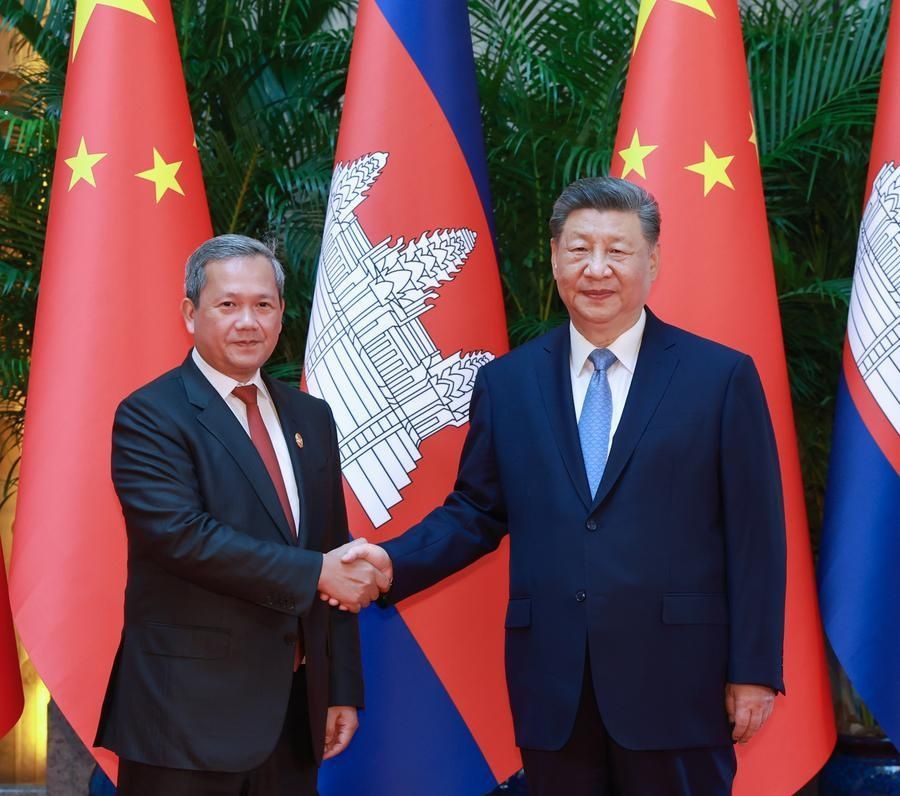
During a high-level meeting in Shanghai on Friday, Chinese President Xi Jinping and Cambodian Prime Minister Hun Manet reaffirmed the enduring bond between their two nations, with Xi emphasizing the importance of preserving the strategic alliance established by previous generations of leaders. The encounter took place while Hun Manet was in China for the 2026 World Artificial Intelligence Conference and High-Level Meeting on Global AI Governance, alongside his broader state visit to Beijing.
The bilateral discussions centred on advancing what both leaders characterized as an all-weather partnership suited to contemporary geopolitical conditions. Xi specifically called for enriching the "Diamond Hexagon" cooperation framework, a multilateral initiative designed to strengthen economic and diplomatic ties across Southeast Asia. The president stressed that deepening this relationship would serve mutual interests and contribute to regional stability at a time when international relations remain fluid and unpredictable.
Economic collaboration emerged as a central pillar of the renewed commitment. Both nations pledged to accelerate development of two key corridors designed to integrate their economies more tightly. The Industrial Development Corridor aims to facilitate cross-border manufacturing and supply chain integration, while the Fish and Rice Corridor targets agricultural cooperation and food security. These initiatives reflect Beijing's broader strategy of using infrastructure and trade to cement influence across Southeast Asia, a region where China faces growing competition from other major powers.
Beyond traditional sectors, the two leaders identified emerging technologies as essential to their partnership's future relevance. They agreed to foster cooperation in artificial intelligence and the digital economy, sectors where China has invested heavily and established competitive advantages. This technological dimension is particularly significant for Cambodia, which seeks to modernize its infrastructure and leap-frog development stages through digital transformation. Upgrading established sectors such as electricity generation and agricultural production remains important, but both governments recognize that prosperity increasingly depends on capturing value in high-technology industries.
Securing the border region featured prominently in discussions, reflecting persistent challenges that affect stability across mainland Southeast Asia. Xi and Hun Manet committed to intensified efforts against cross-border criminality, including counterfeiting operations, smuggling networks, online gambling platforms and telecommunications fraud. These transnational crimes have flourished in the porous border zones of Southeast Asia, generating billions in illicit revenue and destabilizing communities. Enhanced cooperation suggests both governments recognize that uncontrolled criminal activity undermines economic development and governance legitimacy.
The meeting also touched on Cambodia's ongoing border tensions with neighbouring Thailand, a sensitive issue that has periodically erupted into armed confrontation and displaced civilian populations. Xi expressed support for diplomatic resolution through dialogue and consultation, signalling China's desire to position itself as a stabilizing force in regional disputes. China's backing for negotiated settlements carries particular weight given Beijing's growing military capabilities and economic leverage in the region, though analysts note such mediation efforts often serve Chinese strategic interests as well as promoting genuine peace.
Hun Manet responded to Xi's overtures by reaffirming Cambodia's unwavering commitment to close partnership with China, emphasizing that this alignment transcends fluctuations in the broader international environment. The Cambodian premier expressed deep appreciation for decades of Chinese investment in Cambodia's economic and social infrastructure, acknowledging the tangible benefits that development assistance and foreign direct investment have brought to his nation. This gratitude reflects the reality that Cambodia remains heavily dependent on Chinese capital and markets.
Cambodia's steadfast endorsement of the one-China policy underscores the diplomatic alignment between Beijing and Phnom Penh, a relationship that has deepened considerably over the past two decades. Hun Manet committed to expanding bilateral trade volumes, advancing joint projects in major infrastructure sectors, and strengthening what both sides characterize as political mutual trust. The emphasis on trust is notable, as it acknowledges that beyond formal agreements and economic ties, the relationship rests on deeper understanding and coordination of strategic interests.
The discussion of telecommunications fraud crackdowns carries particular regional significance. Southeast Asia has emerged as a global hotspot for online scam operations targeting victims across Asia, generating losses estimated in the billions annually. Chinese citizens have been among the victims, creating a shared interest in suppressing these networks. Enhanced cooperation signals both nations' commitment to addressing this growing challenge, though critics note that enforcement depends on political will and institutional capacity that has sometimes proven inadequate.
For Malaysia and other Southeast Asian nations observing these developments, the Xi-Hun Manet meeting illustrates the deepening of China-Cambodia ties at a moment when regional powers are competing for influence and favorable positioning. Cambodia's strategic location along major trading routes and its proximity to Thailand and Vietnam make it valuable to Beijing's broader strategic calculations. The partnership provides China with a sympathetic voice in regional forums and strengthens its position in mainland Southeast Asia, a zone of traditional Chinese strategic interest.
The expansion of cooperation frameworks and technological partnerships also reflects China's ambition to lead the Indo-Pacific region in emerging sectors like artificial intelligence and digital infrastructure. By anchoring Cambodia more tightly to Chinese technological ecosystems and supply chains, Beijing consolidates its competitive advantages while offering Cambodian partners access to technologies and capital otherwise difficult to obtain. This dynamic shapes competitive conditions across the entire region, affecting how other nations position themselves technologically and economically.
Looking forward, the commitments made during this Shanghai meeting will likely translate into increased Chinese investment in Cambodian infrastructure, expanded trade flows, and closer military and security cooperation. The emphasis on dialogue regarding Thai-Cambodian border disputes suggests China intends to remain actively involved in regional peace-building, though such involvement inevitably carries strategic dimensions that extend beyond humanitarian concerns. For stakeholders across Southeast Asia, monitoring how these bilateral initiatives develop will provide valuable insight into China's regional strategy during a period of significant geopolitical competition and realignment.

