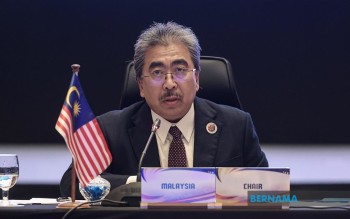
Malaysia's Investment, Trade and Industry Minister Datuk Seri Johari Abdul Ghani has warned that the World Trade Organization faces an existential challenge unless it fundamentally adapts to the realities of today's international economic landscape. Speaking at the 39th Asia-Pacific Roundtable (APR) in Kuala Lumpur on June 30, Johari stressed that the multilateral institution must modernize its approaches and priorities to address the concerns of member nations in an era defined by strategic competition, technological advancement and supply chain vulnerability.
The WTO was established during an era when policymakers unanimously accepted that reducing tariff barriers and broadening market access represented the primary pathways to economic growth and stability. That foundational consensus, however, has fractured under the weight of geopolitical realignments and shifts in how governments conceptualize economic policy. Today's policymakers operate in a dramatically transformed environment where trade considerations no longer dominate strategic calculations in isolation from broader security, industrial and technological concerns. Johari articulated this fundamental shift, noting that the institution's historical mission has become insufficient for navigating contemporary challenges.
At the heart of this transformation lies a profound reorientation in how nations prioritize economic objectives. Rather than pursuing market liberalization as an end in itself, governments increasingly emphasize building resilience into their economies, securing technological leadership in critical sectors, maintaining strategic autonomy from external pressures and fortifying supply chain networks against disruption. This represents not merely a tactical adjustment but a wholesale philosophical recalibration of economic statecraft. The minister emphasized that the terms of global trade debate have fundamentally shifted away from questions about how much further markets should open toward more pressing inquiries about which capabilities warrant protection and why.
The implications of this transition for the WTO's institutional future are substantial. Unless the organization evolves to accommodate these new policy priorities, it risks gradual marginalization as member states increasingly pursue bilateral arrangements, regional trading blocs and unilateral measures outside the multilateral framework. Johari's warning carries particular weight given Malaysia's historical commitment to rules-based international commerce. The minister's acknowledgment that the WTO faces genuine obsolescence risks suggests serious doubt about whether current institutional structures can adequately address member concerns.
Paradoxically, even as the WTO confronts pressures toward irrelevance, the need for credible multilateral trade governance mechanisms has arguably grown more critical. Johari highlighted this seemingly contradictory reality, noting that in periods of intensifying strategic competition between major powers, institutional frameworks capable of establishing clear rules, resolving disputes fairly and preventing economic conflicts from escalating into broader geopolitical confrontation become indispensable. The organization must therefore transform itself into an instrument better equipped to reduce uncertainty, manage contentious trade issues and serve as a stabilizing force during periods of great power tension.
Malaysia's position on this issue reflects the particular vulnerabilities of Southeast Asian economies. As a middle-power trading nation deeply integrated into regional and global supply chains, Malaysia depends heavily on a functioning multilateral trading system. However, the current iteration of the WTO increasingly struggles to address discriminatory trade practices that disproportionately affect smaller nations and undermine their development prospects. Johari specifically identified this problem, calling for the organization to take decisive action wherever such practices emerge, suggesting Malaysian frustration with the WTO's perceived passivity in confronting protectionist measures employed by larger trading partners.
The 39th Asia-Pacific Roundtable, organized by the Institute of Strategic and International Studies (ISIS) Malaysia on behalf of the ASEAN Institutes of Strategic & International Studies network, provided the venue for this significant intervention into ongoing debates about multilateral trade governance. Convening June 30 through July 2, 2026, the conference assembled a diverse array of participants including government policymakers, diplomatic officials, military strategists, academic researchers, corporate leaders and policy analysts. The gathering's overarching theme of "Accelerating Agency and Action" underscored the urgency many in the region feel regarding emerging geopolitical and economic challenges.
Johari's remarks should be understood within the broader context of rising protectionism and the fragmentation of global trade relationships. Several major economies have pursued industrial policies, technology restrictions and supply chain diversification initiatives that sit uncomfortably within the WTO's existing rule set. The organization's dispute resolution mechanisms, already strained by political obstruction of appellate appointments, have proven insufficient to address these novel challenges. Malaysia and other middle powers increasingly find themselves caught between competing blocs pursuing incompatible trade and economic strategies.
Meanwhile, Malaysia reaffirms its continuing support for multilateral trading arrangements and institutions, even while acknowledging their current inadequacies. This nuanced position reflects the reality that abandoning the multilateral system entirely would leave smaller nations even more vulnerable to pressure from larger trading partners. Rather, the preference is for reform that broadens the WTO's mandate and strengthens its institutional capacity to address contemporary concerns. Such transformation would require difficult negotiations among member states with conflicting interests and priorities, but the alternative—gradual irrelevance—appears increasingly unacceptable to many nations.
The challenge facing the WTO extends beyond institutional mechanics to fundamental questions about the purpose of international trade governance. Should the organization focus narrowly on tariff reduction and market access, or should it encompass broader policy domains including technology transfer, labor standards, environmental protection and national security considerations? Different member states answer these questions differently, reflecting their divergent development levels and strategic positions. Finding compromises that satisfy diverse constituencies while maintaining the organization's core legitimacy will require creative diplomacy and genuine willingness to reform entrenched structures.

