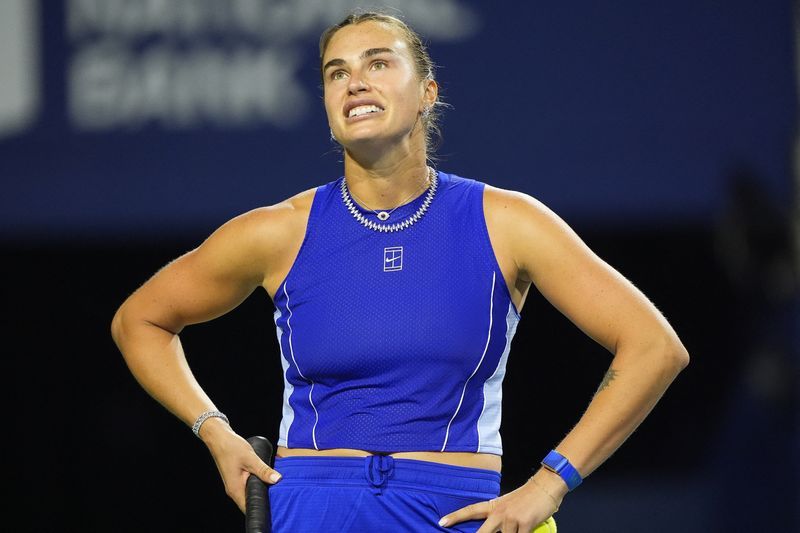
Aryna Sabalenka's bid to build momentum ahead of the U.S. Open championship took a significant blow in Toronto on Saturday when the Belarusian world number one fell to Russia's Ekaterina Alexandrova in a closely contested fourth-round match at the Canadian Open. The 16th-seeded Alexandrova claimed a 7-6(3) 4-6 6-4 victory after nearly two and a half hours of intense competition, advancing to the quarter-finals and dealing a setback to the tournament's top contender just weeks before the year's final Grand Slam event.
Sabalenka arrived in Canada as the reigning U.S. Open champion and a four-time Grand Slam title holder, her pedigree and recent form suggesting she would navigate through the draw with relative ease. Instead, she encountered an opponent who showed tactical discipline and the willingness to engage in prolonged baseline exchanges that tested the usually dominant champion's consistency. The match unfolded as a testament to Alexandrova's resilience—a player who has spent much of her career battling injuries and external challenges, yet continues to demonstrate that she belongs among tennis's elite when fully healthy and focused.
The opening set established the pattern that would define the entire contest: neither player willing to concede ground without extracting a price. Sabalenka, known for her explosive serve and powerful groundstrokes, broke serve early and appeared positioned to control the set. However, Alexandrova's capacity to absorb pace and redirect it with precision allowed her to claw back into the match. The set eventually reached a tiebreak, where Alexandrova's composure under pressure proved decisive. She claimed the tiebreak 7-3, taking the first set and immediately shifting the psychological balance of the encounter.
The second set saw Sabalenka reassert her authority with a more aggressive approach. She secured a crucial break at 4-3 and subsequently held serve to level the match, suggesting that the world number one would impose her will on the remaining contest. This recovery demonstrated why Sabalenka remains the player to beat on most surfaces—her ability to read matches and adjust her game remains among the finest in professional tennis. Yet Alexandrova proved unwilling to fold under the mounting pressure, staying composed and preparing herself mentally for what would become a decisive final set.
What transpired in the third set revealed the volatility that can emerge in elite tennis matches. Alexandrova maintained her aggressive approach, taking calculated risks with her shot-making while Sabalenka's error count climbed alarmingly. At 4-5, with Sabalenka serving to extend the match, the Belarusian saved two match points through clutch play. However, on the third match point, a double fault—perhaps the most painful way to lose a professional tennis match—handed Alexandrova the victory and a place in the quarter-finals.
Alexandrova's post-match comments revealed the tactical mindset that allowed her to overcome a higher-ranked opponent. She emphasized the importance of treating each point as a final opportunity, acknowledging that against Sabalenka, opportunities to break through are limited. Rather than concerning herself with the scoreline, she focused on execution and ball-striking fundamentals—an approach that many professional players recognize intellectually but struggle to implement under the immense pressure of facing the world's best. Her candid admission that she doubted her chances after losing the second set highlighted the psychological roller-coaster that characterizes professional tennis.
The upset carries broader implications for the North American hard court swing, which represents crucial preparation for the U.S. Open. For Sabalenka, the loss presents a useful reminder that consistency remains elusive even at the highest levels of the sport, and that recent success—whether measured in titles, rankings, or head-to-head records—provides no guarantee against quality opposition. The week in Toronto may yet prove valuable if Sabalenka uses the loss as motivation to refine her consistency and reduce unforced errors heading into New York.
Alexandrova's advancement to the quarter-finals set up a meeting with Ukraine's Elina Svitolina, who advanced past American eighth seed Amanda Anisimova with a commanding 6-2 6-4 victory. Svitolina's clinical performance demonstrated that the Canadian Open continued to produce compelling matchups throughout the draw, with multiple players showing their capacity to compete against top-ranked competitors. The eastern European representation at this stage of the tournament reflected the region's growing depth and competitiveness in professional tennis, particularly among women's competitors.
For Malaysian and Southeast Asian tennis enthusiasts following the build-up to the U.S. Open, Sabalenka's loss serves as a reminder that Grand Slam tournaments remain inherently unpredictable despite clear hierarchies in ranking and form. The Canadian Open has long served as an important barometer for form heading into the U.S. Open, with tournament results frequently shifting perceived narratives around which players enter the year's final major championship as true favorites. Alexandrova's victory over the world number one reinvigorated her own confidence while simultaneously raising questions about whether other competitors in the U.S. Open draw might exploit similar tactical approaches against Sabalenka's aggressive but occasionally inconsistent style.
The remainder of the Canadian Open would continue to provide valuable insights for players and observers analyzing the contenders for the U.S. Open title, transforming this first-round exit for Sabalenka into one chapter in a much larger narrative about which players would ultimately emerge as favorites when play moves to Flushing Meadows.

