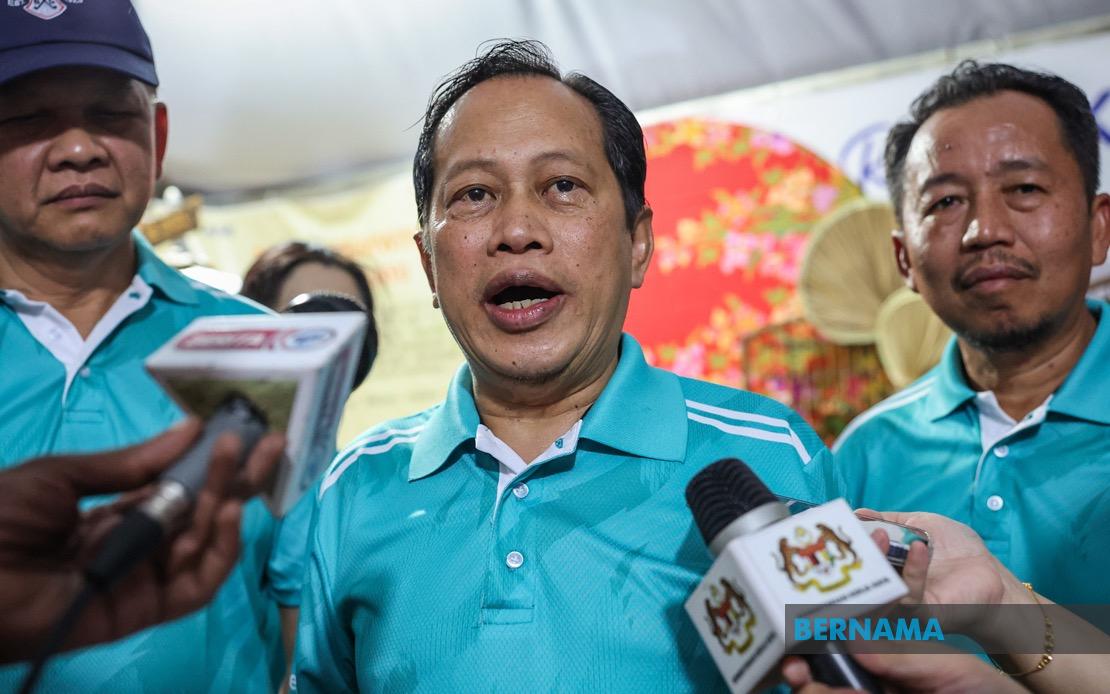
Deputy Works Minister Datuk Seri Dr Ahmad Maslan has signalled the Works Ministry's (KKR) intention to secure the most substantial development budget allocation among all government ministries when Budget 2027 is tabled, positioning infrastructure investment as central to the government's economic agenda. Speaking at the Cultural Night Run event in Batu Kawan, Ahmad outlined how increased funding would unlock wider-ranging development and maintenance initiatives spanning the nation's transportation network and related infrastructure systems.
The ministry is currently in active consultation with its principal agencies—the Malaysian Highway Authority (LLM), Construction Industry Development Board Malaysia (CIDB), and Public Works Department (JKR)—to consolidate proposals ahead of formal discussions with Finance Minister II scheduled for August 28. This methodical approach reflects the competitive budgeting environment where departments must present compelling cases for resource allocation. Ahmad revealed that KKR received approximately RM10 billion in the previous budget cycle, with RM9 billion dedicated to development expenditure, suggesting the ministry is seeking a substantial increase to meet growing infrastructure demands.
A key thrust of KKR's push centres on advancing Malaysia's smart highway ecosystem through coordinated digital transformation. The ministry has invested significantly in developing integrated technology solutions that enhance traffic management and road user experience. The LLM Traffic Control Centre now oversees hundreds of closed-circuit television cameras distributed across Malaysia's 34 highways, providing real-time monitoring capabilities that enable rapid response to congestion and incidents. This surveillance infrastructure represents a fundamental shift toward data-driven highway management, though realising its full potential requires continued investment in both hardware and analytical systems.
TuJu, the locally-developed navigation application launched by LLM, represents a distinctive Malaysian contribution to the digital transport landscape, standing as the nation's third major navigation platform alongside Waze and Google Maps. Rather than duplicating existing global applications, TuJu differentiates itself through highway-specific features tailored to Malaysian conditions and user behaviour. The application integrates real-time CCTV feeds from the LLM control centre, displays current toll rates across different highway sections, identifies rest and recreation facilities, facilitates emergency assistance requests, and delivers live traffic updates. This integration with the broader KKR and MYJalan applications creates an ecosystem where users can report road hazards and maintenance issues directly, contributing valuable data that informs maintenance priorities and safety interventions.
The strategic importance of domestic digital infrastructure deserves particular attention in Malaysia's context. Relying exclusively on foreign navigation applications leaves the country dependent on external data systems and decision-making frameworks not necessarily calibrated for Malaysian geographic and operational realities. TuJu's development demonstrates capacity for home-grown technology solutions that address specific national needs while generating employment in technology sectors. Encouraging highway users to adopt TuJu also strengthens data collection regarding traffic patterns, infrastructure weaknesses, and user preferences—intelligence essential for future infrastructure planning.
Malaysia's highway network comprises a complex patchwork of systems under different operational arrangements, with 34 highways managed by 28 separate concessionaires spanning more than 2,000 kilometres in aggregate length. PLUS Malaysia Berhad alone operates more than half of this total distance, highlighting the concentrated control of major corridors. This fragmented concession model creates coordination challenges but also allows different operators to pilot innovative technologies. Ahmad's mention of Multi Lane Free Flow (MLFF) technology—which enables toll collection without vehicles stopping at payment booths—reflects ongoing efforts to modernise user experience and reduce traffic congestion at toll plazas, a perennial frustration point for Malaysian commuters.
The MLFF implementation strategy reveals how government supports infrastructure innovation through regulatory frameworks rather than direct capital allocation. By positioning the technology as a business-to-business arrangement between highway concessionaires and service providers, without requiring government funding, the model distributes investment risk across private sector partners. PLUS Malaysia's adoption of JustGo as its MLFF payment mechanism demonstrates this approach functioning in practice. However, this decentralised implementation risks creating inconsistency across Malaysia's highways, where users encounter different payment technologies depending on which concessionaire operates each section—a fragmentation that undermines the seamless experience modern travellers expect.
For Malaysian commuters and regional transport stakeholders, these infrastructure initiatives carry significant implications. Enhanced highway monitoring and digital navigation reduce travel uncertainty, enabling better journey planning and improved road safety through faster emergency response. The expansion of smart highway features positions Malaysia as a regional leader in transportation technology adoption, potentially attracting regional traffic and logistics investments. However, the effectiveness of such systems depends critically on consistent funding, sustained technological updating, and genuine integration across competing commercial operators—areas where increased budgetary allocation becomes essential.
The competitive environment for government budget allocation means KKR must present a compelling case emphasising both immediate returns and long-term strategic benefits. Infrastructure investment typically generates indirect economic benefits through improved logistics efficiency, reduced transportation costs, and enhanced business competitiveness. Malaysia's positioning as a regional trade hub makes highway modernisation particularly consequential, as improved domestic transportation networks facilitate the movement of goods destined for or originating from neighbouring countries. Construction and infrastructure maintenance also generate employment, particularly in lower-skill categories where job creation has broader social significance beyond the transport sector itself.
The August 28 meeting between KKR and Finance Minister II will prove pivotal for determining whether the ministry's ambitions translate into budgetary reality. Competition for development allocations remains intense across all ministries, and Finance Ministry officials must balance infrastructure investment against other claimed priorities ranging from education to healthcare to social welfare. Ahmad's public articulation of KKR's budget aspirations reflects confidence in the ministry's strategic importance but also represents careful positioning ahead of formal negotiations. The timing aligns with broader government planning cycles, suggesting Budget 2027 discussions are already underway at senior levels, with line ministry proposals forming foundational inputs to Finance Ministry deliberations.

