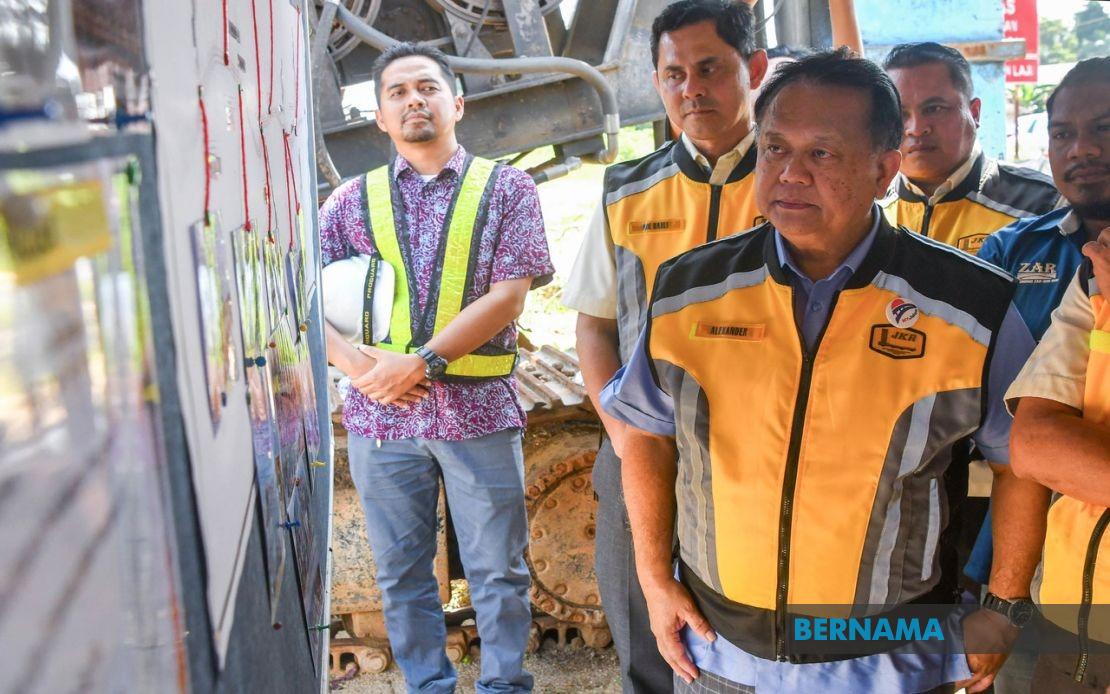
The Works Ministry has placed 50 infrastructure projects under intensive scrutiny as it endeavours to restore their implementation schedules to normal operation. Works Minister Datuk Seri Alexander Nanta Linggi disclosed the figures during a site visit to a major road upgrading initiative in Kelantan, underscoring the ministry's commitment to tackling systemic delays that have plagued the broader development portfolio. These 50 problematic ventures represent a fraction of the ministry's total project portfolio of 865 schemes, signalling that whilst delays affect a minority of initiatives, their resolution remains a priority requiring dedicated intervention and strategic management.
The identification of these underperforming projects stems from a comprehensive audit of the ministry's nationwide activities. In Kelantan alone, seven of the 104 projects administered by the Works Ministry carry the designation of "sick" or delayed status, reflecting both local and national implementation challenges. The ministry's systematic categorisation of project health demonstrates a structured approach to identifying trouble spots before minor setbacks escalate into major derailments. This diagnostic framework allows administrators to distinguish between projects experiencing temporary complications and those requiring fundamental operational overhaul or termination.
Delays plaguing these projects arise from a complex interplay of factors that extend well beyond simple management oversight. Contractor insolvency and internal management failures represent significant obstacles, rendering some firms incapable of sustaining project momentum even when contractual obligations remain binding. Land acquisition procedures have emerged as a substantial bottleneck, particularly in densely populated or contested areas where multiple stakeholders possess legitimate claims to property rights. Utility relocation—involving the rerouting of electrical, water, telecommunications, and sewerage infrastructure—frequently encounters unexpected complications that disrupt construction timelines. Equally problematic are unforeseen ground conditions, such as subterranean obstructions and geological anomalies, that remain undetected during preliminary surveys and only materialise once excavation commences.
The ministry's approach to remedying delays exhibits pragmatic flexibility balanced against fiscal responsibility. Rather than automatically terminating contracts for projects nearing completion, authorities consider the cost-benefit calculus of allowing extensions of time. When a project has achieved 85 to 90 percent physical completion, terminating the existing contractor and appointing a replacement would typically generate substantial additional expenditure through contract respecification, rebidding, and remobilisation costs. This consideration explains why the ministry opts for extension agreements when projects demonstrate imminent completion despite temporary scheduling deviations. However, this leniency applies only where genuine progress is evident and contractors demonstrate capacity to complete remaining works within reasonable timeframes.
Governance mechanisms supporting project oversight have been substantially reinforced to ensure consistency in monitoring and decision-making. The ministry now conducts systematic weekly reviews of all problematic projects through post-Cabinet meeting assessments, embedding infrastructure performance evaluation into the highest levels of governmental coordination. This cadence enables rapid identification of deteriorating situations and swift deployment of corrective measures before problems compound. The Works Minister has delegated specific responsibility to his deputy for overseeing the comprehensive monitoring regime, establishing clear lines of accountability and ensuring that follow-up actions receive sustained attention from senior officials rather than becoming lost in bureaucratic hierarchies.
Enforcement mechanisms underpinning the oversight framework include the capacity to remove underperforming contractors and terminate contracts entirely when circumstances warrant such drastic action. The ministry recognises that some projects require decisively severing relationships with contractors demonstrating chronic inability to perform, notwithstanding the disruption and cost such terminations entail. However, the ministry's approach to this prerogative remains circumscribed by proper governance standards, requiring careful deliberation before exercising termination authority to avoid potential legal challenges and dispute resolution proceedings. This conservative posture reflects Malaysia's broader emphasis on adhering to contractual principles and administrative law, even when acceleration of project delivery might be served by more aggressive enforcement.
A prominent exemplar of the ministry's project portfolio is the FT209 and FT131 road upgrading venture in Kelantan, representing a RM191 million investment scheduled for completion in September 2026. This six-kilometre scheme addresses chronic congestion affecting the crucial corridor from Kubang Kerian through Sabak to Pengkalan Chepa, regions experiencing sustained population growth and commercial activity expansion. The project has achieved 71.61 percent physical progress as of the ministerial visit, demonstrating substantial advancement despite remaining work. Land acquisition alone—encompassing 300 individual properties—has demanded expenditure exceeding RM200 million, underscoring the financial and administrative complexity of securing right-of-way through developed areas where multiple stakeholders possess legitimate property claims.
This particular undertaking illustrates how major infrastructure projects generate secondary effects demanding adaptive management beyond core construction activities. Flooding incidents affecting residents in proximity to the project site prompted parliamentary intervention, with Pengkalan Chepa Member of Parliament Datuk Dr Ahmad Marzuk Shaary requesting mitigation measures. The Works Ministry responded promptly by instructing the contractor to construct a temporary 40-metre drainage channel, addressing immediate community concerns whilst awaiting the project's ultimate completion and permanent drainage system establishment. This responsiveness demonstrates how contemporary infrastructure management must balance primary development objectives with neighbourhood protection and stakeholder welfare.
The ministry's management framework reflects evolving sophistication in handling large-scale infrastructure portfolios characterised by geographic dispersion, multiple stakeholder interests, and complex technical requirements. Rather than adopting inflexible policies applied uniformly across all delayed projects, the approach combines centralised monitoring with contextualised decision-making that accounts for project-specific circumstances. The weekly review cycle ensures that problems receive regular attention whilst permitting sufficient interval between assessments to allow contractors meaningful opportunity to implement corrective measures and demonstrate renewed progress. This balance between accountability and pragmatism represents essential elements in managing complex development programmes across a geographically and economically diverse nation.
For Malaysian stakeholders and the broader region, the Works Ministry's management of delayed projects carries significant implications extending beyond individual construction sites. Infrastructure delays cumulate into broader economic costs through congestion-induced productivity losses, commerce disruption, and reduced competitiveness in key corridors. The intensive monitoring regime signals governmental determination to contain these broader economic consequences through systematic project management. The transparency surrounding project difficulties and remedial efforts also builds public confidence in governmental capacity to deliver on development commitments, essential in maintaining support for taxation and spending policies funding capital infrastructure programmes. Regional economies observing Malaysia's infrastructure management approaches may derive lessons applicable to their own portfolio oversight and contractor performance management frameworks.

