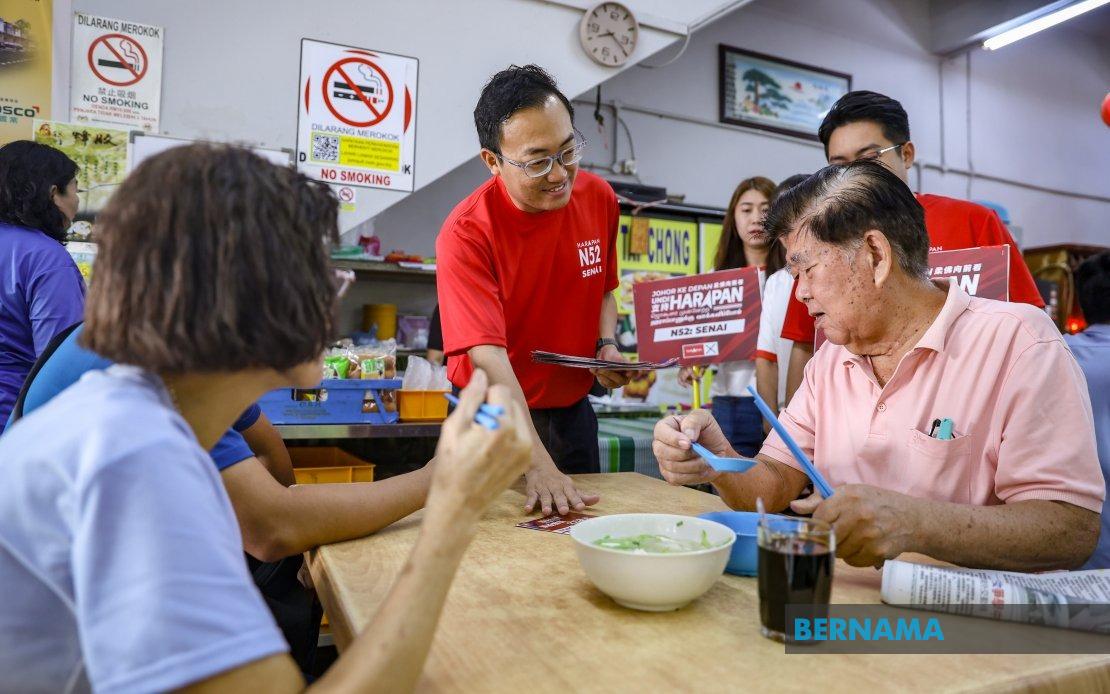
Senai incumbent Wong Bor Yang is banking on a substantial record of constituency work and infrastructure improvements to secure a second term for Pakatan Harapan in the upcoming Johor state election scheduled for July 11. The assemblyman, campaigning in Kulai, expressed confidence that his demonstrated commitment to addressing flood management and upgrading public facilities will resonate with voters in what he characterizes as a politically mature and dynamic electorate that values tangible results over rhetoric.
Wong's political career spans multiple phases of Malaysia's recent electoral history, a trajectory he views as a strategic advantage. Since 2014, he has progressed from serving as a special officer in Kulai Member of Parliament Teo Nie Ching's office, through periods of opposition involvement and local government work as a councillor from 2018 onwards, before eventually securing the Senai state assembly mandate. This varied experience, Wong argues, has equipped him with practical problem-solving capabilities grounded in the realities of constituency management rather than abstract partisan positioning.
Flood mitigation emerges as the centerpiece of Wong's legislative record during his first term. Senai has long contended with flash flooding in multiple areas, a recurring challenge that compounds during monsoon seasons and strains residents' patience with slow-moving bureaucracy. Wong points to sustained pressure on government agencies through state assembly petitions and debates that ultimately yielded RM1 million in state funding for drainage system upgrades in Taman Aman, with water channelled toward Sungai Skudai to improve overall catchment capacity. Through collaborative efforts with Kulai MP Teo Nie Ching, an additional RM3 million was secured for parallel drainage rehabilitation projects in Peladang Kulai Besar and Saleng, both areas removed from the district's designated flash flood hotspots following completion of these works.
Beyond infrastructural necessities, Wong has invested political capital in highlighting and preserving Senai's historical identity. The constituency boasts more than a century of heritage that, despite its longevity, risks erasure amid rapid urbanization. Wong's administration converted a defunct cinema into a community operations centre, restoring a cultural landmark while creating a multipurpose facility for residents. A dilapidated badminton court operated for two decades before Wong's office secured funding under the Sejati MADANI programme to transform it into a family recreational amenity christened Tiny Lake, demonstrating attention to quality-of-life enhancements beyond large-scale infrastructure.
Healthcare provision has crystallized as Wong's principal policy focus for a potential second term, a priority he frames as increasingly urgent given demographic projections. Kulai Hospital currently operates with a 93-bed capacity, a figure that Wong contends has become critically insufficient for serving the district's anticipated population of 500,000 by 2030. A journalism graduate of Taiwan's Shih Hsin University, Wong has consistently advocated for hospital expansion, framing medical accessibility as essential to the constituency's long-term development and quality of living standards.
A parallel healthcare objective concerns resolving a protracted bureaucratic impasse surrounding a new health clinic planned for Taman Mewah, Senai. Wong has identified land-related complications at state administrative level as the primary obstacle preventing the Health Ministry from commencing construction. Should he return to the assembly, eliminating these bureaucratic hurdles figures prominently in his stated agenda, reflecting an understanding that even well-intentioned federal health initiatives require localized political intermediation to navigate state-level processes.
Wong's positioning as a practical administrator derives considerable weight from his prior experience navigating Malaysia's shifting political coalitions. His willingness to pursue constituent interests while serving in opposition—using assembly mechanisms to advocate for flood management solutions and infrastructure upgrades rather than retreating into purely partisan opposition—suggests a pragmatic approach to representative governance. This pattern, he contends, distinguishes his candidacy from competitors advancing untested proposals or relying primarily on party affiliation.
The electoral contest for Senai involves a three-way competition among 66,635 registered voters. Wong faces Barisan Nasional candidate Tai Chee Chee and Bersama candidate Tew Chien How, each advancing distinct platforms and organizational backing. Wong's strategy emphasizes comparative performance assessment, inviting voters to evaluate candidates on concrete achievements rather than campaign promises. This framework positions incumbent advantage as a decisive factor, particularly in constituencies where flood management and healthcare access remain lived concerns.
The Johor state election represents a significant test of public appetite for continuity versus change across multiple constituencies. For Wong specifically, the election offers an opportunity to consolidate constituency-building efforts initiated during his first assembly term. Early voting is scheduled for July 7, with main polling occurring on July 11, providing a definitive timeframe for campaign activities across Senai and neighboring constituencies. Wong's emphasis on demonstrated competence and constituent problem-solving reflects broader PH strategy in Johor, where retaining assembly seats depends substantially on convincing voters that coalition members deliver tangible improvements to daily living standards and essential services.

