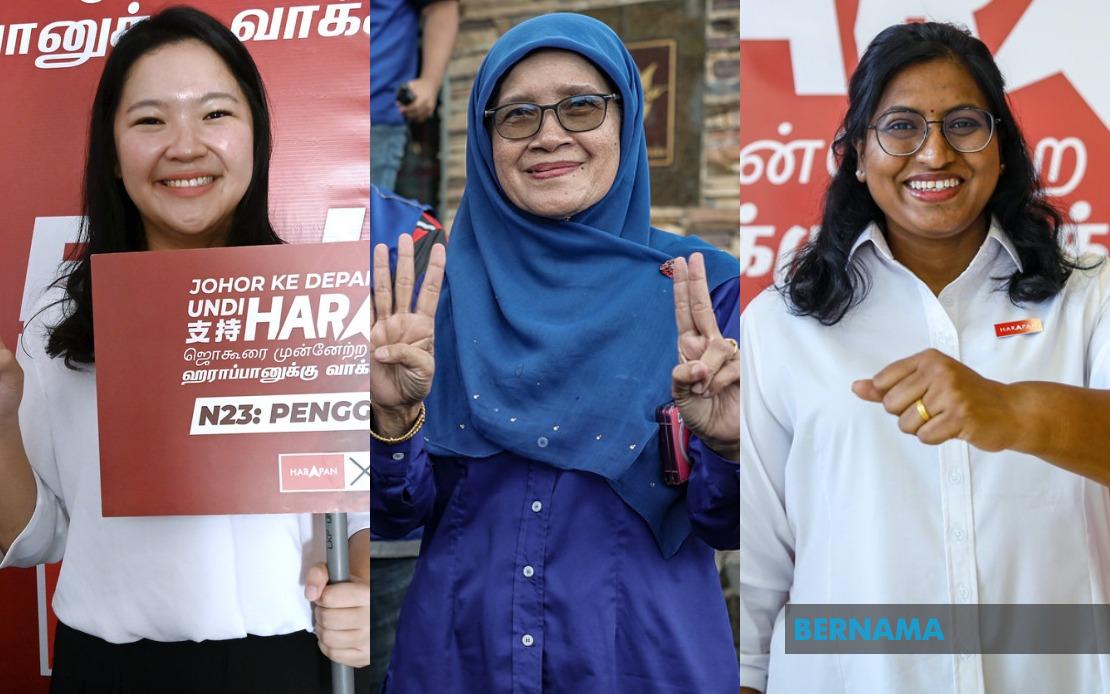
Ten women candidates emerged victorious in the 16th Johor State Election, capturing seats in the 56-member State Legislative Assembly and demonstrating continued voter confidence in female political leadership across the southern Malaysian state. The winning candidates were split along coalition lines, with seven representatives from Barisan Nasional and three from Pakatan Harapan, collectively achieving a success rate of approximately 29 percent among women who entered the contest.
The gender balance in the overall candidate field remained skewed towards male contestants. Women nominees comprised just under 20 percent of the total 172 candidates who stood in the election, significantly below parity levels. This disparity underscores persistent structural challenges in achieving gender equity within Malaysia's political parties, despite growing advocacy for greater female representation in decision-making positions. The gap between available opportunities and actual nominations suggests that internal party mechanisms continue to influence candidate selection processes in ways that favour male applicants.
Barisan Nasional's seven victorious women candidates demonstrated diverse electoral performance across their respective constituencies. Nadhirah Afiqah Abdull Rahim, making her electoral debut as Ledang Puteri UMNO chief, secured the Serom seat by defeating candidates from Perikatan Nasional and Pakatan Harapan with a commanding majority of 9,406 votes. Her success marked a strong entry into state-level politics for a relatively new political figure, signalling potential within BN's emerging leadership pipeline.
Nor Rashidah Ramli's performance in Parit Raja illustrated shifting electoral dynamics within traditionally competitive constituencies. Her 19,572 votes generated a majority of 13,576 votes, representing a substantial increase from BN's 4,219-vote advantage in the 2022 state election held just two years prior. This nearly tripled margin of victory suggests either consolidation of BN support in the constituency or movement away from opposition parties, reflecting broader trends that would require deeper analysis of demographic and political shifts in the region.
Alwiyah Talib completed her hat-trick by retaining the Endau seat for a third consecutive term, securing a 3,041-vote majority despite facing a four-cornered contest that included candidates from Perikatan Nasional, the Malaysian Orang Asli Party, and Pakatan Harapan. Her sustained electoral success demonstrates the value of incumbency and personal political capital in maintaining legislative seats across multiple election cycles. Similarly, Norlizah Noh's resounding 16,344-vote victory in Johor Lama, an increase that positioned her as one of the most convincingly re-elected female representatives, reflected strong constituent satisfaction with her representation.
Fauziah Misri and Hasrunizah Hassan contributed further to BN's female representation through substantial and commanding victories. Fauziah's 15,776-vote landslide in Penawar demonstrated overwhelming support across demographic and factional divisions within the constituency, while Hasrunizah's successful defence of Pulai Sebatang by 13,590 votes marked a 6,325-vote improvement over her 2022 performance. Chan San San's capture of Johor Jaya, traditionally regarded as a stronghold for the Democratic Action Party and opposition politics, represented a notable upset victory by pooling 35,971 votes across multiple competing candidates.
Packatan Harapan's three successful female candidates operated within narrower margins in highly competitive contests, yet each successfully defended existing coalition strength in their respective districts. Felicia Poh Rui Ling, at age 28, marked her maiden victory in Penggaram by defeating her Barisan Nasional opponent by 4,137 votes in a direct contest. Chu Poh Yee retained Mengkibol for PH with a 4,213-vote majority, maintaining the coalition's hold on a seat that has emerged as a focus of intense two-party competition. Kartiyaini Jeyapalan, a Skudai-born lawyer, secured the traditional PH seat with an impressive 15,280-vote majority, positioning herself as an effective representative despite facing a crowded four-candidate field.
The electoral outcomes carry implications for political dynamics within Malaysian federalism and state governance. Johor, as Malaysia's second-most populous state and an economic powerhouse, exerts influence beyond its borders on national coalition politics and policy directions. The decisive Barisan Nasional performance, capturing 48 of 56 contested seats, reinforces the coalition's dominance in the state and provides substantial legislative capacity for implementing state-level initiatives without dependence on opposition support or cross-party cooperation.
The presence of women across both major coalitions suggests that parties recognise the electoral viability of female candidates, yet the overall proportion remains well below gender parity targets established by various Malaysian institutions and advocated by civil society organisations. The geographic concentration of female representation—whether in particular constituencies or among specific party factions—warrants examination, as clustering of female nominees in certain areas might indicate targeted strategy or reflect broader supply-side constraints in female candidate recruitment.
Comparative analysis with previous election cycles reveals incremental rather than transformative change in female political participation. The 10 successful candidates, while representing meaningful individual achievements, must be contextualised within Malaysia's broader trajectory toward gender equity in political leadership. Regional comparisons with other Southeast Asian democracies, several of which have implemented quota systems or legislative measures promoting female candidacy, suggest Malaysia continues progressing at a measured pace without formal institutional mechanisms accelerating this transition.
For Malaysian voters and political observers, these outcomes demonstrate that female candidates can compete effectively across diverse electoral contexts and within established political hierarchies. The mix of new entrants like Nadhirah Afiqah and long-serving incumbents like Alwiyah Talib suggests viable pathways for women's political advancement, whether through party support for newcomers or through sustained engagement over multiple election cycles. However, the continued under-representation of women relative to population proportions indicates that achieving gender balance in political representation remains an ongoing endeavour requiring sustained attention from parties, civil society, and voters.

