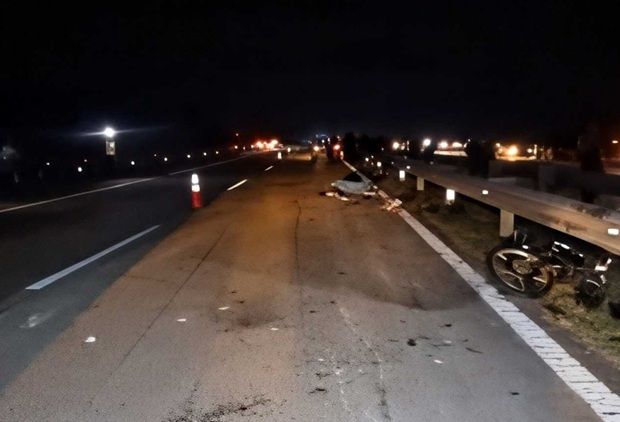
On a quiet Saturday morning at approximately 1am, the East Coast Expressway transformed into a scene of devastating loss when a motorcycle accident claimed four lives and injured thirteen others. The immediate aftermath saw scattered debris marking the roadway and emergency services working to respond to the scale of the tragedy. While news outlets and social media platforms quickly became filled with discussions about road safety and driver responsibility, a quieter but equally profound story unfolded far from the public eye: eight children, ranging in age from one to thirteen years old, lost their fathers in a single moment.
The instinctive human response to such tragedies often focuses on questions of fault and accountability. Online commentators and armchair analysts scrambled to assign blame, debating whether the riders had engaged in reckless behaviour or whether other vehicles were responsible. These discussions, though valid in assessing what legal consequences might follow, frequently overshadow the immediate human cost of such losses. The Social Security Organisation, or PERKESO, has never suggested that negligence should go unpunished or that dangerous behaviour should be excused. Yet beneath the noise of public judgment lies a reality that deserves far greater recognition: families now face an uncertain future without the breadwinners who once supported them.
The practical challenges confronting these families are neither abstract nor distant concerns. Single mothers, thrust overnight into circumstances they neither chose nor anticipated, must now navigate the complexities of providing basic sustenance and shelter for their children. Milk, rent, school fees, and clothing represent daily expenses that suddenly fall entirely upon shoulders already burdened by grief. As these children grow from infancy toward adulthood, the financial demands will only intensify. Educational costs will climb year by year, yet the fathers who once worked to provide these necessities are gone permanently. This is where the purpose of social security transcends simple statistics and touches something fundamental about how societies organise themselves.
Malaysian social security literacy remains surprisingly low despite the system's critical importance. Many workers view their contributions as mere payroll deductions—small amounts disappearing from each pay cheque that feel distant from daily life when circumstances are stable and fortune favours them. Few pause to consider what the system truly represents: not temporary emergency relief nor reward for the unlucky, but rather a foundational pledge of mutual responsibility woven into the social fabric. The principle underlying social security is elegantly simple yet profound: those blessed with health support those facing illness; those spared by tragedy stand alongside those who have suffered loss; those still able to work help carry those whose capacity to earn has been diminished or eliminated.
This philosophy represents more than bureaucratic policy. It embodies a societal commitment that when disaster threatens to collapse the roof over a family's head, the vulnerable beneath that roof—especially children—will not be abandoned to poverty and hardship. The families affected by the East Coast Expressway crash now experience this commitment materialising into tangible monthly support. The widow and children of Che Mohd Suffian Che Gani qualify for RM2,207.63 monthly through the Survivors' Pension scheme, with the widow receiving RM1,325 per month for her lifetime. Similarly, the family of Muhammad Hafiz Al Hakim Mazlan receives RM1,258.33 monthly, apportioning RM755 to the widow. The family of Mohd Aizat Husni receives RM708.33 monthly, with RM425 flowing to the surviving widow.
When calculated across extended time horizons, these figures reveal the substantial economic protection embedded within Malaysia's social security framework. Over thirty years, the pension benefits for these three widows accumulate to RM477,000, RM271,800, and RM153,000 respectively. Beyond the widows, PERKESO has allocated RM1,670 monthly collectively to the eight children left fatherless, which over fifteen years represents RM300,600 directed toward their care and development. Combined, the long-term benefits extended to families affected by this single tragedy exceed RM1.2 million. These are not token gestures or temporary handouts; they represent a sustained institutional commitment spanning decades, flowing back to workers and their families precisely when contributions made during stable years suddenly transform from abstract deductions into lifelines.
The contrast between how these families' futures might have unfolded without such protections and their reality with PERKESO support underscores why public understanding of social security deserves elevation. Without these monthly pensions and survivor benefits, these widows would face pressure to enter the workforce immediately while simultaneously managing the emotional trauma of loss and the practical demands of single parenthood. Their children might experience disrupted education, inadequate nutrition, or unstable living arrangements during formative years. The intergenerational consequences of such deprivation typically extend far beyond the immediate family, creating societal costs that eventually manifest as increased social problems.
The introduction and expansion of social protection schemes like Lindung 24 Jam represents meaningful progress in recognising that accidents and tragedies do not announce themselves or wait for convenient moments. The scheme's implementation before June of the previous year meant that among the thirteen injured victims of the expressway crash, five qualified for benefits under expanded provisions that might not have existed in prior circumstances. Previously, victims of similar accidents might have simply become statistical entries in applications that PERKESO held no legal authority to approve. The scheme modification reflects an evolving understanding that comprehensive social protection must extend beyond death benefits to encompass disability and injury support.
For Malaysia and the broader Southeast Asian region, this tragedy carries lessons extending far beyond road safety conversations. As economies develop and labour forces become increasingly mobile and precarious, the adequacy and accessibility of social security systems becomes ever more critical. Workers frequently shift between formal and informal employment, with millions lacking the security of stable, long-term positions with reliable employers. In such environments, social security functions not as a luxury for wealthy nations but as essential infrastructure protecting societal stability. When workers understand that their contributions genuinely protect their families against catastrophic loss, their motivation to participate in formal employment and contribute to these systems strengthens.
The financial calculations matter, certainly, but the deeper significance concerns what these numbers represent: recognition that human beings possess inherent dignity and that societies have obligations to their members beyond legal minimums and what markets dictate. The eight children left fatherless by the East Coast Expressway accident will grow up knowing that their country's institutions acknowledged their vulnerability and responded with sustained support. Their mothers will not face the impossible choice between work and childcare, between immediate survival and long-term planning, with no institutional support. This is what transforms social security from abstract policy into lived reality—not as charity or welfare, but as the organised expression of collective responsibility.
Looking forward, the continued expansion and strengthening of Malaysia's social security framework remains crucial. The Lindung 24 Jam scheme's expansion to include those previously ineligible represents progress, yet gaps and limitations undoubtedly remain. Informal sector workers, freelancers, and gig economy participants often fall outside protective frameworks entirely. The adequacy of benefit levels, the accessibility of application processes, and the cultural understanding of social security's purpose all merit ongoing attention and improvement. For Malaysian policymakers and society broadly, this tragedy offers an occasion not for self-congratulation about existing protections but for honest assessment of what remains undone.
Ultimately, the East Coast Expressway crash reminds us that social security deserves recognition as one of society's most important investments, worthy of understanding, support, and continuous strengthening. When four men lost their lives on a Saturday morning, eight children's futures hung in the balance. That their mothers could face this catastrophe knowing that institutional protections would help sustain their families represents genuine social progress. Yet millions of other Malaysians lack such assurance, working daily without knowing whether their contributions genuinely protect those depending on them. Expanding that circle of protection, ensuring that all workers understand these systems, and continuously improving benefit adequacy remain the unfinished work of a truly comprehensive social security vision.

