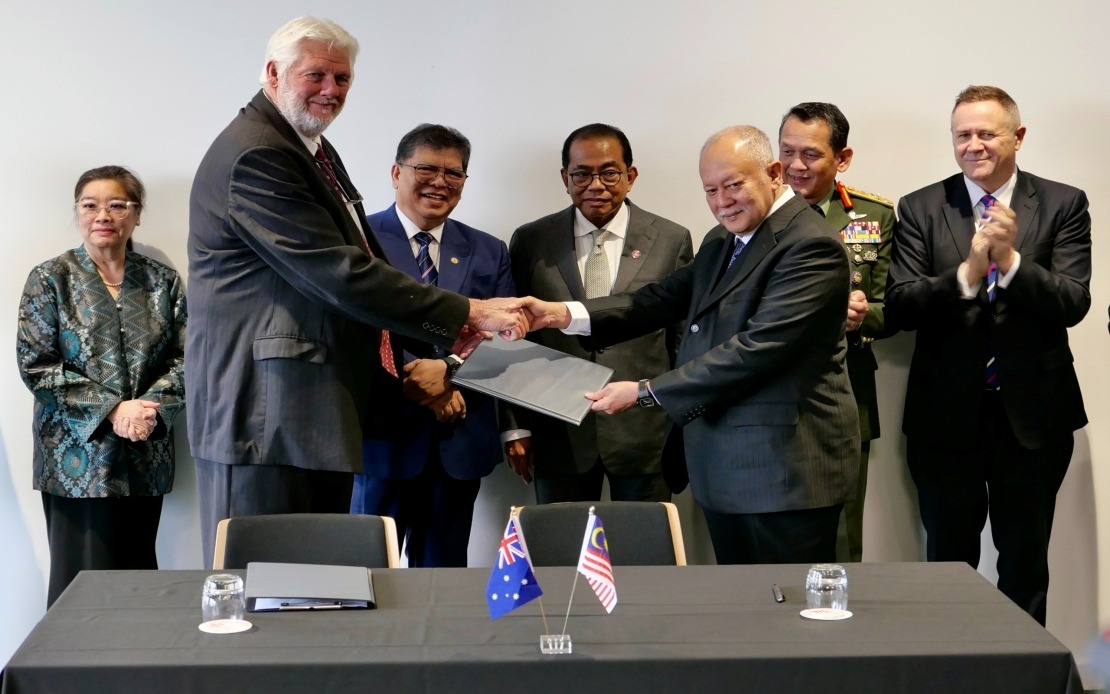
Malaysia is moving closer to developing indigenous rocket and missile capabilities following a landmark collaboration between homegrown defence company Weststar Defence Industries Sdn Bhd and Australian firm Rocket Technologies International (RTI). Defence Minister Datuk Seri Mohamed Khaled Nordin announced the strategic alliance during an official visit to Australia, signalling Kuala Lumpur's determination to reduce reliance on foreign defence suppliers and build sovereignty in critical military technologies.
The partnership, formalised at the National Convention Centre in Canberra, represents a watershed moment for Malaysia's defence industrial ambitions. Weststar Group founder and group managing director Tan Sri Dr Syed Azman Syed Ibrahim and RTI founder Allan James Payne signed the agreement, cementing a relationship that could reshape Southeast Asia's defence landscape. The collaboration directly supports Malaysia's National Defence Industry Policy (DIPN), which prioritises nurturing local expertise in designing and producing advanced weapons systems. Rather than simply importing finished defence products, Malaysia is now positioning itself as a manufacturing hub within a broader Indo-Pacific defence ecosystem.
Under the agreement's terms, Weststar will construct and operate a production facility on Malaysian soil, with rocket manufacturing commencing within two years. This timeline indicates serious operational intent rather than a ceremonial arrangement. The facility's subsequent expansion into missile manufacturing marks an even more ambitious frontier, potentially encompassing guided weapons systems that have historically been accessible only to nations with established military-industrial bases. For a regional power like Malaysia, this capability would substantially alter military equations and strategic calculations throughout Southeast Asia.
Mohamed Khaled emphasised that the investment transcends simple commercial value. By integrating Malaysia into RTI's global supply chain, Weststar's initiative opens doors for Malaysian companies to participate in international defence procurement networks and subcontracting arrangements. This exposure would generate technological spillovers, skills transfer, and export opportunities far beyond the parent companies involved. Engineering firms, materials suppliers, and systems integrators across Malaysia could eventually compete for work on defence contracts across the broader region and beyond, creating a sustainable ecosystem of defence manufacturing expertise.
The ministerial delegation's itinerary illuminated strategic thinking beyond the headline partnership. Visits to the Institute for Space, Defence and Advanced Technologies (ISDAT) at the University of Southern Queensland, along with tours of advanced composite manufacturing and hypersonics laboratories, underscored Malaysia's commitment to bridging academia and industry. This model, increasingly central to modern defence innovation, concentrates cutting-edge research within university settings while facilitating rapid technology transfer to commercial manufacturers. Malaysian planners appear keen to replicate this approach domestically, potentially through deepened collaboration between Universiti Pertahanan Nasional Malaysia (UPNM) and industry partners including NAICO Malaysia.
Australia's backing for the arrangement carries geopolitical weight. Deputy Prime Minister and Defence Minister Richard Marles's engagement with Mohamed Khaled during the visit signifies Canberra's strategic interest in strengthening Malaysia's defence capabilities as part of broader Indo-Pacific security architecture. Australia benefits from a more capable Malaysian partner capable of contributing meaningfully to regional maritime security, counterterrorism, and deterrence against potential destabilisers. This convergence of interests—Malaysia seeking technological advancement and Australia seeking a more robust regional security partner—creates durable mutual incentive for the arrangement's success.
For Southeast Asian nations watching these developments, the Weststar-RTI partnership carries instructive lessons about diversifying defence suppliers and building indigenous capacity. Malaysia has historically depended heavily on established defence exporters, particularly from Western nations, limiting strategic autonomy in procurement decisions. A functioning domestic rocket and missile industry reduces this vulnerability and creates leverage when negotiating with foreign suppliers. Other ASEAN states facing similar constraints may view Malaysia's trajectory as a potential template, though the resources, expertise, and international partnerships required remain formidable barriers.
The parliamentary diplomacy accompanying Mohamed Khaled's visit—including meetings with Speaker of the House of Representatives Milton Dick and interactions at Parliament House in Canberra—reinforced the institutional backing for defence deepening. When defence partnerships secure parliamentary-level endorsement, they typically enjoy more sustained funding, bipartisan support, and protection from short-term political fluctuations. The presence of Dewan Rakyat Speaker Tan Sri Johari Abdul signalled that Malaysia's legislature views the Australia relationship as constitutive of national strategy rather than executive discretion.
The timeline for operational commencement carries implications for Malaysia's broader defence modernisation agenda. Rocket production within two years suggests that facility construction, workforce training, and technology transfer processes are already contemplated in specific detail. This compressed schedule differs markedly from typical industrial establishment timelines, hinting either at exceptionally strong commitment and resources or at leveraging existing Malaysian manufacturing infrastructure and expertise. Either interpretation indicates serious intent to move beyond conceptual partnership toward tangible military capability.
Missile production expansion represents the ultimate objective, transforming Malaysia's defence posture from reliance on imported systems to indigenous design and manufacturing. Modern missile systems, particularly guided variants, embody multiple technological domains—propulsion, guidance and control systems, warhead integration, and launch platform compatibility. Developing competence across these specialisms would constitute a generational achievement for Malaysia's defence industry, potentially positioning the nation as a regional leader in unmanned systems and precision-guided munitions manufacturing.
Looking forward, the partnership's success hinges on sustained political commitment, adequate capital investment, and cultivation of a skilled workforce capable of executing complex aerospace and defence manufacturing. Malaysia possesses relevant industrial foundations through existing defence contractors and skilled labour pools, but scaling these toward rocket and missile production demands focused capability development. Success could establish templates for other technological domains, from advanced materials to artificial intelligence systems, cementing Malaysia's position as Southeast Asia's emergent defence technology hub.

