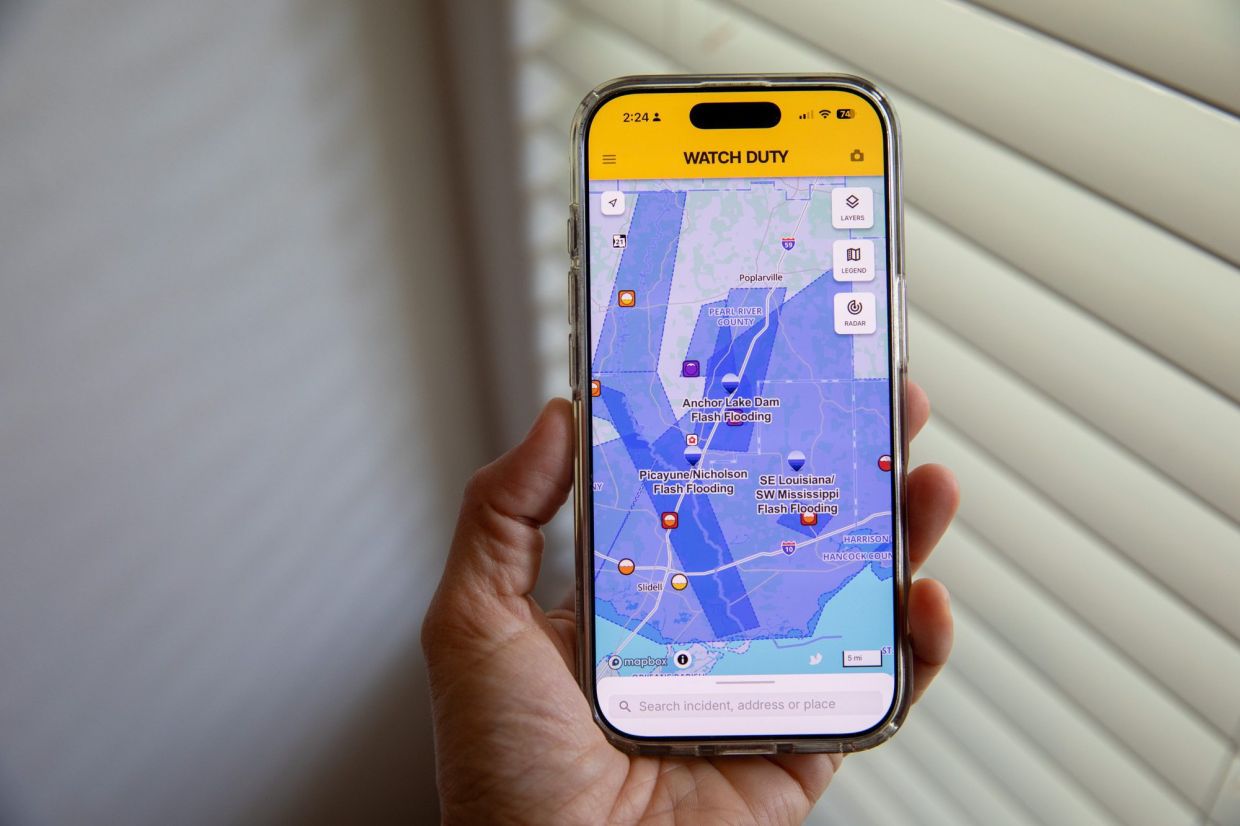
When disaster strikes without warning, lives hang on split-second decisions. Matt Blea faced that reality on the evening of January 7, 2025, when the Eaton Fire approached his Altadena home. A recommendation to download Watch Duty—a free application tracking real-time fire data—proved decisive. The app showed him the fire's boundary, evacuation directives and emergency response details, nudging his family to leave hours before their neighbourhood was consumed by flames. Blea's experience reflects a broader transformation in how Americans are learning to navigate climate-driven emergencies, one that has significant implications for how Southeast Asian nations might approach disaster communication in an era of intensifying natural hazards.
Watch Duty emerged from a moment of personal frustration. John Mills, the app's founder, created it in 2021 after receiving no official alerts when a wildfire threatened his Northern California neighbourhood. Rather than accept bureaucratic failures, Mills assembled volunteers and engineers to build a parallel information system. During the catastrophic Los Angeles fires of January 2025, the platform reached more than 2.5 million users simultaneously—a scale suggesting that informal, technology-enabled networks can compete with, and sometimes outpace, government systems in delivering critical information during emergencies.
The operational model behind Watch Duty reveals why traditional emergency channels often falter when speed matters most. A core team of roughly 25 staff members coordinates with more than 100 volunteers who monitor police and fire radio frequencies, aircraft communications, satellite imagery and official announcements. This distributed network extracts relevant details from the overwhelming noise of emergency channels and translates them into plain language accessible through maps, text feeds and push notifications that penetrate even silenced phones. Crucially, Watch Duty's reporters have a singular mandate: watch and listen. Unlike government officials juggling incident command, resource allocation and political considerations, these volunteers focus entirely on information gathering and verification.
David Hertz, captain of a Malibu fire brigade and resident of Los Angeles County, characterised Watch Duty's function as "democratisation of data." This phrase captures something essential: the app redistributes information that often exists within institutional silos—held by fire departments, sheriff's offices and weather agencies but never properly synthesised for public consumption. When the Eaton and Palisades fires killed 31 people, many communities received inadequate or no evacuation warnings, underscoring how communication failures compound the tragedy of natural disasters. For residents across dispersed neighborhoods, having a single curated feed proved far more useful than trying to monitor a dozen different official channels.
The expansion into flood monitoring, announced in June 2025, reflects recognition that climate change is shifting disaster patterns. Peak flash flood season coincides with mounting evidence that rainfall is intensifying in regions where it historically was rare. The timing resonates with the July 2024 Texas floods that claimed over 130 lives and exposed critical gaps in how Texas Hill Country residents learned of imminent danger. Mills responded to continued frustration over slow information dissemination by extending Watch Duty's model to a second category of climate hazard. The nonprofit received nearly six million dollars in grants and donations during 2025, enabling this expansion despite competing demands.
Watch Duty's flood-tracking functionality layers data from the National Weather Service, National Oceanic and Atmospheric Administration and US Geological Survey. Users can view flood watches and warnings, monitor river gauge heights in real-time, and receive alerts if water levels approach dangerous thresholds. The platform also helps people understand their baseline risk before crisis strikes—they can identify whether their address sits in a FEMA-designated flood zone or learn what specific gauge readings signal danger. This granular, personalised information moves beyond generic alerts toward what Mills calls "meeting people where they are," embedding emergency context within everyday awareness.
Pete Curran, a retired firefighter now serving as Watch Duty's meteorologist, emphasises the speed advantage of the nonprofit model. Because Watch Duty reporters have no operational responsibilities—they neither manage incidents nor deploy resources—they can push information faster than agencies balancing multiple competing duties. The consolidated platform eliminates the need for users to navigate between weather services, county emergency websites and other fragmented sources. Information arrives in plain language, in multiple languages, through channels that interrupt even silent phones. This design philosophy directly addresses what researchers identify as a persistent failure mode in disaster communication: information exists but proves too dispersed, technical or bureaucratically delayed to reach people in time for meaningful action.
Yet Watch Duty's success illuminates rather than eliminates fundamental challenges in emergency communication. Chad Berginnis, executive director of the Association of State Floodplain Managers, points out that warnings prove worthless if people lack knowledge of how to act on them. Effective evacuation requires not just understanding danger but knowing specific routes, having practised movement, and possessing resources to leave. Watch Duty can alert someone to rising flood waters, but it cannot substitute for advance community planning, evacuation route clarity, or resources for those without vehicles. The app also reaches only those who download it and possess cell coverage—a significant limitation in rural areas or among older populations less likely to use smartphone applications.
The underlying infrastructure supporting all emergency communication systems faces pressure from budget constraints and policy uncertainty. Proposed funding cuts to federal agencies and local emergency warning systems threaten the National Weather Service, NOAA and other institutions that provide the foundational data Watch Duty relies upon. Berginnis stresses that maintaining eyes and ears on the environment—whether through weather monitoring, satellite systems or volunteer networks—requires sustained investment. Watch Duty's rapid growth might create an illusion that technology alone solves emergency communication, but the nonprofit represents a complement to, not replacement for, professional emergency management infrastructure. Mills himself emphasises that Watch Duty cannot substitute for National Weather Service operations, fire services or the broader apparatus of disaster response.
For Southeast Asian nations grappling with monsoon floods, typhoons and other climate hazards, Watch Duty's model offers both lessons and cautions. The nonprofit's success demonstrates that crowdsourced information, properly curated and presented, can fill gaps in government communication channels. Countries with volunteer fire brigades or disaster response networks might adapt similar approaches, training community members to verify and disseminate information during emergencies. However, reliance on volunteer networks presupposes technological infrastructure, literacy, and stable internet access that remain unevenly distributed across the region. The model also works best when complementing rather than replacing professional emergency management systems—a distinction important for governments already stretched thin in disaster response capacity.
The philosophical shift embodied by Watch Duty reflects broader recognition that traditional top-down emergency communication no longer suffices in an era of rapid, intensifying climate hazards. Mills founded the organisation because official channels failed him; millions now rely on his answer. Yet the superintendent of emergency management systems, and even Watch Duty's own leadership, acknowledge that technology cannot replace the combination of professional expertise, community preparation, accessible evacuation routes, and sustained investment in monitoring infrastructure that genuine disaster resilience demands. Watch Duty accelerates information flow and improves its accessibility, but it operates within constraints that only broader policy changes—funding for emergency systems, land-use planning that reduces exposure, and advance community education—can ultimately transcend. As climate change makes floods and fires simultaneously more frequent and less predictable, the question becomes not whether apps like Watch Duty prove useful, but how societies can embed them within comprehensive approaches to collective survival.

