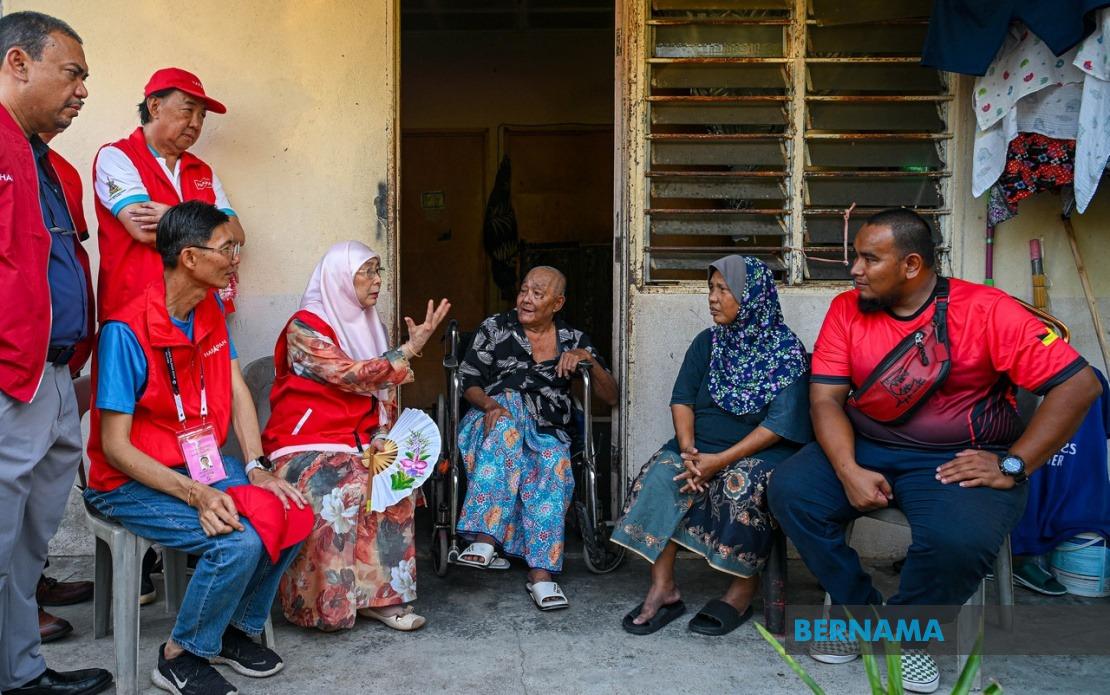
In a carefully choreographed campaign moment ahead of the Negeri Sembilan state election, Pakatan Harapan's political leadership descended on a modest residential address in the Chuah State Legislative Assembly constituency to meet with residents grappling with poverty and declining health. The visit underscores the coalition's attempt to build grassroots momentum in the marginal seat, where the stakes remain high and every voter contact carries strategic weight as the campaign intensifies toward polling day.
Wan Azizah, the prominent PKR figure and perennial party stalwart, arrived accompanied by Datuk Yew Boon Lye, the PH candidate contesting in Chuah. The pair spent roughly twenty minutes at the residence of Zaiton Hasan, aged 60, and Paimin Sapari, aged 71, engaging in what amounted to a direct conversation about the household's circumstances and the challenges confronting the aging couple. This form of personal engagement—sitting down with ordinary constituents to understand their predicament—has become increasingly central to opposition campaign strategies across Malaysia as political parties recognize that ground-level connection matters in competitive electoral contests.
The elderly residents, managing chronic conditions that plague much of Malaysia's aging population, opened up about their struggles. Zaiton manages high blood pressure while Paimin contends with diabetes, both conditions requiring ongoing medical attention and medication costs that compound household financial stress. For families already straining under the weight of limited incomes and insufficient support systems, health complications represent an additional burden that can quickly spiral into crisis. The visit provided these residents with a platform to articulate their needs directly to party leadership rather than through intermediaries or formal complaint channels.
The emotional response from the couple revealed the depth of their gratitude and perhaps, too, the rarity of such direct political engagement in their community. Zaiton expressed profound appreciation for Wan Azizah's willingness to visit their home, noting that this marked the first occasion a high-ranking political leader had made such a personal call. Her words—describing the moment as dreamlike and praising both visitors for their kindness and apparent genuine concern—suggest that visibility from senior party figures carries symbolic weight beyond the immediate policy discussion. In constituencies where voter alienation runs deep and political institutions feel distant, these moments of direct contact can reshape perceptions of whether political parties genuinely care about ordinary citizens' welfare.
Beyond the dialogue itself, the visit included a tangible expression of support. The Port Dickson People's Spirit Welfare Association presented Paimin with a wheelchair, a practical contribution that would meaningfully improve his mobility and independence. While such gestures might appear modest in isolation, they represent the kind of targeted assistance that makes a genuine difference in the daily lives of individuals managing disabilities and chronic illnesses without adequate family or state support systems. The timing of the donation—coinciding with the high-profile visit—also demonstrates how political campaigns weaponize charitable acts to reinforce messaging about candidate commitment to vulnerable populations.
The Chuah constituency contest itself reflects broader patterns in Malaysian politics where rural and semi-rural seats often remain genuinely competitive. Yew faces a direct confrontation with Pau Jeou Ching, the Perikatan Nasional candidate, in what election observers characterize as a straight fight between the two main coalitions. This binary contestation, absent viable third-force candidates, typically means that ground mobilization becomes paramount. Every household visited, every elderly resident engaged, and every donation distributed feeds into the overall campaign calculus. For PH, which experienced significant setbacks in the 2022 general election particularly in Negeri Sembilan, reclaiming ground in state elections carries strategic importance beyond the immediate seat count.
Negeri Sembilan holds particular significance in Malaysian electoral mathematics. The state, traditionally a Barisan Nasional stronghold, has shifted politically in recent cycles, creating genuine uncertainty about which coalition might govern post-election. The 16th state election represents an opportunity for PH to demonstrate recovery from its earlier decline and to push back against PN's momentum in peninsular states. Chuah, as a marginal seat, becomes a microcosm of this larger contest. Every vote potentially swings the overall state outcome, explaining why senior party leaders personally invest time in constituency-level campaigning rather than delegating these activities entirely to local candidates.
The Election Commission has structured the electoral calendar to require early voting on July 28, with the main polling day scheduled for August 1. This compression means campaigns must move quickly and efficiently to reach dispersed voters across multiple constituencies. The visit to Zaiton and Paimin's residence, therefore, represents one data point within a broader blitz of campaign activity. Senior leaders must maximize their limited time by concentrating visits in contested areas where their presence can potentially influence outcomes or attract media coverage that amplifies the campaign message beyond those physically present.
From a broader perspective, this encounter illustrates how Malaysian electoral politics increasingly intersect with growing anxieties about aging, poverty, and healthcare access. As the population ages and economic inequality persists, elderly residents managing multiple chronic conditions on fixed or inadequate incomes have become a fixture in many communities. Political parties recognize that campaign messaging emphasizing concrete support for vulnerable groups—whether through direct assistance, policy commitments, or simple human attention—resonates with broad voter segments. The visit therefore serves multiple functions simultaneously: it generates positive campaign narrative, it provides direct feedback to leadership about constituent concerns, and it offers material assistance to individuals genuinely in need.
For Malaysian voters observing from outside the immediate constituency, such campaign moments reveal something important about how political competition operates at the ground level. The visit combines performative elements—the presence of senior leadership, the photographers documenting the moment—with what appears to be genuine engagement with constituent difficulties. This mixture of authentic concern and strategic calculation defines much of modern Malaysian politics, where parties must simultaneously demonstrate both sincere commitment to ordinary people's welfare and sophisticated campaign competence. Whether voters ultimately reward such engagement through their ballots will depend on numerous factors extending far beyond any single constituent visit.

